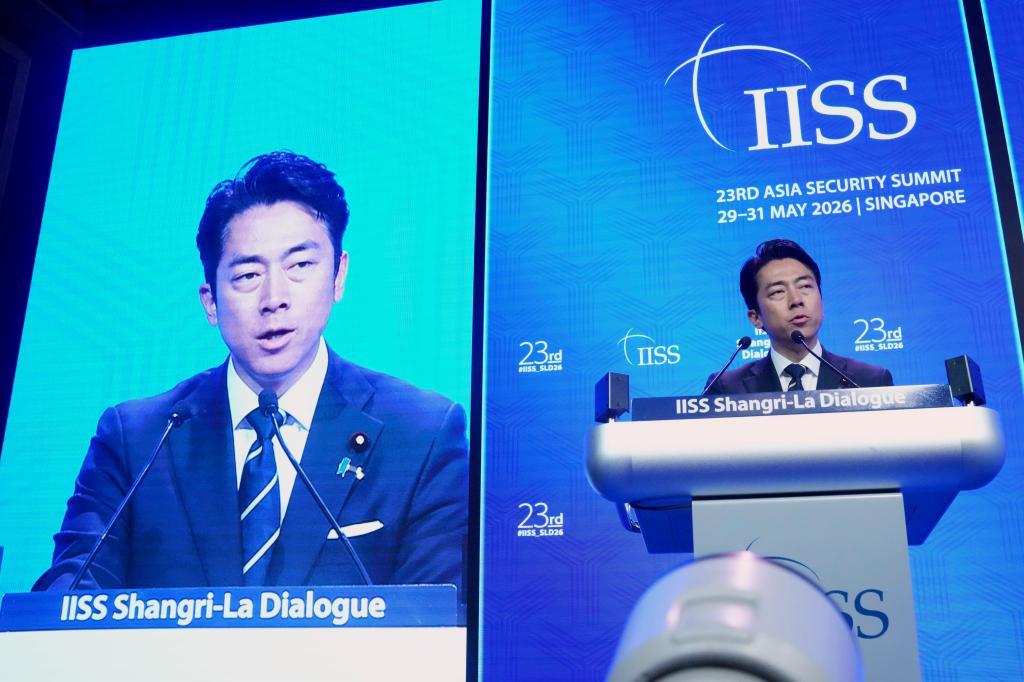
Japan refuses to accept continued accusations of returning to the militarism that devastated Asia during the first half of the 20th century. At the Shangri-La Dialogue, the main regional security forum held this weekend in Singapore, Japanese Defense Minister Shinjiro Koizumi strongly responded to criticisms, particularly from Beijing, and defended the strategic shift undertaken by Tokyo.
"Think for a moment. There is a country that possesses a huge nuclear arsenal and strategic bombers. Japan does not have any of these weapons, yet we are accused of militarism again," Koizumi stated on Sunday before an audience of political leaders, military officials, and security experts from the region.
Without directly mentioning China at that moment, the Japanese minister aimed to dismantle one of the most repeated arguments by Beijing since Tokyo accelerated its rearmament, justifying the Chinese and North Korean threats. However, shortly after, he did point directly towards the Asian giant. "China's foreign approach and its military activities are of serious concern to Japan and the international community," he declared, denouncing the lack of transparency surrounding China's continuous increase in military spending.
Koizumi's intervention reflects how the rivalry between the two largest economies in Asia has entered a new phase. For decades, Japan maintained Self-Defense Forces limited by a pacifist Constitution drafted after World War II.
However, the increasing Chinese military pressure around Taiwan, the frequent Chinese vessel incursions into waters near the Senkaku Islands - administered by Tokyo but claimed by Beijing - and the increasingly close alliance between China and Russia have led recent Japanese governments to review some of the principles that had guided their defense policy for almost eight decades.
Under the conservative leadership of Sanae Takaichi, this transformation has accelerated. During her tenure, Tokyo has deepened the strategy initiated by her predecessors to acquire greater deterrence capabilities and project an image less dependent on the U.S. military umbrella.
The most significant step occurred last April when the government approved the most ambitious reform of arms export regulations since the end of the war. The measure removes historical restrictions that prevented Japan from selling offensive systems abroad and opens the door to exporting warships, missiles, and other advanced military equipment to the 17 countries with which it has defense cooperation agreements, including the United States, the United Kingdom, Australia, and the Philippines.
The decision represents a profound change for a country that for decades made pacifism a national identity. Until now, Tokyo could only export materials for limited functions such as rescue, transport, or demining. With the new regulations, Japan aims to become a significant player in the global defense industry and strengthen the military capabilities of countries that share its concerns about China's rise.
Takaichi defended the measure by arguing that "no country can protect its security alone" in an increasingly unstable international context. Her government maintains that strengthening regional partners contributes to conflict prevention and enhances Japanese security. However, for Beijing, these reforms are evidence that Tokyo is abandoning the restrictions it imposed on itself after its defeat in 1945.
Accusations were heard again on Sunday in Singapore. Chinese Major General Meng Xiangqing, representing his country at the forum, openly questioned Japan's international credibility. "I deeply doubt that a country that has not completely eradicated the toxic legacy of militarism can extensively discuss defense cooperation and gain the trust of the Asian countries it once invaded," he stated.
The verbal clash highlights the deterioration of relations going through one of their most delicate moments in recent years. Tensions escalated especially at the end of last year after Takaichi warned that a potential Chinese invasion of Taiwan could trigger a Japanese military response.
In this context, Tokyo seeks to strengthen alliances and increase its deterrence capabilities. Koizumi emphasized in his speech that his country is willing to play a more active role in regional military cooperation. "We seek a region capable of resisting coercion, a region that does not succumb to pressure," he concluded.