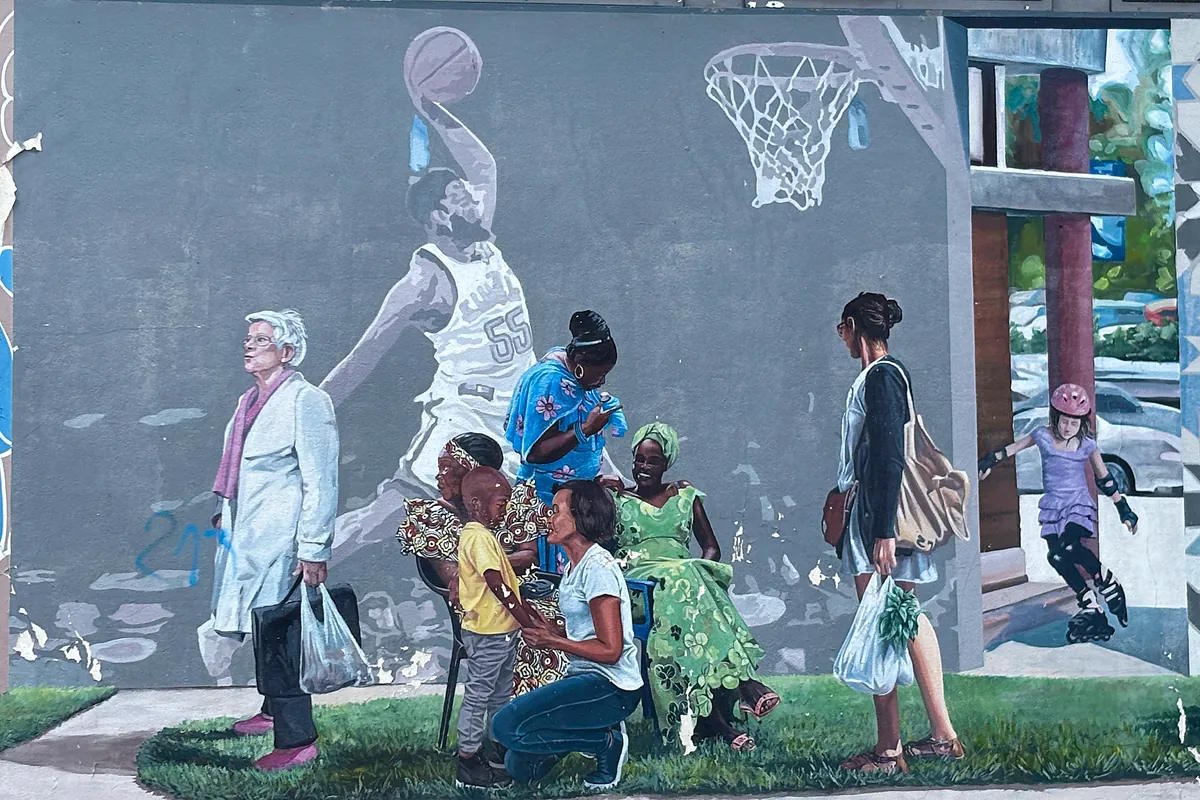
The history of cities is written on their walls. In Creil, with about 37,000 inhabitants, there is a mural with children forming something like a children's UN: Amir, Assan, Idia, Oriane, Reoduan, Barthélemy, David, Aurelia... And so on, up to 107 names, representing as many countries that make this urban and industrial center - on the banks of the Oise River and 68 kilometers from Paris - the multicultural mirror of that "new France" that is so often talked about.
"The truth is that sometimes I struggle to recognize my own city", admits Théo Legrand, born 42 years ago in Creil. "More and more people from outside come, and I'm not saying it's bad, I don't agree with the far right. But little by little, you start to feel excluded, as if the place is not yours. And that feeling grows when you have children and take them to school, and you see that you have little in common with other parents."
Théo has a mechanic workshop next to the children's mural in the Rouher Plateau, the working-class neighborhood that was also the landscape of his childhood: "My father came here to work at the Chausson factory, where they made Renaults, when the town was prospering. Then came the factory closures and economic difficulties. Many people ended up leaving, like my two brothers. Others arrived, from Algeria, Somalia, or Pakistan, you know."
He refers to the new mayor, Omar Yaqoob, from the France Insumisa, whose video in Urdu ("Today we win, and not just me, but all Pakistanis") went viral on social media and had a wide echo even on Pakistani television, where his victory was celebrated almost as a national success. The mechanic voted for the socialist Sophie Dhoury-Lehner, who lost by 167 votes and ended the tense electoral campaign with police protection after receiving death threats.
"It's not that the socialists were going to change things, they had been governing here for over a century and look at how we are, with 25% unemployment and among the poorest cities in France," acknowledges Théo. "But I'm worried that tensions will escalate, not to mention the insecurity. It was near here where a few years ago they killed Karim, the manager of a restaurant, with a shot to the head in broad daylight."
The Rouher Plateau, with its five mosques, its synagogue, and the Gothic cathedral of Saint-Médard, is one of the neighborhoods with the highest proportion of social housing in France, almost 50%. The city, divided by the width of the Oise River, comes to life here (animated by the Nina Simone conservatory, the Gallé-Juillet museum, and the La Faïencerie cultural center) in contrast to the succession of shops with metal shutters and the feeling of semi-abandonment around the station.
Along the way, on a sweltering morning, we stop at the Le Balton bar-tabac, where only men are sitting under the umbrellas. There we meet 27-year-old Moroccan Malik Naciri, who invites us to see everything in a different light: "Look at the French team going to the World Cup: there are hardly any white players. There are Dembélé, Doué, Kanté, and the defector Mbappé... Spain has my countryman Yamal and will go the same way. What do they call it? Generational turnover. Normal if immigrants are the only ones having children."
Malik has been in Creil for three years, met his girlfriend here (Tunisian), and still has no offspring. He works at a nearby kebab shop and acknowledges that there are more promising jobs and places near Paris... "But you can always spend your salary there on a Saturday and come back the same day. And yes, it's true that you can feel insecure at night in Creil and the media never stop talking about drug trafficking, but it's not much different from other places in France. It's not a Muslim ghetto as they say. People greet each other interchangeably with 'bonjour' or 'salam alaykum' ('peace be with you')."
Near the bar-tabac is the "Little Senegal" of Creil, and in one of the many African hair salons works 37-year-old Khady Gueye, who arrived eight years ago through the twinning of the city with the rural community of Nabadji Civol. For Khady, her new country meant above all "economic liberation," although she acknowledges that Creil has its problems and she worries about the future of her two daughters.
"Recently, the headquarters of Femmes sans Frontière, which works to prevent economic precariousness and domestic violence, was vandalized, and I don't know if that is a message directed at women," she warns. "The mosques have joined forces to address the situation, although I don't know if spirituality is enough to end violence."
Creil first made headlines in 1989 when Leila, Fátima, and Samira openly defied the rules of the Gabriel-Havez school and refused to remove their veils in class. The three teenage girls of Moroccan origin justified their attitude by their religious beliefs, and one of them (Fátima) even expressed her desire to "wear the hijab until death". The three were expelled from the school.
That was the spark of an unprecedented media and political debate in France. The then Minister of Education, Lionel Jospin, sought the opinion of the Council of State, which recognized the students' right to express their beliefs in school but at the same time determined the need to set limits on religious symbols. In 2004, driven by President Jacques Chirac in the face of "worrying violations of secularism" in schools, the law was finally passed prohibiting religious symbols of a "ostentatious and conspicuous" nature in French schools.
Another episode, this time with macabre overtones, once again put Creil in the spotlight: the death of a 15-year-old girl, Shaina Hansye, of Mauritian descent. She was stabbed and burned alive by her teenage boyfriend, who said he killed her because she was pregnant and refused to be "the father of a bastard." Shaina had been raped at the age of 13 and carried the stigma of being a "loose girl." The incident caused a national shock and exposed the existence of a "rape culture" and social control of girls in French suburbs.
Charlie Hebdo journalist Laure Daussy delved deep into the tragic story, with dozens of testimonies from Creil residents, and wrote a damning book, La réputation, denouncing the "patriarchal law," religious pressure, the city's division into "sexist ghettos," and the complacency of local authorities.
"Reputation functions as a sword of Damocles to decide what is respectable or not", wrote Daussy. "Girls are subjected to a scale to evaluate them in the dating and marriage market. You become an 'easy girl' for nothing, for a slightly freer attitude, for a piece of clothing, or even for being a victim of rape. In Creil, these reputations are manufactured in a context of identity deterioration, academic failure, unemployment, poverty, and religious rigor."
France is no longer a secular Republic: although political leaders do not openly admit it, the time of communitarianism has come," warns Lucas Jakubowicz, author of El voto religioso: tabú francés. In his opinion, the recent election of Muslim mayors is due to the weight that "the religious variable" has at the polls, which is as important as or more than age, gender, or education.
"We must not underestimate the religious criterion in the electoral dynamics", emphasizes Jakubowicz, referring in particular to the growing impact that "Muslim communitarianism" (with its strong group belonging ties) is having on voter turnout, as has happened in Creil or Saint-Denis.
The author of The Religious Vote recalls how the leader of La France Insumisa, Jean-Luc Mélenchon, anticipated the trend and was able to capture 69% of the Muslim vote in the 2022 presidential elections. His appeal among Muslims, he claims, is comparable to that which Donald Trump has with evangelicals. This explains his 180-degree turn on the issue of the veil: if in 2010 he considered it as "a sign of regression and patriarchal submission," he now denounces the "religious war" and the implementation of "a clothing police in schools."
Mélenchon has indeed turned the concept of "the new France" into his banner. In his opinion, the country has undergone "significant sociological, economic, and even anthropological changes," and he refers to the data: one in three French citizens today is an immigrant or child of immigrants (compared to one in ten in 1958). The rebellious leader appeals to "unite the different elements" of the new French identity and to bring together "anti-racist, feminist, and labor sectors" to shake the foundations "of oligarchic capitalism and the sclerotic Fifth Republic," quite a challenge.
Mélenchon has been accused of "cultural appropriation" of the concept (Jospin used it in 2001) to the point of turning it into an ideological metaphor. From the right, his idea of "the new France" is equated with "the denial of France." The far-right clings to the conspiracy theory of the "Great Replacement." And the Minister of Justice, Gérald Darmanin, recalls these days how the country has reached "the limit of its capacity for integration and assimilation" and advocates for a three-year moratorium on legal immigration, an option favored by 63% of the French, according to a survey by the CSA institute.
"Today we win, and not just me, but all Pakistanis"... We return to the video in Urdu of Omar Yaqoob, the new mayor of Creil, installed in the Hôtel de Ville, the most Frenchified place in the city. "That video was completely taken out of context," says Yaqoob, who claims he was simply thanking campaign volunteers. However, the images served as fodder in TV debates, where the controversy extended to the use of French among immigrants.
Omar Yaqoob was born 46 years ago in Creil, the son of Pakistani immigrants and a specialized educator turned politician. Before joining the ranks of La France Insumisa -"I identified with its values"- he participated in the founding of the Génération Creil movement and was considered a centrist and moderate politician, once close to Emmanuel Macron's La República en Marcha. The political turmoil does not seem to have affected his calm temperament.
"We are in favor of an inclusive secularism that does not stigmatize any community", asserts Yaqoob, who resists considering Creil as the testing ground for La France Insumisa, with its commitment to disarm the municipal police and make public transport and school meals free. "The time has come for appeasement and collective work: the mayor must be at the service of all, without distinctions". A promise that, in a city with 107 nationalities, five mosques, and 25% unemployment, will sound familiar to those who have been hearing it for decades.