Get this: "The big picture is this: markets are rational." Amid the worldly noise, populist governments, wars, supply chain issues in the industry, soaring oil prices, unmanageable housing prices, and savings parked in bank accounts with no ambition... the American financial giant and one of the world's largest asset managers, JP Morgan Asset Management, not only sees reasons in the markets for them to continue rising but also believes that Europe is currently experiencing its best moment in years.
In a Victorian-style auditorium, with high ceilings, colorful stained glass windows, and noble wood, the American asset manager gathered journalists from across Europe last week to explain that it is Europe's time to "be invested" and to ride the wave of change promoted by the European institutions, convinced of it for the first time. Only through JP Morgan AM did European companies receive $7 billion in net flows last year. It was the first time in a while that such interest was seen from investors.
The top executives of the asset manager (with $675 billion in assets under management, the second largest in Europe) emphasize the current challenging moment every time they take the stage, stating that "it is impossible to predict what will happen the following week" in a world that is "the most dangerous since World War II." The Donald Trump administration goes against the predictability that money favors. However, "political chaos has two consequences: increased public spending (...) The U.S. is cutting taxes while spending more on its independence, which ultimately leads to higher growth," stated Karen Ward, EMEA Chief Strategist for JP Morgan AM.
And the other additional impact is on companies. "Hyperscalers are competing among themselves to see who presents the highest capex [capital expenditure] spending to create or develop technology," and this involves huge amounts of money from companies like Google, Microsoft, Amazon, Meta, and Oracle. The forecast is for an investment of $700 billion this year alone by the four companies in artificial intelligence.
"The more chaotic the world becomes, the more it forces these companies to improve their business models (...) Being invested is a must to be part of what they define as a 'virtuous circle' of increased consumption and greater household wealth." And this leads to the other elephant in the room: the savings of European families.
According to JP Morgan AM's calculations, since the outbreak of the pandemic until now, German and French households have accumulated savings close to €1.7 trillion, in Italy it reaches a trillion, the same as in the UK, and in Spain, slightly lower, it stands at around €600 billion. In total, it amounts to about €6 trillion, of which more than a third is in bank accounts or similar accounts that offer little to no return. In summary: with current inflation, they are losing money.
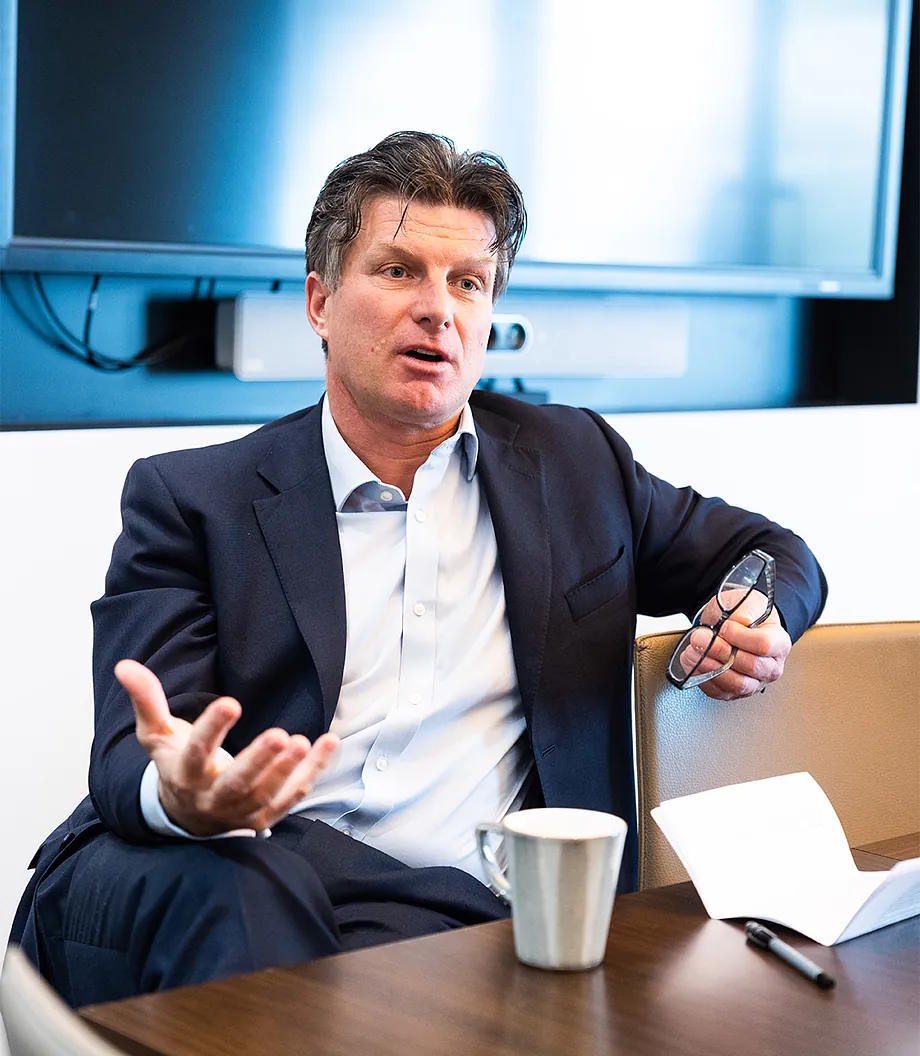
"How long has Europe been trying to shape a single market? About 20 years. And this time, following reports written by Mr. Draghi and Mr. Letta, it seems that regulators are taking it very seriously," says Patrick Thomson, CEO of JP Morgan AM, in an interview for Actualidad Económica. Seated at the table, the top executive of the asset manager in EMEA (Europe, Middle East, and Africa) explains how issues such as investments proposed by governments like Germany (with €400 billion planned in defense until 2027) will impact the growth that the Eurozone is pursuing or an ongoing conversation in Europe about "the need to reform the pension system due to the inability of states to meet them." "A big change is happening. In France, with general elections on the horizon, there is talk of pension reform. Everyone is talking about it. The fact that cross-border mergers are being promoted, consolidation in the financial sector... All of this makes me more optimistic that Europe will not waste this opportunity, this current crisis, to step forward.
The reality is that Europe needs to grow, "this is our big problem," and it could do so and address the aging population if the trillions of savings that citizens have stored in their bank accounts were "unlocked." Voilà: the third pillar that will boost the stock markets.
Thomson, aware that in Europe "we are more pessimistic" than Americans, believes that European governments have become more predictable with the aim of attracting capital. "For example, in Spain," he recalls, "they decided to review the taxes applied to renewable energies and changed them years ago. Well, they haven't done it again (...) As investors, we don't want special favors, we just need stable policies." He understands that this is a lesson learned not only in Spain but in most EU states.
One of the EU's goals is to increase in size, to be able to compete with American financial giants in terms of payments, banks, asset management, private capital... and much more where the U.S. has a significant advantage. Asked about how he sees the landscape of European asset managers in ten years, Thomson predicts that "we will find a few national and international players and there will still be many small niche boutiques and new ones that will emerge as more innovative."
The American bank launched its digital brand Chase in the UK five years ago as a neobank, without physical branches but with the balance and solvency of a giant behind it. It was the first market in Europe where it targeted retail customers. "We have €30 billion in deposits and 2 million customers. We want to offer a full service, mortgages, credit, etc.," confesses Thomson.
Last week, Chase landed in Germany, the market that the rest of Europe looks to due to the growth of neobanks and because they are the vanguard in financial education in Europe. As a presentation card, JP Morgan's retail brand offers a 4% APR for the first four months, which will then drop to 2%. In Spain, the most advanced neobank offers 3%, while the official deposit rate in Europe still stands 100 basis points below. "We must work on how to defend our business against these neobanks" from the traditional banking industry if they do not want to be left out of the game board of the new Europe.