The United States is significantly reducing its naval presence around Iran in what seems to suggest the abandonment of the possibility of carrying out ground missions against Teheran. The only option left is a prolonged blockade of Iran until the country agrees to the terms of the Trump administration or until global oil inventories that keep the world economy afloat start running out, which according to the International Energy Agency could happen by the end of July or in August.
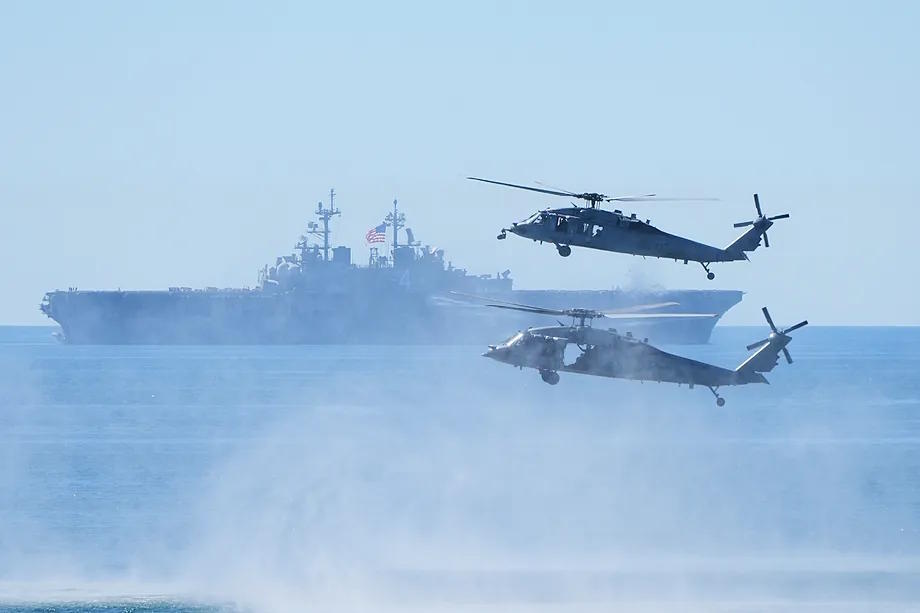
The key is the departure, last Saturday, of the amphibious assault ship 'Boxer', with about 2,000 Marines, from Singapore heading west, that is, in the opposite direction to the Persian Gulf, without any other unit taking its place. The ship is now in the South China Sea, a region of the Pacific Ocean with an area equivalent to about five times that of Spain, which Beijing is progressively taking from its neighbors Philippines, Vietnam, Malaysia, Indonesia, Brunei, and Taiwan. Therefore, the operations of the 'Boxer' have shifted from being focused on Iran to moving towards China. In addition to the soldiers, the 'Boxer' carries, depending on its configuration, from 5 to 25 aircraft, including radar-invisible F-35 fighter bombers. The 'Boxer' is a ship similar to the Spanish 'Juan Carlos I', a mix of aircraft carrier and landing ship.
The movement of the ship has not received special publicity from the U.S. government. It has happened just the opposite of what occurred on March 19, in the midst of the war, when the ship left its base in San Diego, California, supposedly heading to the Arabian Sea, carrying the Eleventh Marine Expeditionary Unit (the 'Marines').
The departure of the 'Boxer' sparked all kinds of speculations, given that, despite President US Donald Trump's promises not to deploy "boots on the ground" in the war, the 2,000 'Marines' aboard the 'Boxer' are trained to fight on land and, more specifically, to carry out amphibious missions, frontline operations with high firepower and mobility, but not permanent occupations, something that falls more within the competencies of the Army. Six days before the 'Boxer', another similar ship, the 'Tripoli', had been sent to the region, where it still remains.
However, the 'Tripoli' is an amphibious assault ship more specialized in air attacks than in pure troop landings. The 'Boxer' has a floodable dock, allowing it to launch landing craft and amphibious vehicles directly, while the 'Tripoli' lacks this feature. On the other hand, the latter has much more air capacity, making it ideal for conducting command operations on ships or specific targets on land or bombing missions. This is what the United States is currently doing in the war against Iran: rendering ships trying to break the blockade useless and attacking fast boats laying mines in the region and missile bases on land.
With the new movements, the capture of the island of Kharg, from which Iran used to export between 90% and 95% of its crude oil before the conflict, or some areas of the Strait of Hormuz are completely ruled out. The decision could also be seen as a certain 'de-escalation' by Washington, although it does not seem to be the case. Experts had already pointed out that the less than 4,000 Marines from the 'Boxer' and 'Tripoli' represented little more than a symbolic force given the scale of the conflict, even for carrying out limited actions.
Despite reports placing the 'Boxer' in the area of responsibility of the Central Command and the Fifth Fleet, within which the conflict region falls, it never left the Indo-Pacific Command and the Seventh Fleet, covering the Pacific and the Indian Ocean. Available information indicates that the ship remained in the Andaman Sea region, between Indonesia, Myanmar, Thailand, and Malaysia. That region is more than 5,000 kilometers away from the Strait of Hormuz, although the ship could have reached it in less than ten days.