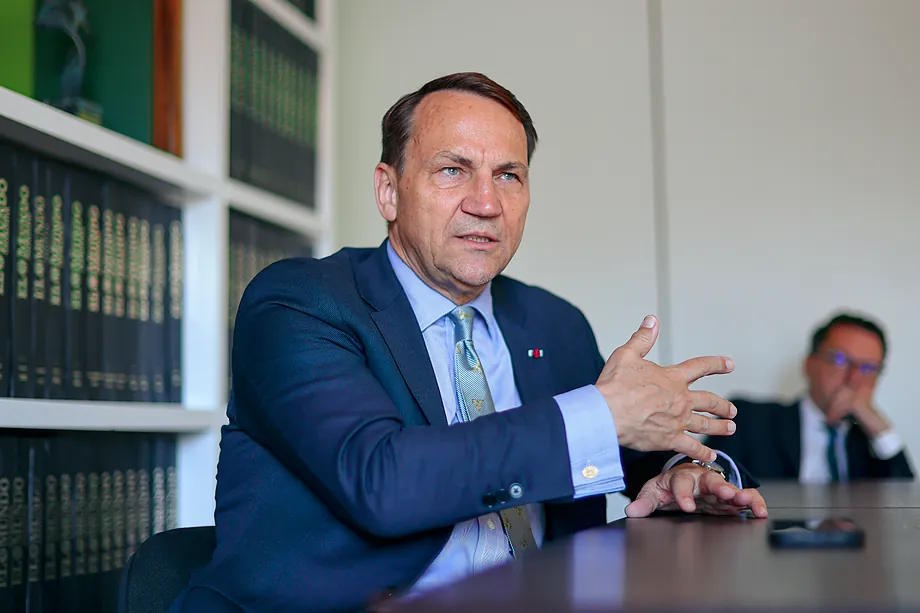
Former journalist and geopolitical analyst in the United Kingdom and the United States, Radoslaw Sikorski represents, along with the Polish Prime Minister, Donald Tusk, the new European liberal right that has managed to beat the identitarian and Trumpist right at the polls. The Minister of Foreign Affairs of Poland has been in Barcelona this week, where he participated in the sessions of the Circle of Economy.
QUESTION. The arrival of your government in Poland ousted identitarian populism at the polls; then came the Hungarian example with the defeat of Viktor Orban.
ANSWER. In its day in Poland we defeated communism and now we are at the forefront of how to defeat the populist path that is affecting all Western democracies. It is a global phenomenon; in the UK, it took the form of Brexit, there are separatist movements and opposition to Brussels. The motivation is the same: the division between the city and the countryside, also the phenomenon of immigration, a nostalgia that idealizes the past, a certain rejection of globalization phenomena. Likewise, we must be aware that some countries like Russia spend millions of dollars polarizing European society, fueling controversies, falsehoods, and conflicting debates, and that American technology companies invest a lot of money in capturing our attention and stirring up polarization. So, the first lesson we can draw from the Polish and Hungarian cases is that we must provide a rational and democratic response to the demands of citizens, not ignore them. In Poland, for example, we want regulated and controlled immigration. And that is what we have done.
Q. How to find a balance between a tough policy that does not resort to racist measures?
A. In recent years, the left has prevented a rational debate on immigration by excluding any proposal for regulation, control... At the same time, many Europeans consider a deep and sincere debate necessary, away from any racist position, about the advantages and disadvantages of immigration. How many do we need? For how long? What policies should we apply for them to become contributing citizens to the system? Once you have these parameters clear, it is easier to implement policies. What cannot be is that the argument is that any restriction on immigration is racist because then you do leave the field open to populists, as it is not true. We do not have to apologize for wanting immigrants entering Europe to be able and should integrate, to be an economic advantage for us and not a long-term challenge or problem. And in this sense, we must be aware that not all communities integrate well.
Q. Poland is one of the European countries that is most aware of the threat posed by Russia to Europe; however, in Spain, the war in Ukraine is increasingly perceived as a distant conflict.
A. The Russian threat is very diverse. For example, it uses immigration through Belarus to try to destabilize Poland. It was an operation that brought people from the Middle East to the EU to provide arguments and fuel to the far right. Regarding the sentiment in Spain, obviously geography matters, and it is normal that the Russian threat is perceived differently than in Poland. But Spaniards must be very aware that Russia has already interfered in the Spanish political debate - for example, supporting Catalan separatists, as it also supports the independence of Scotland - and Russia has mercenary troops - the so-called Afrika Korps - in the Sahel, whose destabilization could have consequences for Spain. So, it is a dangerous fiction to think that the geographical distance from Moscow puts them safe from Putin's intentions, his disinformation campaigns, and his state terrorism, killing and attacking on European soil.
Q. Do you think Russia could directly attack a NATO country?
A. In September, 21 military drones entered our airspace after being launched from Russia and Belarus; we were shooting to try to shoot them down for seven hours. It is not a small matter. If it had been one or two, we could accept that it was just a mistake. We must not take Putin's threats lightly. We have the example of Romania. We must protect our borders and develop new security instruments, prepared for drone warfare as we are seeing in Ukraine, and that includes Spain. It cannot think that it cannot affect them because what Russia is doing today in Ukraine, with Poland and the Baltic countries, perhaps one day not too far away, will be carried out by political actors within states close to Spain.
Q. Do we need to move towards a European army?
A. I do not like the concept because it would mean the disappearance of national armies, and that is not going to happen. What we must do is collaborate more and better, prepare for new threats using EU instruments better. And we should have joint rapid reaction battalions for low-intensity emergencies within the EU, but also in other countries where Europe has interests and must defend them; for example, in Libya, where Putin is trying to establish military bases. In such circumstances, we should be able to act militarily without always depending on the United States.
Q. Along with the Russian threat is China, which tries to penetrate the EU through the economic agenda, but also through espionage and interference campaigns with social networks...
A.China cannot be seen as an ally. They try to exploit Europe's weaknesses whenever they can. Our position should be to collaborate with it when possible, such as in the fight against climate change or transnational terrorism. Compete when necessary in the economic field, where they generally outperform us, and confront it when it spies on us or helps Russia. We must be careful with China, not be naive about its intentions because it tries to exploit our weaknesses in its favor.
Q. Is it possible to redirect the EU's relationship with the White House?
A. The most important thing for Europeans is to take our defense seriously and increase military spending. We have a test at the upcoming NATO meeting in Ankara because we should then know what each country plans to increase. Poland is clear: 4.8% of the Polish GDP dedicated to Defense, a budget close to 50,000 million. I admit that our proximity to Russia facilitates rearmament and that Spain has a different geographical perspective.