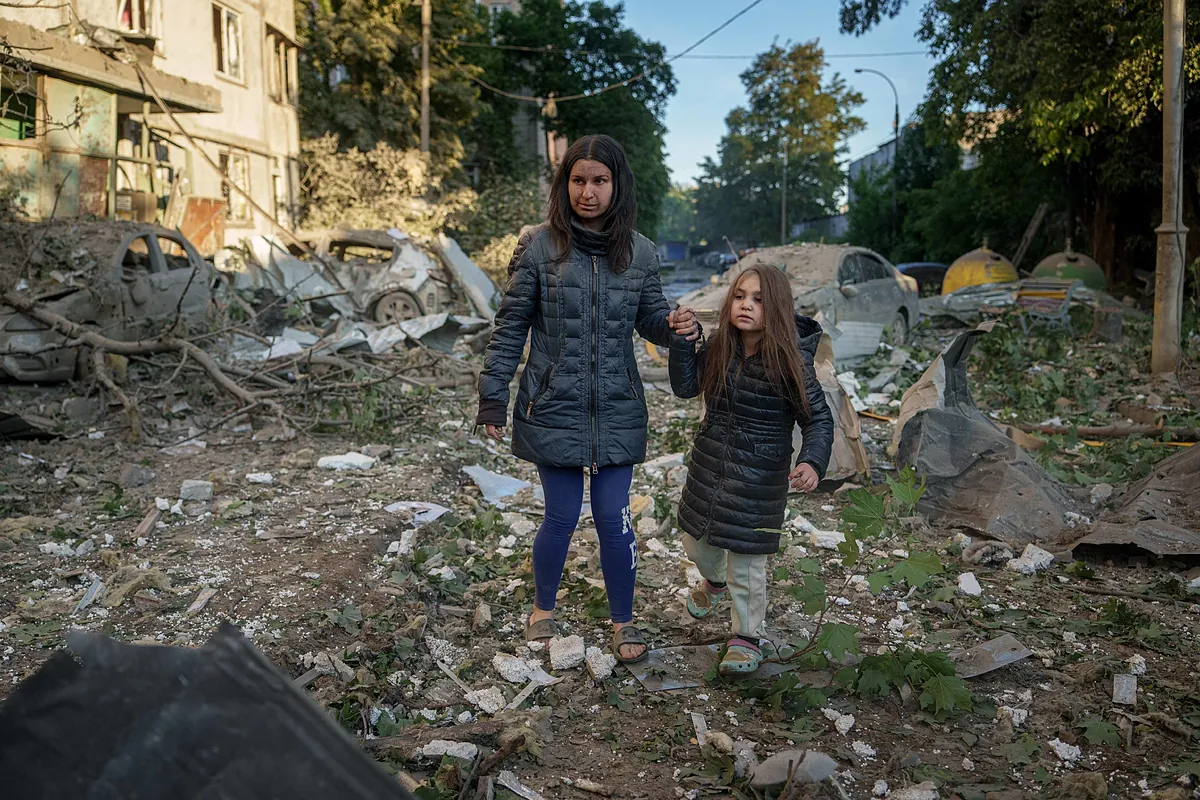
Russia has once again targeted the Ukrainian civilian population in another night of massive bombardments. Putin launched his nightly blitz —the first since the Kremlin ordered foreign ambassadors to leave Kiev immediately— with a force of 73 missiles and 656 drones, estimated to cost around 250 million euros. The preliminary toll is 21 dead and over 100 injured.
The attack does not bring Russia closer to winning the war nor the Ukrainian people to surrender, but it allows the Moscow regime to maintain its strategy of terror against the rest of Europe and, above all, to satisfy its most radical internal sectors, those demanding to "set fire to Kiev" and representing the main threat to Putin's popularity on the domestic front.
The main weapon used in the attack was the ballistic missile, much harder to intercept than cruise missiles, especially due to the concerning lack of Patriot interceptors both in Ukrainian arsenals and worldwide. Russia used 33 Iskander ballistic missiles, which hit urban areas without effective defense, in addition to eight hypersonic Zircons, 27 Kh-101 cruise missiles, five Kalibrs, and 656 Shahed drones. The majority of cruise missiles and drones were intercepted. Ballistic trajectory ones were not. In one of these impacts, 15 civilians were killed while sleeping in their homes in the city of Dnipro.
Last week, President Volodymyr Zelenski sent a letter to Donald Trump requesting the sale of new Patriot interceptor units due to the increasing vulnerability. These missiles have not arrived and Trump has not responded, just as he has remained silent about the Russian drone that hit a city in Romania. "If Ukraine is not protected against ballistic missile attacks, these attacks will continue. Europe needs its own anti-ballistic defense for this war to come to an end. And the assistance of the United States in supplying missiles for Patriot systems is absolutely necessary," Zelenski wrote in X.
It is hard to explain why companies like Raytheon, responsible for Patriot manufacturing, have not increased their production to sufficient levels, considering that these interceptors save lives both in Ukraine and the Middle East. The same goes for SAMP-T projectiles and manufacturers like Thales or MBDA, also supplied at an insufficient rate. Ukraine has requested that companies grant manufacturing licenses for these missiles to Ukraine to at least meet their own defensive needs.
In Ukraine, these attacks are referred to as "Phase V-2 of the war", in reference to the final months of the Third Reich when Nazi Germany bombed London every night with the first missiles in history, a pure show of force in a war already lost. Russia has not lost the war, but has not achieved any of its goals in four years and does not seem likely to achieve them in another four, with an economic and human toll threatening its own foundations. Meanwhile, Ukraine not only survived the aggression but has taken the war into Russia with its deep strikes.
In total, V-2 missiles killed about 2,754 civilians in London and injured another 6,523 during the final months of World War II when the Third Reich could no longer win the conflict. At least 815 civilians have been killed by Russian missiles and 4,174 have been injured in the first four months of 2026, according to the UN Human Rights Monitoring Mission in Ukraine. This represents a 21% increase compared to the same period in 2025 and a 93% increase compared to the first four months of 2024.
Lawrence Freedman, professor of War Studies at King's College London, is clear in analyzing Russian attacks on Ukrainian cities: "This is not a new strategy to win the war, but a tantrum. Electricity will be restored, debris will be cleared, and Ukrainian armies will continue to advance."
According to analyst Tatiana Stanovaya from the Carnegie think tank, "the fear of defeat is so strong, especially for those now fully immersed in this military adventure, that Putin's indecision has become a problem."
The reality on the battlefield confirms Russian stagnation. According to the Institute for the Study of War (ISW), Ukrainian forces "largely halted the Russian spring-summer 2026 offensive." The ISW also states that Putin "has developed a false perception of Russian military successes, based on highly exaggerated claims from the military leadership. This misunderstanding of the situation on the battlefield is likely contributing to his insistence on maintaining high war spending."
The data supports it: Russian troops captured only 14 square kilometers of Ukrainian territory in May, the lowest figure since October 2023, according to the DeepState open-source verification system. With a front dominated by drones, where any human advance is almost impossible, the aerial battle between both sides intensifies week by week.