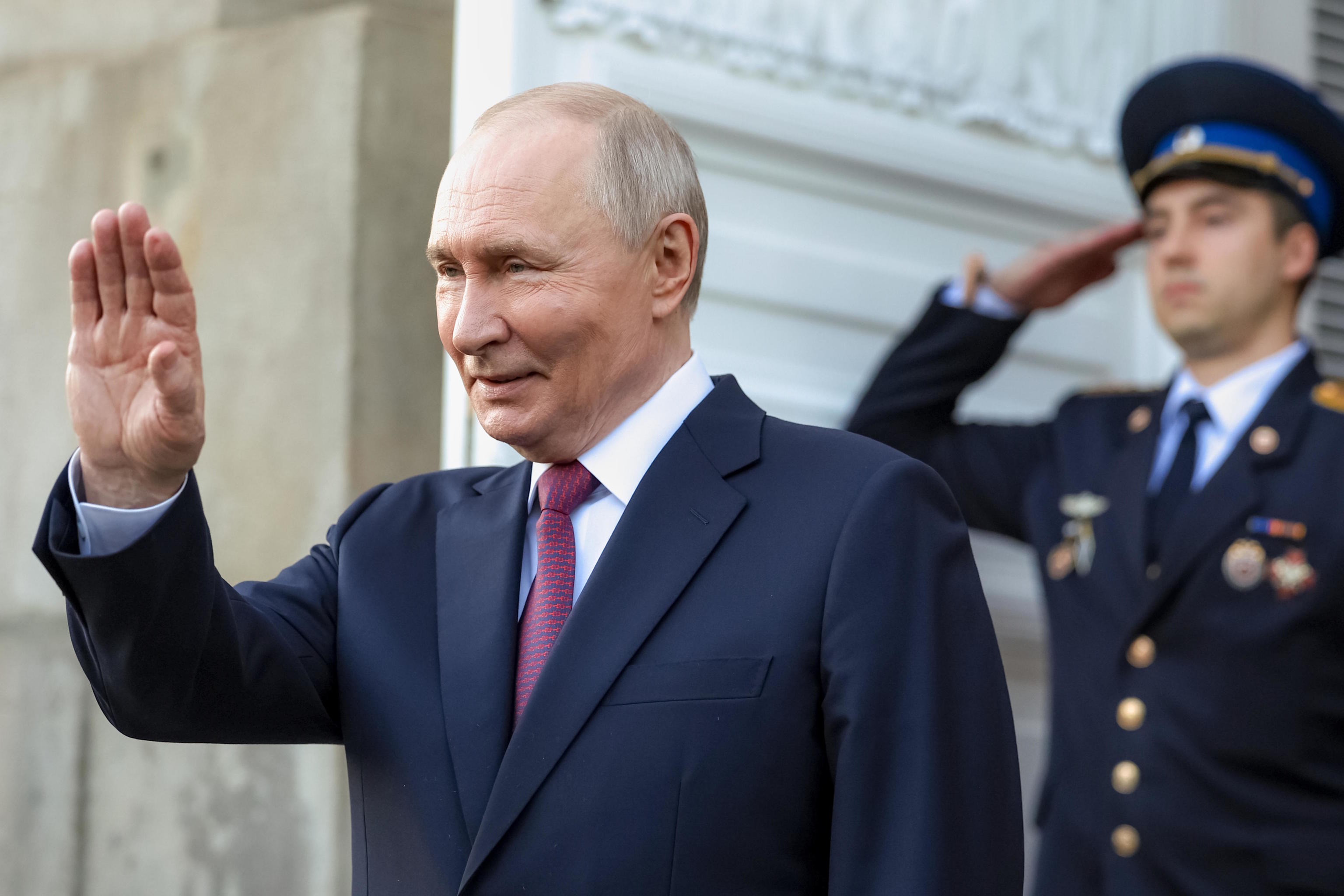
When the USSR fell and criminal gangs roamed the streets of old Leningrad, Vladimir Putin used to carry a compressed air gun in his jacket: "It won't save me, but it makes me feel calmer," he told a friend. Thirty years have passed, and the Russian president has once again resorted to fetishes to protect himself, facing a war that increasingly impacts his territory and his economy.
The solution has been to restrict 3G and internet usage nationwide. The goal was to disorient Ukrainian drones and prevent weary Russians from communicating too much with each other. However, attacks continue, Russians are speaking up more, and Vladimir Vladimirovich's popularityis decreasing. The fading magic has had to be replaced by coercion. This is why Russian security services are gaining power and intimidating other elite sectors with detentions. In 2023, hope for a sudden victory was lost, in 2025 hope for Trump's urgent peace was lost. Now, the elite and the general population are starting to come to terms with the idea that they are not winning the war.
When Russians turned on their televisions on February 24, 2022, they saw their president promising to defeat and disarm Nazism in Ukraine. Russian propaganda has shifted from triumphalism to managing attrition: the narrative no longer justifies the war but rather covers up Putin's 2022 mistake. The president's high popularity, who recently lost his voice trying to cheer "hurrah" with his troops, has been declining for seven consecutive weeks (according to the VTsIOM poll) or even months (according to the Levada Center). "The Putin before the war, bare-chested and riding a black horse, is now impossible to imagine," says Alexander Baunov, author of the book Koniec rezhima (The end of the regime), translated into Italian but not yet into Spanish.
One reason for the decline is the economy. Authorities have had to raise taxes and crack down on tax evasion. Interest rates remain high because the Central Bank is implementing a restrictive monetary policy to combat inflation. As a result, economic growth and household incomes have slowed significantly. There is exhaustion from the war model: military spending still supports factories, but at the cost of inflation, high interest rates, tax pressure, cuts, and an increasingly difficult-to-contain deficit. Putin has spent almost three-quarters of the gold from the National Welfare Fund he had in 2022 because those coffers no longer hold dollars or euros. The Russian economy grew by 4.1% in 2023 and 4.3% in 2024, driven by military spending. But it slowed to 1% in 2025; in the first quarter of 2026, it contracted by 0.3%.
Another reason for frustration is the problems on the front. Anne Keast-Butler, director of GCHQ, a British intelligence service, confirmed what observation centers like ISW had been pointing towards since March and April of this year: the Russian Army is gaining less territory, suffering more casualties for every kilometer gained, and, for the first time in a long time, Ukraine is starting to regain more ground in some weeks than it loses. Russia has likely suffered over a million total casualties, with several hundred thousand deaths. The documented minimum figure exceeds 200,000 names, and the most reliable independent estimate is around 352,000 deaths by the end of 2025.
"Russia has run out of economic resources. People are tired of the war. There are no major victories. And both in the elites and in society, there is an understanding that a change is needed," explains Roman Dobrojotov in Tallinn, who had to leave Russia in 2021 after years as an activist and is now a star researcher at the website The Insider.
The outbreak of war destroyed several tacit agreements of Putinism that had been more or less in force until then: before, power did not interfere in citizens' lives in exchange for citizens not getting involved in politics, the system prevented change but guaranteed stability, and Russian patriotism could emulate that of their elders without requiring risk or sacrifice. Suddenly, censorship began monitoring ordinary citizens, the economy faced the unknown as in the bad years of Boris Yeltsin, and recruitment drove away hundreds of intimidated Russians.
Still, Putinism quickly offered a new agreement: one could not be against the war, although one could live apart from it. But now, internet shutdowns, acute crisis, and fear of drones betray the idea that the war can be ignored. "I live near a military barracks, from my window I have seen continuous drone attacks at night," explains Olga, a mother of three who lives near Kotelniki, a satellite city of Moscow with a Russian army logistics and support facility just minutes from the center. The city gained prominence due to massive raids for forced recruitment, especially in metro stations, prayer centers, and stores in the area to stop military-aged men and send them directly to the district recruitment offices. "During the day, I come across young people missing a leg or an arm, and except at home, I can hardly open Telegram, which is how my clients contact me."
After the invasion began, Olga found a new way to make a living through the parallel import of sanctioned goods, but her reincarnation has become complicated again. The source of discomfort is no longer so much the sanctions imposed by foreign governments, but the limitations designed by the Russian authorities themselves.
While Putin hoped that Ukraine would tire out and Europe would lose interest in its desperate cause, Russia has been quietly progressing. 2022 was the year of shock and denial: the invasion was not a war and the cruel destruction of neighboring cities was supposed Western propaganda. In 2023, it was accepted that it would not be a short battle, and in 2024, a feeling that Baunov describes as "citizen patriotism" was established. After the initial impact (mobilization, disappearance of beloved brands, exodus of friends and celebrities amid a wave of repression and bans), a new prosperity emerged from the ruins of the previous life and under the illusion of an economy based on war consumables.
Rearmament pushed investment towards the forgotten provinces, where the new liquidity from killing or dying on the front is already visible. Although the Russians had not taken Kiev, they demonstrated that Ukraine could not push Russia out of its territory. But above all, it became clear that excluding Russia from the global economy was not easy. Nor from geopolitics, as Donald Trump won the elections. Ukraine was tough to crack, but so was Russia. Even for those who did not support the war but hate to see their country lose, economic survival became a source of pride.
2025 was the year of expectations, with Trump's imposed negotiation on Ukrainians and their European allies. But in the spring of 2026, "the shared sentiment of 2024 no longer exists," says Baunov, and last year's expectations have faded. Now people are realizing the impossibility of winning the war, which has lasted longer than the battle against the Nazis fought by their grandparents.
All this process is leading to some protests that, isolated, are an anecdotal effect for the police but together represent an uncomfortable symptom for a regime dedicated to immobilizing a minority and demobilizing the majority. Among the most prominent voices, influencer Viktoria Bonya posted a video directly addressing Putin that garnered millions of views, in which she denounced digital censorship by criticizing the "thick wall" that isolates the president from the real problems of the citizens.
Putin, who has neither email nor a mobile phone, "understands little of what is happening, but still has given his approval" to the proposed internet shutdowns by his securocrats circle, explains Tatiana Stanovaya, founder of R.Politik, an independent political analysis firm.
But all this discontent does not currently have the potential to turn into a political change. Partly because the intelligence services are operating at full capacity. And also because the elite understands that they are tied to the leader: "I think the people around Putin realize that he is leading the country in a very wrong direction. But if they try to remove him, the system could collapse and they would be buried with him, as Putin is at the center of a very sophisticated network of mutual dependencies, conflicts, and resource management," explains Boris Bondarev to EL MUNDO, who in 2022 was the only Russian diplomat to resign over the invasion: "That's why they are in a trap. Putin is going to destroy the system with his policies, but if they try to save themselves by removing him, the system will collapse anyway."
"I think the invasion was aimed at solidifying the regime and repeating the experience of Crimea," says Bondarev. With that goal forgotten, the gun that reassures Putin is the FSB, heir to the KGB, "which is particularly powerful in times of war and, if the fighting in Ukraine were to end, could have to give up its goal of achieving such total control," writes analyst Farida Rustamova in Vlast, who believes that "Putin's declining popularity is significant," but "not critical." Nina, a teacher in the capital, disagrees: "Prices are rising and people are irritable, internet problems are constant."
In any case, Dobrojotov warns: "The first thing we must understand is that, even if you don't see protests in the streets, that doesn't mean that people really support this regime. We saw it in the Soviet Union. It seemed like a very stable system, and suddenly it collapsed, and then we saw a very different face of society."