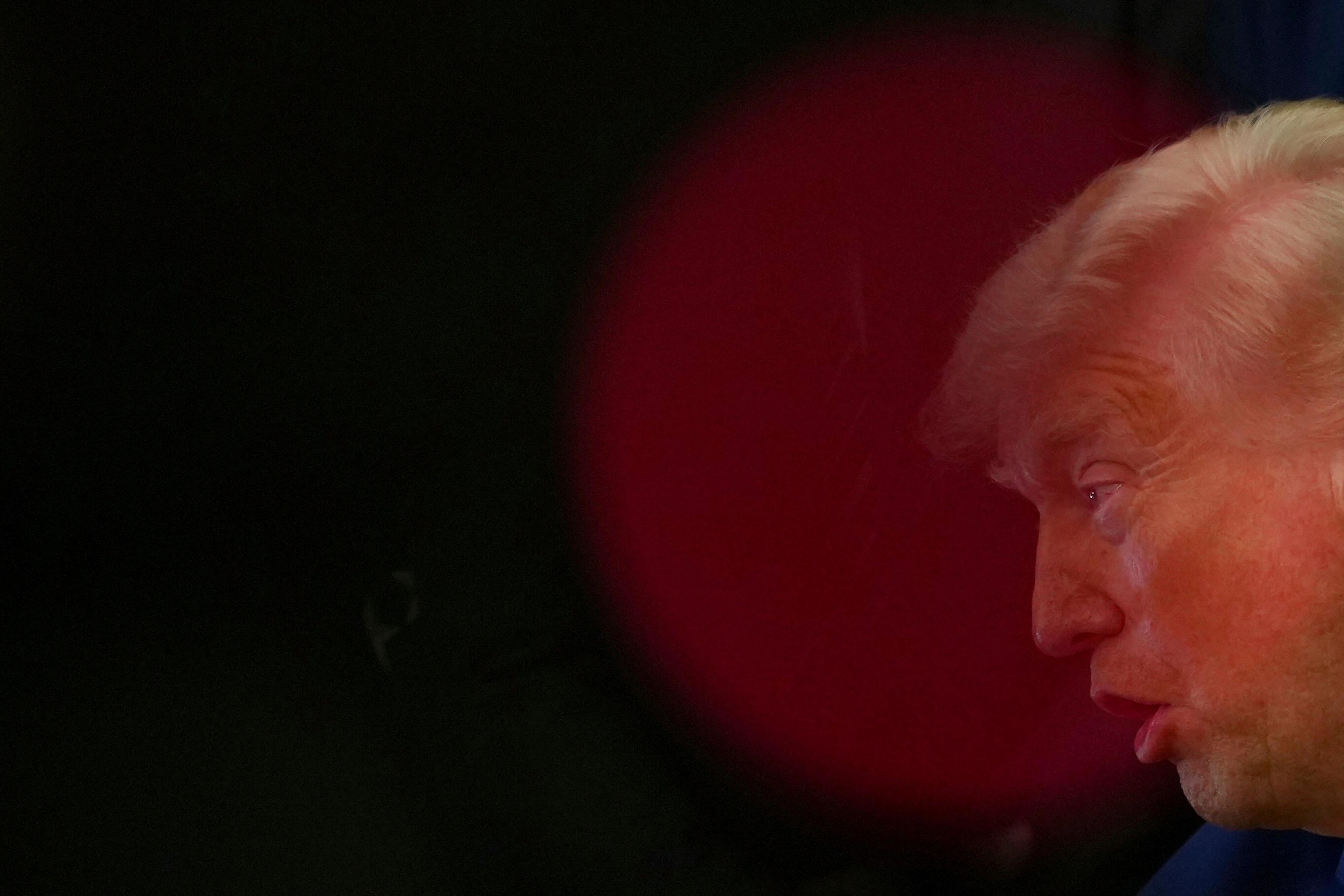
On Wednesday afternoon, the US House of Representatives approved for the first time a resolution to limit President Trump's powers in the Iran war. The result, 215-208, tight, was made possible by the support of four Republicans and carries more weight than it might seem. Since February, the Democratic opposition has tried half a dozen times to push through similar initiatives: a text ordering the president to withdraw troops or obtain Congress approval to continue the war.
A message, in short, that the Legislature is against an intervention they consider harmful, unnecessary, poorly managed, and costing a fortune as it approaches 100 days. The White House had managed to keep ranks tight time and time again. Not anymore.
The United States is fed up with the situation in the Middle East. Although there has been a ceasefire for weeks, skirmishes are continuous, and news about drones or missiles keeps coming. And the price of gasoline remains high. The president himself cannot hide his fatigue and frustration. One day he says an agreement could be imminent, and the next morning he doesn't care if there is an agreement or not. He insults and scolds his main partner in the region, Israel. And acknowledges that there is no good, easy, or quick way out.
However, the biggest challenge is not currently in the specific details of the agreement, not even in the main obstacle, the issue of the nuclear program. The long-term problem is the limits of US hegemonic power, the loss of its influence, and the theory of its leader's power. The Third Gulf War may structurally change the oil cycle or the alliances and balances in the region, or it may not. But it is undoubtedly rewriting the way alliances, loyalty, war, and brute force are understood in the era of drones and AI.
After the summer 2025 bombing, with an astonishing deployment of planes worldwide, and after the operation that resulted in the capture of Nicolás Maduro, Trump sent a powerful message to the rest of the world, especially to Russia and China. He made it clear that his Army can do things that others can only dream of. That he can strike almost anywhere, without consequences or casualties. But the operation in Iran has also shown all the weaknesses of the country that could not defeat Vietnam and ended up fed up with the Taliban.
"The situation is unsustainable"
Trump's threats have worked in this year and a half of his second term against his commercial partners and allies, resigned to mistreatment as a lesser evil; and against small countries overwhelmingly surpassed in military terms, explaining why he has been able to bomb up to six of them with little resistance. But his methods have not worked with China regarding tariffs, negotiations, and trade, nor much less with Taiwan. And they have not served to subdue Tehran as he thought would happen. Therefore, the White House is now forced to seek a completely different and much more difficult way out to fit into its usual narrative.
"The situation with Iran is unsustainable. As much as Trump needs and desires an agreement to overcome the stalemate, his own decisions continue to sabotage the negotiation process. To reach an agreement, Trump must first readjust his demands to the strategic reality, which now favors Iran. This implies abandoning maximalist positions on the Iranian nuclear program and definitively giving up any hope of imposing restrictions on Iran's missile capabilities or support for proxy forces. For the agreement to be viable, Trump must also address a problem created by US actions over the last 18 months: the lack of credible guarantees. Pressuring Tehran to accept an agreement requires more than mere military threats. It also requires convincing the Iranian regime that by cooperating with US demands and renouncing its nuclear program, it can prevent future aggressions. By attacking during negotiations and using maximalist rhetoric, such as his threat to eliminate 'an entire civilization,' Trump has made it increasingly difficult for Washington to offer the type of commitments," warn Jennifer Kavanagh, a professor at Georgetown University's Center for Security Studies, and Rosemary Kelanic, director of the Middle East program at the Defense Priorities think tank, in a recent article.
Trump's insults and the outbursts of Defense Secretary Pete Hegseth do not change the fact that the main objectives of Operation Epic Fury — to permanently eliminate the Iranian nuclear program and, as far as possible, provoke a regime change — have not been achieved. On the contrary. Despite decapitating the government and ending its supreme leader, despite destroying the navy and many missile silos, Iran is not defeated. After closing the Strait of Hormuz and attacking all its neighbors, hitting dozens of American installations in the process, the situation is now much more delicate throughout the region. Worse, in many aspects, than before the operation.
Trump is a very impatient person, who quickly tires of issues, especially if they are going wrong. His obsessions are perpetual, his hatreds eternal, but his ability to concentrate and follow through is limited. He is always in a hurry, which does not align well with long-term strategies and aligns with what Lawrence D. Freedman, one of the great contemporary analysts of history and military issues, calls the problem or the 'short war fallacy,' that is, the conviction that clear military and technological superiority "would allow a state to defeat an enemy with the speed, precision, and forcefulness of an initial attack."
Freedman explains that major powers "tend to assume that their significant military superiority will quickly overwhelm their adversaries," as happened to Russia in Ukraine. "US tactical brilliance could not guarantee strategic success," largely because US military thinking, which largely coincides with Trump's worldview, "has enshrined the idea that attacking forcefully and quickly invariably leads to the enemy's defeat and surrender." This conviction has only been reinforced with Artificial Intelligence.
In their appearances, military commanders and the Defense Secretary always boast about the number of positions attacked, the amount of planes used in each operation, and the number of troops involved. Just as the president repeats in each intervention the number of enemy ships sunk. AI and the ability to choose targets have further reinforced that way of approaching conflict and power. That something may be effective on the battlefield does not mean it can work in diplomacy. "The lesson from Ukraine and Iran is that any leader offered a plan for a quick and easy victory should first ask, 'How can we be so sure?'. And then: 'What if they are wrong?'. Trump did not ask and is now paying the consequences.
Mark Leonard, from the European Council on Foreign Relations, has long argued that this Iran war is showing for the first time, beyond academic speculations, what geopolitics is like when the very idea of order collapses. It is a state of affairs he calls 'un-order,' something that does not translate exactly as disorder but as a lack or absence of it. Trump did not like the previous international order because he believes the US was losing out and that it is foolish for the planet's greatest power not to gain even more benefits from the system. Despite doing everything possible to disrupt it, he wants another order, with him at the center, perhaps even with spheres of influence, but not a total absence of hierarchy. On the contrary, he dreams of a basic order with everyone bending to his wishes and interests.
"Disorder arises when established rules are deliberately violated. Describing a situation as disorderly paradoxically implies that shared norms still exist, even when violated. Non-order, on the other hand, arises when events surpass those norms, and there is no longer a common understanding of what is right and wrong, not even of truth itself. Instead, a deeper and irreducible uncertainty persists. Instead of being governed by shared norms, the international system is now besieged by episodes of coercion and retaliation."
And that is why, after shaking up NATO, offending neighbors, mocking friends and the weak, now everyone looks at Washington with a mix of fear and satisfaction in the old political mantra: if you break it, you pay for it.