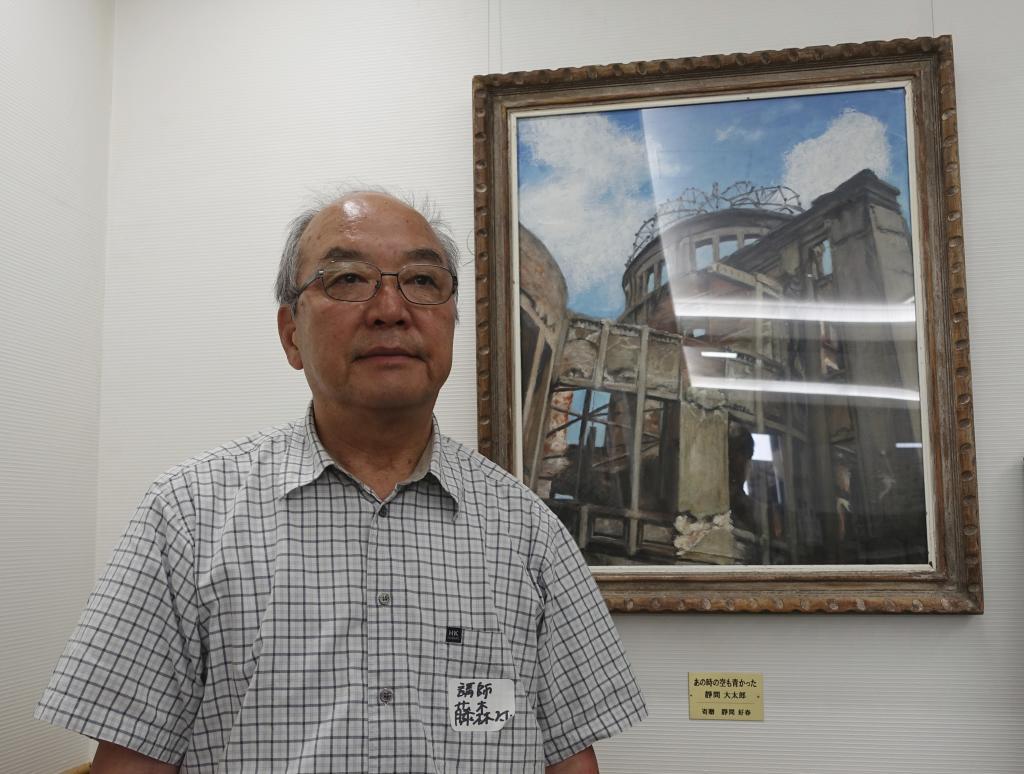
In Japan, tragedy and stigma merge into a single word: hibakusha, which means bombed person. "The Government does not recognize the survivors as war victims; they have fought for decades for the State to cover their medical treatments, without success," explains Iain MacGregor, who condenses decades of neglect in his essay The Men of Hiroshima. Men, women, and children not only were left out of institutional protection as cancer spread but also faced the systematic rejection of a society that denied them access to higher education and job opportunities.
Between five thousand and ten thousand documents have attempted to dissect the tragedy of the atomic bomb. Faced with this pile of paper where memories, data, and academic studies navigate, MacGregor challenges the official narrative. His most recent publication does not aim to be just another historical reconstruction but a map of voices that engages with the geopolitical conflicts of the present.
From the first pages, the British writer portrays the serenity with which Michiko Kodama, 88 years old, recalls the "warm and sunny" morning of August 6, 1945: her first day at Furuta National Elementary School. The elderly Japanese woman, as recorded by the historian, describes the impact of Little Boy as a blinding light. "A mix of yellow, silver, and orange" that engulfed her. The survivor took refuge under a desk while, nearby, 400 students and 11 teachers died instantly.
Beyond the physical wounds, ignorance about the effects of radiation condemned the survivors. Kodama embodies the face of exile: she was forced to leave her city and change jobs after being labeled as a stained woman. The final blow, however, came when her fiancé broke off the engagement: fear of the bomb's invisible aftermath ended the relationship.
On the outskirts of Tokyo, the author discovered a statue of a mother embracing her child. It is a memorial that, far from the monumental scale of the Atomic Bomb Dome -a World Heritage Site-, stands as an intimate symbol; a tribute erected by survivors to transform pain into a message of peace.
"There are fewer and fewer people who speak out against the Government. While Hiroshima and Nagasaki overflow with ceremonies and plaques, the rest of the 67 cities bombed by the United States remain in the shadows: if a memorial were erected in each one, the country would be a cemetery. In the end, forgetfulness is also a cynical and political decision," denounces MacGregor.
His narrative alternates between the memories of victims and attackers; a counterpoint of unpublished testimonies where the same reality is fragmented into two opposing versions. "It's like a puzzle. Talking to American veterans was the most difficult: half expressed frustration, convinced they acted correctly and that they are now being judged unfairly. The other half, on the other hand, cannot stop feeling ashamed for having used the bomb."
The author draws a dichotomy between life before and after the explosion that began to mark the end of World War II. It was the first time a nation decided to surrender without the enemy army present on its territory. Without appealing to great feats, MacGregor shows the horror of combat from the everyday: domestic scenes, minimal gestures, and interrupted routines. Death does not appear as collateral damage from a "gigantic firestorm" but as a result of a system that turned silence into propaganda: The U.S. deliberately concealed the so-called radiation plague, which resulted in famines and hereditary diseases.
The weight of a wedding band: Censorship and the postwar era
The author points out a significant omission: the collaboration of the British Government. By revisiting this alliance, MacGregor offers a critical reading of the relationship between both powers and rethinks the foundations of the Manhattan Project. He highlights, in particular, physicist Mark Oliphant, responsible for ensuring that the memorandum with the research secrets crossed the Atlantic and reached the hands of J. Robert Oppenheimer. "Britain had been at war for two years and was heavily indebted. It did not have the finances or the space to develop the bomb before the Nazis."
MacGregor believes that Oppenheimer, the Oscar-winning film by Christopher Nolan, offers a partial view of reality by omitting the direct consequences of the bomb. The writer argues that it is a Hollywood story: a drama that strays from reality by ignoring the true protagonists of the bombing and relegating the Japanese voices. He also emphasizes that General Leslie Groves was more relevant than Oppenheimer himself and questions why Matt Damon, tasked with portraying him, appears on screen for only eight minutes.
For the author, Oppenheimer was reduced to a political tool after the war, used to soften the narrative about the devastating effects of nuclear weapons: "He was not the best researcher in the room or the brightest physicist at Los Alamos, but he was a key piece in connecting scientists, politicians, and military personnel."
Before the U.S. military debut on the European front, an invisible machinery was already operating in the New Mexico desert. Around 100,000 workers confined in ghost towns sustained the Fortress program, which allocated $3.7 billion to design and build the Silverplate, a plane designed for a single mission: to transport Little Boy, the most dangerous weapon ever created. "Most were unaware they were working on a nuclear bomb; they believed they were part of a secret project. Here lies the moral dilemma. When the bomb was dropped on Japan, Germany had already surrendered, but the decision was politically unstoppable: the Government had spent millions."
With six islands connected by a network of bridges: Hiroshima was not a random choice. Although it had 350,000 inhabitants, it was not the largest city in Japan or the seat of the Government, and until then, it had escaped hostilities. For the White House, it was the ideal scenario: an urban nucleus large enough to measure the bomb's reach. On that map, the T-shape of the Aioi Bridge became the reference point that set the target.
"Uncertainty surrounded the operation; there was no certainty that the bomb would detonate. In fact, it was assembled in mid-flight, barely an hour after takeoff. From that logic, Nagasaki could be classified as a war crime: by dropping the plutonium payload three days after the uranium one, there was already a clear precedent of its devastating reach."
"He is a man history has forgotten. If you search his name on Google, you will find some brief biographical data." A chance discovery led MacGregor to Senkichi Awaya. "I read his story in a Christian magazine published for the 70th anniversary of Hiroshima. Only 5% of the population there is Christian. His daughter survived the attack and, in an interview, stated: 'My father was in charge'."
After five months of searching, MacGregor found a copy of Awaya's memoirs at the National Library of Tokyo. Through his voice, the researcher narrates the evolution of the Empire until its surrender on August 15, 1945. With Awaya—mayor since February 1943—the historian presents "a fascinating character that defies any Japanese stereotype."
The work also explores the ethical contradictions of American troops. While General Haywood Hansell was dismissed for condemning attacks on civilian populations and describing Washington's strategy as "inhuman and cruel", President Harry Truman did not hesitate to order the offensive that left 80,000 dead. Convinced he had made the right decision, the president maintained his stance until the end. He died in 1972 without the slightest hint of remorse or intention to apologize.
A contributor to magazines such as The Spectator and BBC History, Ian MacGregor not only analyzes the aftermath of the conflict but also denounces the role of the media, which acted as allies of those in power. According to the author, the press, radio, and even television presented the atomic bomb as a natural evolution of dynamite to hide the reality: melted skin, scorched lungs, and bodies disfigured by radiation.
"Radiation poisoning is a very pleasant way to die," General Groves asserted before the Senate. That lie vanished with Hiroshima, the report John Hersey published in The New Yorker in 1946. The account forced the public not only to distrust the state but also to empathize with those who, just a year earlier, had been their enemies. "The report had the same effect on public opinion as an atomic bomb; overnight, nuclear energy went from being a promise of progress to a threat to humanity."
"Learning and developing this technology is becoming faster and cheaper," the author warns. In light of the world's ongoing conflicts—such as the one currently pitting the U.S. and Israel against Iran—he puts forward an uncomfortable thesis: "North Korea has nuclear power, and no one is threatening it. I don't sympathize with Iran, but if an oppressive regime seeks to ensure its survival, it assumes it needs nuclear weapons."
Scientists predicted it would take seventy-five years for Hiroshima to recover. It took only thirteen. MacGregor avoids passing judgment and does not take sides in history: "I present the facts to the reader, and he decides: both the Allies and the Axis powers were willing to use any weapon."