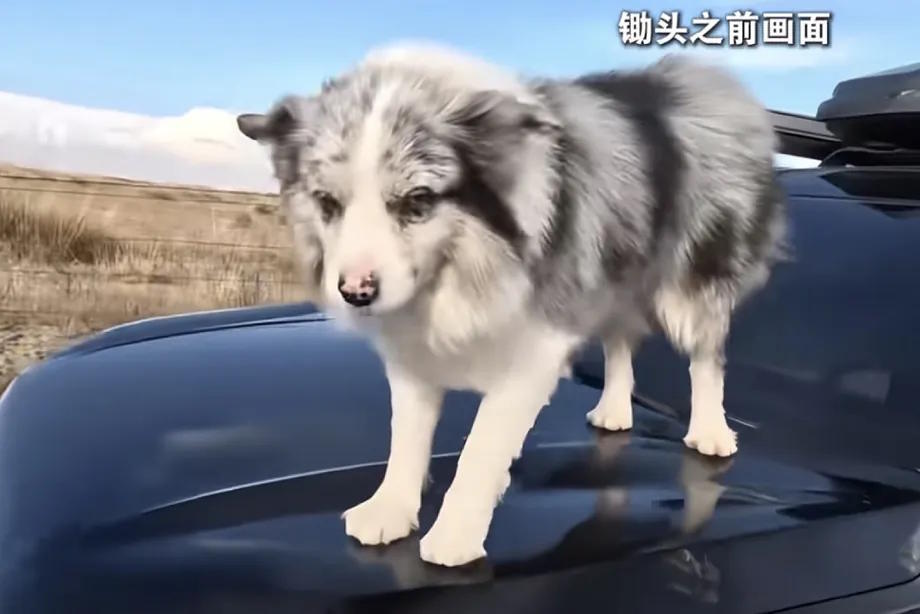
For almost nine years, Chutou accompanied his owner through deserts and snowy mountains in China. He slept next to a tent in the Gobi, watched over the car during stops, and appeared in videos that millions of people followed on social media. He was a docile border collie with an alert gaze, a small internet celebrity with over one and a half million followers on a channel his owner had created on Douyin, the equivalent of TikTok.
Chutou's story ended in the most brutal way possible. In May, while his owner, Guo, was on a road trip abroad, Chutou was left in the care of his parents in a rural area of Henan province, in central China. One morning, Guo's father was working in the field and the dog was by the road watching the family vehicle, a common scene for an animal accustomed to being with the family. Surveillance cameras then captured a sequence that shocked millions of Chinese.
The footage shows a couple arriving on an electric motorcycle. The woman gets off first and surveys the surroundings. When she sees that no one is watching, she runs towards the dog and grabs his neck. The man immediately approaches, immobilizes the dog's legs, and both forcibly put him on the motorcycle. They cover the body with a windproof blanket and leave the scene at high speed.
When Guo received the news, he immediately interrupted his trip and returned to China. For days, he searched villages, reviewed camera recordings, and asked door to door until he located the culprits. But it was already too late. According to the police investigation, three days after the theft, the dog was sold for just 180 yuan (about 26 dollars) to a dog meat restaurant that sacrificed him for consumption.
The news sparked outrage on social media. An animal that had accompanied his owner for almost a decade, followed by over a million people and turned into a small internet star, was reduced to the price of a meal. The reaction of the alleged perpetrators further exacerbated the scandal.
When Guo demanded explanations from the thieves, they claimed they thought it was a stray dog. The explanation contradicted the camera footage, where it is clear that the animal was forcibly restrained. Additionally, Chutou was wearing a collar and a tracking device.
Desperate, Guo tried to at least recover some remains of the animal. He asked if it was possible to retrieve the skin or fur. The response from the merchant who bought him was devastating: everything was sold or discarded.
The case has now evolved from being just the story of a stolen dog. It has become one of the most intense social debates this week on Chinese social media.
Thousands of users and animal rights groups are demanding exemplary punishments and calling for specific legislation to protect companion animals. Many believe that Chutou's death has exposed a significant legal gap in a country where the number of pets continues to grow, but where legal protection lags far behind social reality.
China currently does not have a specific national law for the protection of domestic animals. Legally, dogs and cats are still considered material goods. In practice, the loss of a pet often results in a civil dispute for economic damages, regardless of the emotional bond between the animal and its owner.
Just two decades ago, the vast majority of dogs in China served utilitarian functions. They guarded farms, protected homes, or were considered simply farm animals. In some rural regions, there was still a long tradition of consuming dog meat.
Today's China is very different. The country now has one of the largest pet industries in the world. Millions of urban youth consider dogs and cats as family members. They spend fortunes on premium food, veterinary insurance, pet hotels, clothing, toys, medical treatments, and even specialized funerals.
In modern cities like Shanghai, Shenzhen, or Hangzhou, it is common to find dog cafes, dog daycare centers, and veterinary hospitals equipped with technology comparable to many human medical centers. The transformation has been so profound that in 2020, the Ministry of Agriculture officially removed dogs from the national catalog of livestock. The political message was clear: dogs should be seen as companion animals and not as animals for consumption.
Subsequently, cities like Shenzhen explicitly banned the consumption of dog and cat meat. Although the market has significantly decreased and many restaurants have quietly removed these dishes from their menus, the dog meat trade still exists in certain rural areas and traditional markets.