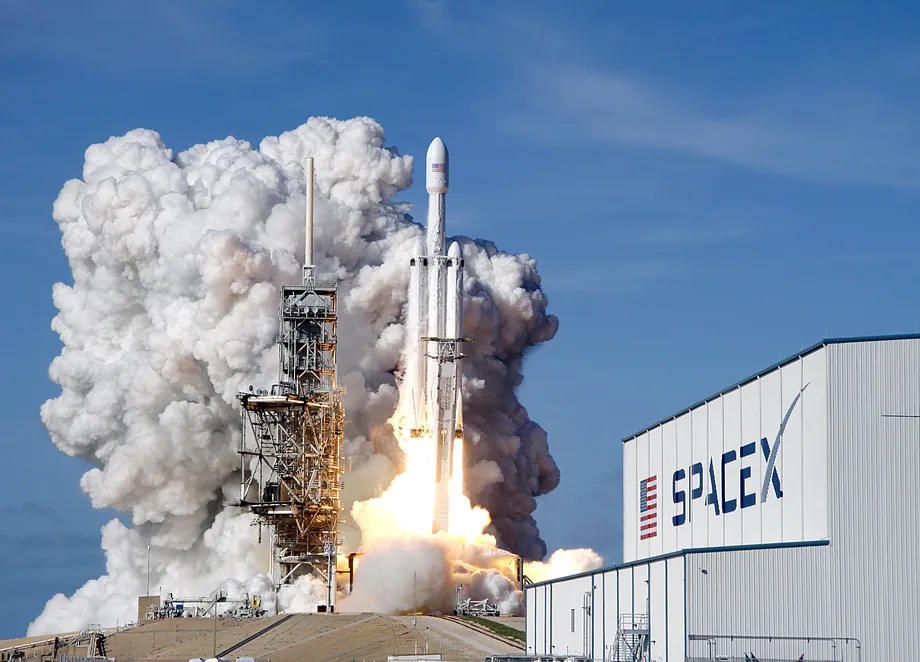
A five-day countdown for Space Exploration Technologies, better known as SpaceX, to debut on Wall Street breaking all existing records to date, also generating vertigo among investors and fueling market risks. It is an IPO "surrounded by uncertainty," as commented in the analysis circles. Its valuation will be $1.75 trillion, with a market placement through a capital increase of around $70 billion. This implies that the free float that will be traded on the stock market will be only 4% of the company; the rest will remain in the hands of the core group, and its founder, Elon Musk, will retain 86% of the voting rights of the space company once it starts trading.
SpaceX will go down in history as the largest offering ever seen in the free market. Still fresh in collective memory is the IPO of the Saudi state oil company Aramco in December 2019, which was seen as the arrival of a giant from another planet, with around $30 billion in shares placed among investors. Well, Musk's feat is more than doubling this figure through a public offering in which the company's capital will be expanded without the need to release his share, posing a clear governance risk. Elon Musk, a former member of Donald Trump's Republican government and a well-known agitator of the X social network (acquired in 2022 when it was Twitter for $44 billion), has been involved in various scandals that have been investigated as market manipulation. He did so in Tesla's IPO in 2018, in the purchase of Twitter, or trying to influence the price of some meme coins recently.
Beyond the controversial figure of SpaceX's founder, the U.S. market will test its seams in 2026 amid the boom of artificial intelligence. Two other mega-companies will make their debut on Wall Street: Anthropic (creator of Claude) is already working on it, with an initial valuation of around $900 billion; and OpenAI, which will seek its debut in the fourth quarter of the year. Together, they aim to place around $130 billion among investors through share sales and capital increases. Combined with SpaceX, this amounts to $200 billion entering the market in just three operations.
Last week, Nasdaq, the company that manages the benchmark index for technology worldwide, announced that it was lowering the entry requirements for its index that includes the 100 most relevant companies in the sector to include SpaceX. It was impossible for them to ignore this "elephant in the room," and it will be part of the Nasdaq 100 in 15 days. In the Russell 1000, it will be in five. Standard & Poor's did not see it the same way, after the S&P 500, deciding not to modify the terms of 'fast entry' in the selective, which include waiting 12 months to enter, being profitable (i.e., being in profit, and SpaceX has not reached breakeven yet), and having a minimum free float of 10%. This is very relevant because the S&P 500 index is the most replicated in the world, also by passive funds.
Nevertheless, the market expects a true buying frenzy among funds and ETFs that track indices like the Nasdaq to try to replicate its new composition with Musk's company and, in the future, with the arrival of Anthropic and OpenAI. It is important to note that over half of the entire market capitalization of the U.S. market is in the hands of passive funds, which surpassed active funds in terms of assets under management for the first time last year. What does this mean? If Elon Musk sneezes... the rest of the world better be prepared. The arrival of the three AI giants (which is also the fastest-growing part for SpaceX) will lead to an unprecedented concentration in a dozen listed companies and in a single sector, which, if it fails in any of the avenues being explored, could result in seismic dimensions; the consequence of combining automated portfolio management (machines executing orders without looking at what's behind them) and AI and technology mega-companies that are oligopolies.
"Funds indexed to the Nasdaq 100 and the S&P 500 would have to acquire around $20 billion of the $75 billion SpaceX IPO, approximately 26% of the total size of the offering," emphasizes J. Safra Sarasin Sustainable AM. Additionally, these are funds that would not participate in the IPO but would buy in the "secondary market (...) which could have a significant short-term impact, amplified by retail investor interest"; this provides support for the aerospace intelligence company's stock price.
In a way, the market is rigged because the rules have changed. Just a few days ago, the CEO of SIX, manager of the Spanish stock exchange, Bjorn Sibbern, pointed out that "80% of IPOs" on Wall Street had suffered losses afterward, precisely because the valuations being paid in their IPOs were very high. But they were playing on a different board than SpaceX will. "Historical data suggests that larger IPOs tend to have more moderate initial gains and a more pronounced correction in the following months, but now the 'forced purchases' that passive funds will make could 'amplify these declines' once the initial frenzy subsides," explains the French asset manager.
"Another implication of passive funds is that they replicate an index regardless of whether they consider it a fair price or not. They decouple the fundamental value from the price because you have to buy" regardless," recalls Natalia Aguirre, Director of Analysis at Renta 4. And here comes, once again, the much-repeated topic of valuations: Is there a bubble around AI? The valuations of the three planned debuts for this year are among the highest in the Nasdaq 100. Based on the price-to-sales ratio (since it cannot be based on profit, following a widely used metric like the P/E ratio, because they are still incurring losses), SpaceX is going public at a 100 times/revenue multiple, meaning an investor who participates in its IPO would have to wait a century to recoup their investment based solely on its sales estimate. It is on par with Microstrategy and above ARM or Palantir (defense). OpenAI is expected to trade at over 30 times, similar to Anthropic, three times higher than the average of the top 100 U.S. technology firms.
It is important to note that the lead underwriters have committed to holding their shares for a period of time - a common practice - but they may sell them if their price exceeds a certain threshold, which is a breeding ground for more pronounced declines once they exit. The operation is led by Goldman Sachs among a syndicate of underwriters including Banco Santander as the sole Spanish representative. SpaceX plans to attract European institutional investors. Last Friday, the German regulator (BaFin) approved its IPO prospectus, which also means it can be marketed in other countries like Spain, where Santander has the monopoly on the placement, although some private banks from other entities are considering allowing clients who request it and are figuring out how to make it happen.
The offering has reserved "30% for retail investors, compared to the 10% average in IPOs" due to the expected good reception from small investors, says Anthony Toupin, Senior Analyst at Edmond de Rothschild, given the "nature of the company and the long-term prospects it has communicated: dual exposure to the space and artificial intelligence markets, an addressable market estimated at $28.5 trillion, data centers in space by 2028, a colony on Mars, etc."
"The opportunities arising from lunar development are staggering. With ecosystem growth prospects in the space sector ranging from 9 to 10% annually, according to McKinsey, the market should reach a value of $1.8 trillion by 2035. Meanwhile, global space industry revenues could exceed $1 trillion by 2040, according to data from Morgan Stanley," compiles the French asset manager La Financière de l'Échiquier, which has a fund specializing in the field.
The dimensions handled by SpaceX are of such magnitude that it will directly enter the 'top 10' of the largest publicly traded companies globally alongside the select group of 'the magnificent seven' of American technology, led by Nvidia (above 5 trillion), Apple, and Alphabet (over 4 trillion dollars in market value). Tesla itself, Elon Musk's flagship, has a market capitalization of over 1.5 trillion dollars, making him even richer. He aspires to become the world's first trillionaire after the bell rings next Friday.