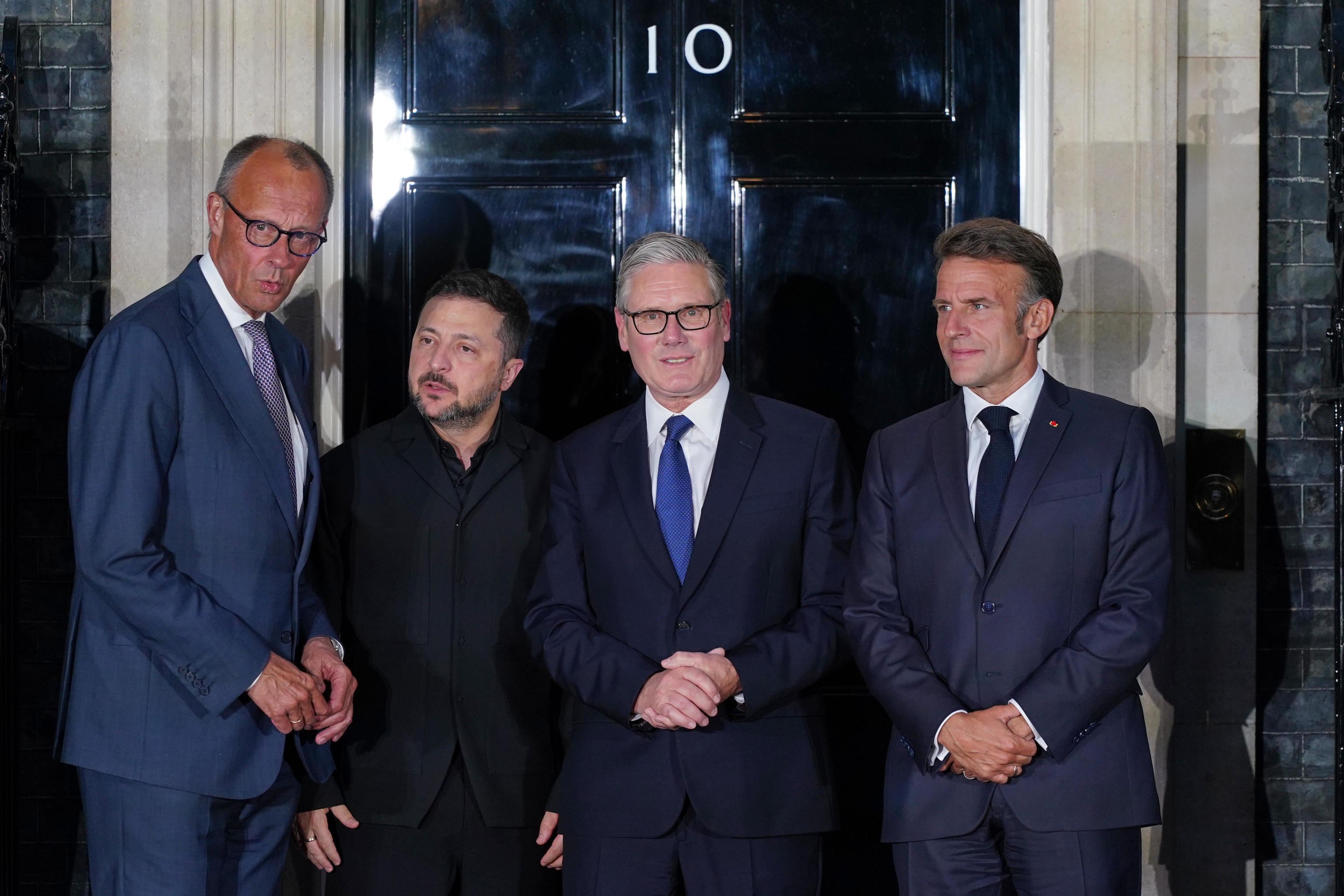
More than four years have passed since Russia invaded Ukraine. Now, it's not that Ukrainians want NATO to provide them with military technology. On the contrary: Ukraine has reached such technological capacity in the development and use of drones and missiles that the United Kingdom, France, and Germany want "the Alliance [Atlantic] to learn from Ukraine's battlefield experience" and seek "an increase in long-term industrial cooperation [between NATO and Ukraine] to strengthen European defense."
This is stated in the final statement of the meeting held yesterday in London by the E3, composed of British Prime Minister Keir Starmer, German Chancellor Friedrich Merz, and French President Emmanuel Macron. Ukrainian President Volodymyr Zelenski dined with them last night in London, in a discreet meeting that resulted in a joint statement of strong support for Kiev's idea of a ceasefire as a basis for subsequent negotiations to define the borders between the two countries and Moscow's compensations to its neighbor as prior and indispensable steps to lifting sanctions on Russia.
In practice, the declaration constitutes a direct rejection of the peace plan launched by the United States in November, which implied that Ukraine should cede more territory than it has lost to Russia. The Washington plan has not made progress, despite the efforts of the Trump administration, largely because Vladimir Putin did not consider it favorable enough to Russia.
The key point now, as stated by the E3, is that Ukraine has the military initiative and is even regaining territory occupied by Russia. This gives Kiev much more room for maneuver. The stalling of Donald Trump's peace proposal opens a window of opportunity. In a week, there is the G-7 summit in Evian (France); in a month, the NATO summit in Ankara (Turkey); and in five weeks, the 'Volunteer Coalition' summit supporting Ukraine in Paris. Therefore, the next month and a half could be decisive for resolving the war.
Zelenski indirectly confirmed this goal upon his arrival in London on Sunday afternoon, stating that the summit would focus on "the war, increased cooperation to strengthen air defense throughout Europe, and our common perspective on diplomatic prospects."
For the first time since the Russian invasion began in February 2022, Ukraine is systematically destroying the Russian rear, dramatically increasing Moscow's casualties on the front lines. Meanwhile, Russia is unable to capitalize on the rise in oil prices caused by the Iran war and the closure of the Strait of Hormuz due to Ukraine's missile attacks.
All of this paradoxically turns Ukraine into a military power that interests London, Berlin, and Paris. Even U.S. military officials are urging the White House to establish cooperation channels with Kiev, despite Donald Trump's clear antipathy towards Zelenski and his sympathy towards Putin.
However, Ukraine still relies entirely on European assistance to maintain the functioning of its state and defense. The Iran war has negatively impacted Kiev. The United States has spent half of its Patriot missiles in the conflict and has had to deploy batteries to the region or deliver them to its allies, Israel and Gulf countries. As a result, although Ukraine has improved its air defense against Russian drones of Iranian design, it is increasingly defenseless against Moscow's missile attacks. Ukraine is using Franco-Italian Iris-T missiles, the European version of the Patriot, but the production of these weapons is progressing very slowly, and cannot keep up with the Russian rocket salvos.
Other risk factors discussed at the meeting yesterday add to the situation. Putin has isolated himself even further, making decisions with a very small number of advisors appointed for their loyalty rather than effectiveness, as evidenced by the inclusion of his former head of security among them. This poses the risk that the Kremlin, seeing the war going badly, may escalate either horizontally - with more drone attacks like last week's against Romania - or vertically - with the threat of using nuclear weapons. Therefore, today's summit framework was paradoxical: on one hand, monitoring a war that could spiral out of control; on the other, preparing for the day after, including the deployment of peacekeeping forces.
Finally, there is the economic aspect. Today, the announcement of new sanctions against Moscow by the E3 was expected. However, the pressure from oil prices could lead the EU to relax the cap on Russian oil prices imposed in 2023 or to loosen restrictions on Russian petroleum product exports as long as they pass through third countries. This is not a theoretical assumption: United Kingdom, supposedly the Western European country with the greatest sympathies for Ukraine, has already done so.
Meanwhile, Kiev continues to seek a diplomatic solution. Last week, Zelenski sent a letter to Putin proposing a face-to-face meeting and the opening of direct negotiations between the two countries. The Russian dictator merely questioned the legitimacy of his adversary again. However, this did not deter Zelenski from his peace proposals. Last month, the Ukrainian president invited Russian oligarch Roman Abramovich to his country and conveyed a peace proposal for Putin, as reported by the Financial Times on Sunday. Abramovich is one of the leading Russian oligarchs with strong ties in the West, to the extent that he owned the London-based Chelsea football club, which he had to sell in 2022 following Putin's invasion of Ukraine. He currently resides between Russia, Israel, and Turkey.