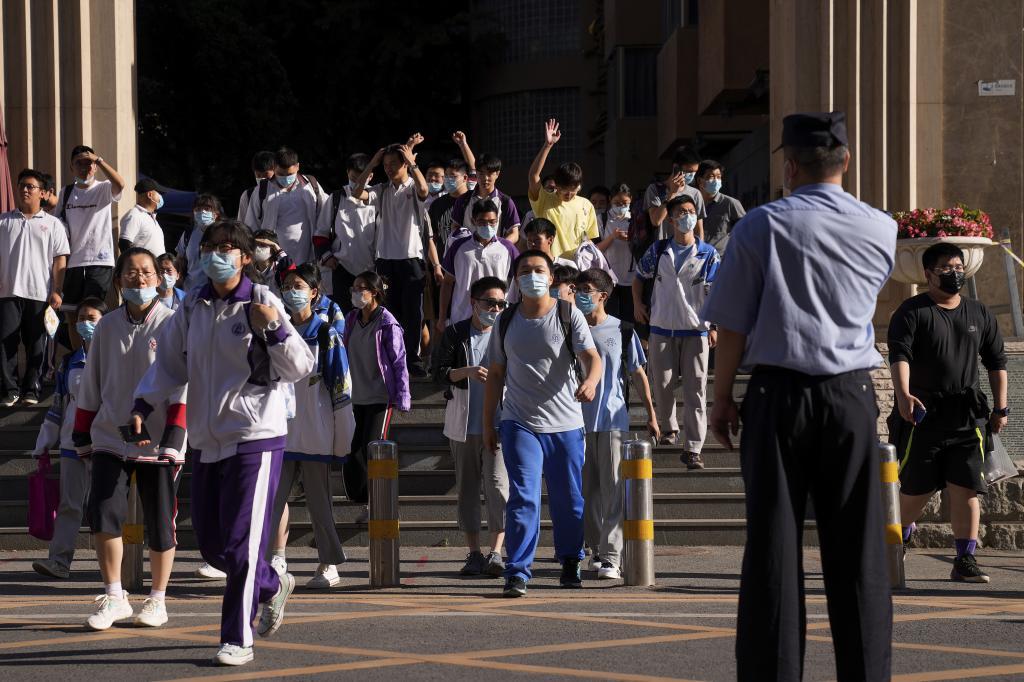
Early in the morning, in front of a school in Xuhui, one of the most affluent districts in Shanghai, a police officer asks an impatient driver to stop honking because students need concentration. Several patrols monitor nearby intersections. On the same street, construction workers have been instructed to stop the noisiest machinery.
Under a row of trees, dozens of nervous parents watch. Some teachers also appear with bouquets of flowers to offer encouragement. Students pass through the turnstiles equipped with facial recognition systems one by one. Some walk with their eyes fixed on the ground. Others review their notes one last time. Ahead of them are nine hours of exams spread over two days that can determine much of their future.
This Sunday marked the beginning of the gaokao, the national university entrance exam that paralyzes China every June and remains the great meritocratic ritual of the world's second-largest economy. In the morning, the first test was Chinese Language and Literature. In the afternoon, Mathematics.
"We have been unable to sleep well for a month," admits Zhang, a mother waiting outside one of the 188 exam centers in this city. Her son wants to study Computer Engineering.
A few meters away, another mother wears a red shirt, a color associated with good luck. Some families have come dressed in traditional clothing that includes auspicious symbols. Others have visited temples in recent days to seek fortune.
In many cities, hotels near the exam centers display signs wishing success to the students. Social media is filled with messages of encouragement. For 48 hours, the entire country seems focused on a single test.
This year, 12.9 million students are taking the gaokao. The number remains colossal, equivalent to the population of entire countries, but it represents a decrease of 450,000 students compared to the previous year and marks the second consecutive year of declining registrations.
A decrease that reflects a new and uncomfortable phenomenon: university no longer guarantees the social elevator it once represented for previous generations. China faces a prolonged economic slowdown and a persistently high youth unemployment rate. This summer, around 12.7 million new university graduates will enter the job market, a record number. Many young people discover that, after years of academic effort, the best-paying jobs are still concentrated in a small number of companies and sectors.
"The important thing is to get into a good university. If it's not one of the best, finding a job is increasingly difficult," says Chen, a father of a student aspiring to study Economics.
His observation summarizes one of the great dilemmas of present-day China. Although higher education has expanded dramatically in recent decades, the university system still operates as a pyramid.
At the top are a hundred elite institutions, led by Peking University and Tsinghua University, which receive priority in funding and government resources. Below them are thousands of universities with varying levels of prestige and resources. According to official data, out of the millions of students taking the gaokao each year, approximately 500,000, the top 5%, enter a top-tier university.
The gaokao decides who advances and who falls behind. The exam score remains the decisive factor. The result is compared with that of all students in the same province and establishes a ranking that determines access to different universities. That's why many Chinese people still see the gaokao as a tough but relatively fair system.
In a country where regional inequalities remain deep, the exam maintains the promise that a brilliant student from a humble family can reach an elite university solely based on their results.
This idea has deep historical roots. The modern gaokao is the heir to an examination tradition that dates back over 1,300 years when imperial officials were selected through complex written tests. In present-day China, there is still a belief that exams are the best tool for distributing opportunities. But that faith also comes with a huge cost.
Chinese students dedicate a large part of their secondary education to preparing for this test. During the last two years, many study from early morning until late at night. Weekend reinforcement classes remain common despite official attempts to reduce academic pressure.
"My daughter has been preparing for this moment since primary school," says Liu, another mother waiting outside the school in Shanghai. "Everything revolves around the exam. Holidays, schedules, family finances. Everything."
Statistics reflect this investment. Chinese families allocate a proportion of their expenses to education that is much higher than the global average. Although primary and secondary education in China is free, millions of parents spend huge amounts on private tutoring, supplementary courses, and specialized preparation in the hope of improving by a few points that can make the difference between a prestigious university and a second-tier one.
This year, authorities also face a new concern: artificial intelligence. Many local governments have strengthened measures against possible cheating using smart devices. Glasses equipped with AI assistants, increasingly popular and affordable in China, have become the main focus of attention.
The Ministry of Education has warned that wearing smart glasses inside an exam center will be automatically considered a violation. Teachers have been instructed to carefully inspect students' optical devices. Mobile phones, smartwatches, and any device capable of data transmission are also prohibited. Earlier this year, university researchers publicly demonstrated that smart glasses connected to advanced AI models could effectively solve complex exam questions.
While authorities try to shield the system from technology, at the entrance of the school in Shanghai, concerns are much more human. When the bell announcing the end of the Chinese exam rings, family members approach the fences. Some raise flowers. Others prepare water bottles and food.
In the morning test, this year's essay topic in the financial capital revolved around a question especially relevant in the era of artificial intelligence: how does technology change our ability to imagine?
In the afternoon, the immense classification machinery that selects winners and losers in the most massive educational race on the planet resumed. In a rapidly changing superpower where AI threatens jobs and the economy loses momentum, the gaokao still retains an almost sacred power. For millions of families, it continues to represent what it did for their parents and grandparents: the hope that a single score can open the door to a better life.