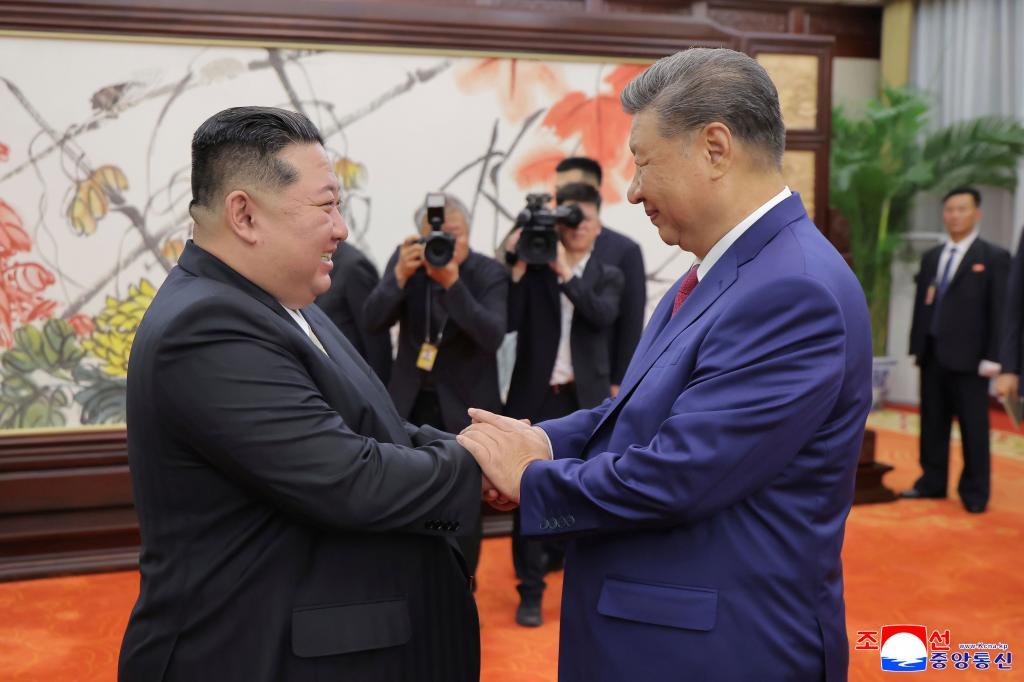
Xi Jinping landed on Monday in Pyongyang for a two-day visit that speaks volumes about how the balance of power in Asia is changing. After hosting U.S. President Donald Trump and Russian Vladimir Putin in Beijing, the Chinese leader has dedicated his first foreign trip of 2026 to North Korea, a gesture aimed at reaffirming China's influence over one of its historical allies at a time when Kim Jong-un has gotten closer to Moscow than ever before.
This is Xi's first visit to North Korea since 2019. After hosting Trump and Putin, positioning himself as an essential interlocutor shaping the international agenda, the president of the second world power has now decided to travel to one of the most isolated countries on the planet to remind that Beijing remains the key player for the economic and political survival of the North Korean regime.
In recent years, North Korea has strengthened its ties with Russia at a pace that few anticipated. Since the beginning of the invasion of Ukraine, Pyongyang has provided projectiles, missiles, and thousands of soldiers to support Putin's war. In return, it has received economic assistance, fuel, and, according to numerous Western and South Korean analysts, valuable military technology.
For Beijing, some voices within the Communist Party expressed satisfaction with the rapprochement between Kim and Putin because it strengthens the bloc of countries opposed to the West. However, other Chinese officials have also acknowledged concerns because, for the first time in decades, China has ceased to be the almost exclusive interlocutor of North Korea.
History explains much of this concern. The People's Republic of China and North Korea are united by a relationship forged in blood during the Korean War. When U.S.-led troops advanced towards the Yalu River in 1950, Mao Zedong sent hundreds of thousands of "people's volunteers" to save Kim Il-sung's regime, the current Kim's grandfather. That intervention cost hundreds of thousands of Chinese lives but consolidated an alliance that has survived all transformations in the international system.
Both countries still share a border of over 1,400 kilometers and a mutual defense treaty signed in 1961, which turns 65 years old this year. It is also the only military pact of its kind that China maintains with another country. For decades, North Korean leaders have perfected a balancing policy between their two major neighbors, China and Russia, using one to obtain concessions from the other. Kim Jong-un continues to apply the same logic. After getting closer to Moscow during the Ukraine war, he now seeks to regain Beijing's economic favor.
"Our relations are at a new historical starting point, facing new development opportunities," Xi declared on Monday to the Rodong Sinmun, the official newspaper of the North Korean regime. "Both countries must strengthen communication and mutual learning to jointly promote the stable development of the socialist cause."
Last year, Beijing and Pyongyang drew closer again when Xi invited Kim to a military parade in the Chinese capital, placing the North Korean dictator prominently beside him and Putin. The Chinese leader then praised both as "good neighbors, good friends, and good comrades united by a common destiny."
Russia provides Pyongyang with weapons, military technology, and diplomatic support. However, it cannot replace China as the economic lifeline of the regime. Over 90% of North Korea's foreign trade depends on its neighbor. Food, fuel, raw materials, and a significant portion of consumer goods entering the country do so through the Chinese border. Last year, Chinese exports to North Korea surged to reach $2.3 billion, the highest level since before the pandemic.
Due to this extreme economic dependence on China, Kim needs to increase cross-border trade, attract Chinese tourists to its new beach resorts and ski resorts, and secure new investments for joint economic projects. He also aims to strengthen his internal legitimacy by showing the population that he still has the support of the world's second-largest economy.
Xi, on the other hand, aims to regain his old influence over an ally he considers strategic. For China, North Korea remains a geopolitical buffer against U.S. troops deployed in South Korea and Japan. A North Korean collapse could trigger a humanitarian crisis on the border and, worse for Beijing, open the door to a unified Korea aligned with Washington.
The nuclear program also looms over the visit. For years, China officially advocated for the denuclearization of the Korean Peninsula. Following the meeting in May between Xi and Trump, Washington stated that both leaders shared the goal of denuclearizing the Korean Peninsula, although the Chinese statement did not mention the issue.
On Sunday, Kim Yo-jong, the leader's sister, declared that her country's nuclear weapons program was "irreversible," describing the U.S. call for denuclearization as an "anachronistic dream." North Korea considers its nuclear power as the key to self-defense, and the leader's sister stated that Pyongyang "will never yield when it comes to defense and sovereignty."
Xi's trip is being closely watched from Seoul. The South Korean government hopes that the Chinese leader will use his influence to convince Kim to resume some form of dialogue with the South. However, expectations are very limited. Since the North Korean leader officially buried any reunification project and defined the South as a "permanent enemy," the possibility of reconciliation seems more distant than ever.