After Xi Jinping hosted Donald Trump in Beijing in May, some U.S. media outlets claimed that the American president had asked the Chinese leader to use his influence over the North Korean dictator Kim Jong-un to restart some form of dialogue on the North Korean nuclear program or, at the very least, to convince Pyongyang to return to the negotiation table with Washington. The White House itself stated that both leaders had "reaffirmed the goal of denuclearizing North Korea."
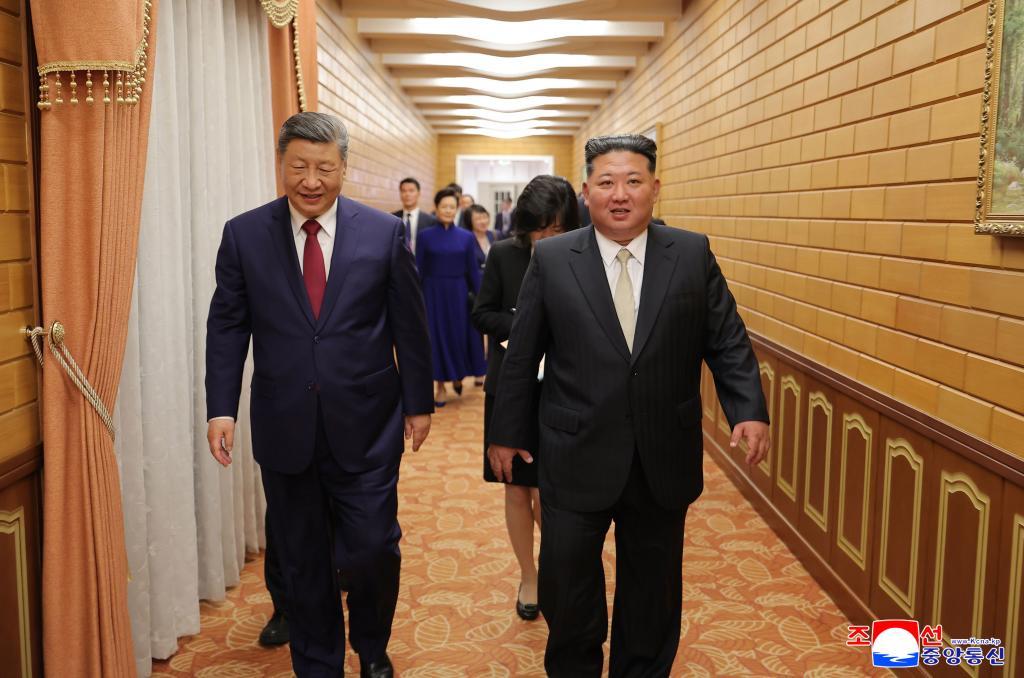
This week, Xi began his first visit to Pyongyang in seven years. After the first day of talks with Kim, there is no indication that the nuclear issue has been a prominent topic on the agenda. In fact, the most delicate matter for regional stability was conspicuously absent from the official statements released by Chinese and North Korean channels.
Far from any reference to denuclearization, the Chinese president focused on strengthening political, economic, and military ties with the North Korean regime during a two-day state visit, marking his first trip abroad in 2026. This detail reflects the strategic importance that Beijing continues to attribute to an uncomfortable yet essential neighbor for its regional interests.
On Monday, Xi was welcomed with all honors by Kim Jong-un and his wife, Ri Sol-ju. During the meeting, the Chinese leader assured Kim that his country is willing to maintain "close strategic communication" and elevate bilateral cooperation to "new heights."
As reported by the official Xinhua news agency, both leaders discussed strengthening diplomatic exchanges, security and defense cooperation, and coordination in the face of regional challenges.
Furthermore, the Chinese leader emphasized that Beijing's commitment to the stability of the bilateral relationship "will not change regardless of how the international situation evolves."
On Tuesday, the official North Korean news agency CNA reported that the two leaders promised to "open a new chapter" in bilateral relations and "expand exchanges and cooperation in political, economic, cultural, and other areas." According to the publication, Kim stated that strengthening ties with China was the country's "most important strategic mission."
The absence of any public reference to the North Korean nuclear arsenal was striking, considering that for decades, China officially advocated for the denuclearization of the Korean Peninsula and even supported the tough sanctions imposed by the UN against Pyongyang in 2016 and 2017. However, this position has diminished as relations between Beijing and Washington deteriorated.
This week's meeting seems to confirm that Beijing has accepted a reality that North Korean spokespersons constantly remind: Kim has no intention of giving up his nuclear arsenal.
On the eve of the meeting, Kim Yo-jong, the powerful sister of the North Korean leader and one of the most influential figures in the regime, made it clear that North Korea's status as a nuclear power constitutes a "point of no return."
Her remarks came just days after her brother Kim visited a new nuclear material production facility, inspected a next-generation destroyer, and ordered a 2.5-fold increase in missile production capacity over the next five years.
According to the latest estimates from the Stockholm International Peace Research Institute (SIPRI), a leading defense and armament research center, North Korea already possesses around 60 nuclear warheads and enough fissile material to produce several dozen more.
If the nuclear program was left out of public discussion, another issue did take center stage: Taiwan, the autonomous island that China considers a separatist province. According to the Chinese statement, Kim expressed his "unwavering" support for the One China principle and endorsed Beijing's position.
Regional analysts have noted in recent hours that this explicit support on the Taiwan issue is noteworthy because North Korea traditionally avoided getting too involved in China's sovereignty disputes. Some opinions even see the declaration as a kind of implicit exchange: Pyongyang supports China's fundamental interests, and in return, Beijing tones down its criticism of North Korea's nuclear development.
Xi's trip to Pyongyang comes at a particularly sensitive time for the balance of power in Asia. North Korea has strengthened its ties with Russia to unprecedented levels. Pyongyang has sent weapons, ammunition, and even troops to support Moscow's war in Ukraine, while Vladimir Putin has responded with economic assistance, military cooperation, and a mutual defense treaty signed in 2024.
This rapprochement has raised some concerns in Beijing. Although Xi maintains a close strategic partnership with Putin, he does not want to lose influence over a country that he considers an essential part of his security perimeter. North Korea remains a geopolitical buffer against U.S. military presence in South Korea and Japan, in addition to sharing a border of over 1,400 kilometers with China.
On Monday, Xi stayed at the Kumsusan State Guesthouse, an exclusive residence in the heart of Pyongyang, near the mausoleum that houses the bodies of previous North Korean supreme leaders.