The US military resumed airstrikes on Iran on Tuesday afternoon (early morning in Tehran) as retaliation for the downing of an Apache helicopter on Monday night over the Strait of Hormuz. This was confirmed by Central Command, responsible for the deployment in the Middle East. "CENTCOM forces began launching self-defense strikes against Iran at 5 p.m. ET today at the Commander in Chief's direction, in response to yesterday's downing of a US Army Apache helicopter," the Pentagon stated on social media.
Air Force and Navy planes targeted Iranian air defenses, ground control stations, and radar sites, according to the Pentagon. Iranian state television immediately reported explosions and anti-aircraft sirens in several points along the coast, including Bandar Abbas, Qeshm, and Sirak, three locations previously hit in recent months. Reports gathered by AP indicated that Sirak and Qeshm had been attacked repeatedly.
Hours later, Kuwaiti air defenses were activated upon detecting aerial attacks. The Revolutionary Guard claimed responsibility for downing a US MQ-9 drone over the Jam area and launching ballistic missiles against the US military base at Al Azraq in Jordan, as well as against the radar base of the US Fifth Fleet in Bahrain, although Washington denied this.
Bahrain and Kuwait fired anti-aircraft defenses in response to the Iranian attack, and Jordan reported downing five missiles launched by Iran against that US airbase.
The attack was no surprise. Donald Trump had forewarned hours earlier, in a brief note on his social media, that retaliation was inevitable after yet another incident in recent weeks. "I have just been informed by our Great Military that last night the Iranians shot down one of our highly sophisticated Apache Helicopters while patrolling over the Strait of Hormuz. There were two pilots involved, both are safe and uninjured. Nevertheless, the United States must, of necessity, respond to this attack" explained the president almost resignedly.
ABC journalist Jonathan Karl, who was on the phone with Trump when CENTCOM announced the attacks, shared the president's real-time reflections: "I think it is very important to respond. They shot down a helicopter, and we are responding as we speak. I think the response should be very strong, very powerful, and that is what this is."
The action, telegraphed to give the ayatollah regime time to prepare, is further evidence of the White House's strong desire to find a way out of the crisis Trump got himself into. "It was not a big deal," said Trump downplaying the action, which was carried out with a Shahed, one of the suicide drones Tehran sold to Moscow and are commonly used against Ukraine. "Our Powerful Armed Forces will leave no attack or threat unanswered," reacted Iranian Foreign Minister Abbas Araghchi.
On paper, there is an almost ready-to-be-announced agreement. Ten days ago, it seemed imminent, inevitable, but the parties have not quite taken the final step. On Monday, Iran and Israel exchanged missile and drone launches in a series of skirmishes that infuriated Trump, who moved heaven and earth to try to calm both sides. However, hours later, the Revolutionary Guard shot down the US helicopter, whose crew had to be rescued by a water drone.
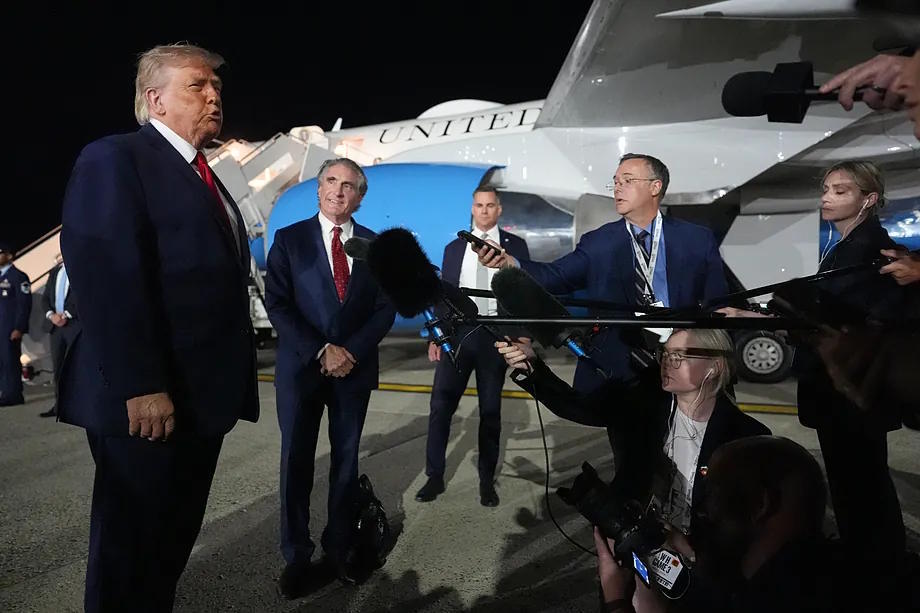
In an exchange with journalists on Tuesday morning, Trump promised that the fragile ceasefire between Iran and Israel would hold despite everything and assured that both parties "would leave each other alone for another week." "We are very close to achieving a very good, solid, and powerful agreement," stated the president. "Their economy is suffering a lot," he added in his usual rhetoric, emphasizing that if the US wanted, it could easily obliterate Iran.
Vice President JD Vance echoed similar sentiments, stating in a recorded interview that he saw an agreement close, but anything was possible. "I think that the deal could happen in the next week, but the deal could also happen months from now" Vance said.