World Cups have never been immune to major controversies. In 1978, it was held in Argentina during the dictatorship. In 1986, Mexico, still with the memory of the massacre at the Plaza de las Tres Culturas during the 1968 Olympics, hosted the tournament after Colombia resigned and following a devastating earthquake that left thousands dead. The one in Italy came when the Tangentopoli scandal, the largest corruption network of democracy, was about to explode, and with the ever-threatening presence of the Mafia. The World Cup in Russia began preceded by a storm of criticism and denunciations due to the worst human rights crisis in the country since the Soviet era, according to Human Rights Watch, and enormous pressure on journalists, activists, and opponents. Long before the ball started rolling in Qatar, The Guardian estimated that at least 6,500 foreign workers, mainly from India, Pakistan, Nepal, Bangladesh, and Sri Lanka, had died during the construction works to finish the tournament's infrastructures on time. Not to mention the discrimination against women or the LGBTQ community, censorship, and the evident effort to whitewash an authoritarian regime in exchange for millions.
Trump, the first US president to attend a final: booed during the anthem and taking a nap in the third quarter
The World Cup in the United States also arrives loaded with many shadows, controversies, denunciations, and fears. The tournament of chaos, especially geopolitical, but not only. Presented by the organizers as an instrument of global unity, but at risk of ending up as an unwanted showcase of the fractures in the international system and the limits of sports as a soft power tool. Previous tournaments, even in problematic locations, took advantage of a relatively stable globalization context and certain optimism. Back then, it seemed like the world was always moving towards greater integration: more trade, more mobility, more cultural exchanges. The World Cup, like the Olympics, fit perfectly into that vision of globalization. That world is yesterday's world.
This tournament coincides with a phase of pure global disorder, with growing rivalry and distrust among major and medium powers, political polarization, doubts about democracy, and questioning of the liberal international order by the country that did the most to shape it after World War II. With three host countries with three different realities and delicate relationships, dependent on the changing mood of the White House.
The event is marked by armed conflicts, diplomatic frictions, and a completely unstable international scenario that conditions the tournament far beyond the strictly sporting aspect. But also, and above all, by the whims of Donald Trump, the Administration's drastic immigration policy, foreign fans' fear of bottlenecks at border controls, visa restrictions, and the possible actions of the feared ICE near the stadiums.
The Third Gulf War, on pause but not over, is the most extreme case, given that the logistical participation of the Iranian team will be a major problem. But the chaos that has driven up gasoline prices and travel does not stop in Tehran. The conflict directly involves at least four participants: the US, Iran, Saudi Arabia, and Qatar, after several teams were already excluded for non-sporting reasons. Russia due to the war in Ukraine, Pakistan and Congo due to administrative sanctions, and Eritrea, which withdrew from the qualifiers for fear that its players would seek asylum in away games.
In the last 18 months, Trump has bombed seven countries, launched the largest military deployment in the Middle East since the invasion of Iraq, and the largest naval operation in the Caribbean since the capture of Grenada. He has killed dozens of people, many unidentified or simple fishermen, in boat attacks in the Caribbean accusing them of drug trafficking. Taking advantage of the operation, he captured Nicolás Maduro in Caracas and forced a regime change.
Now he threatens Cuba, suffocated without access to fuel; he has targeted leaders like Gustavo Petro in Colombia or Lula in Brazil, supporting their opposition and approving sanctions. He rescued his ally Javier Milei saying there would be money for Argentina, but only if his friends won the elections. And he has the CIA operating in Mexico against the cartels. Furthermore, he continues to attack Europe and NATO or brandishes the possibility of annexing Canada. Not to mention a possible forceful takeover of the Panama Canal or Greenland. "It's from Denmark... for now," said Secretary of State Marco Rubio.
Washington's hostility towards its allies and neighbors is the differential fact of this mandate and the umbrella to understand an event with many doubts and less enthusiasm than previous ones. Tourists are welcome but also scrutinized. Four countries whose teams have qualified for the World Cup are subject to Trump's travel bans: Haiti and Iran completely, and Ivory Coast and Senegal partially. Fans from these countries will not be able to attend matches in the US unless they are residents or have dual nationality with other countries not on the blacklist.
The main labor unions, representing thousands of hospitality and stadium service workers where the Los Angeles matches will be held, have launched the No ICE in the Cup campaign, threatening to strike if they do not receive guarantees that there will be no immigration operations during the tournament. In Dallas, the civil rights group El Movimiento DFW has distributed thousands of defense kits with information on how to obtain free legal advice in case of raids. More than 120 civil society organizations have simultaneously issued a coordinated warning to the five million potential tourists and fans, warning of "serious rights violations" and the likely "arbitrary denial of entry and the risk of arrest, detention, and/or deportation."
The Government wants a successful event and has significantly reduced rhetoric and measures in recent months, but since January 2025, it has normalized arbitrary detentions and pressures on travelers. Starting with the strictest enforcement of the rule that allows any official to demand that visitors provide full access to their mobile phones. Foreigners can refuse the request, but then they are deported after hours of confinement.
But there is much more beyond the geopolitical and migratory aspects. For example, doubts about attendance at stadiums due to high ticket prices. Complaints about what is denounced as an organization maneuver to inflate its cost have multiplied as thousands of cheaper options gradually appear. The same goes for hotels, after FIFA blocked hundreds of thousands of rooms and is only now releasing them.
The US government has allocated nearly $900 million to the nine host states to strengthen cybersecurity, emergency devices, security, and protection against drones in the 11 host cities. Intelligence reports from US officials and FIFA, obtained by Reuters in March, warned that "the potential for extremist attacks on games, fan events, or transportation infrastructure, as well as civil unrest, had increased due to tensions from Trump's immigration policy and the war in Iran." Not to mention the cartels in Mexico.
Soccer's popularity has increased in the United States since 1994 but still lags far behind other major sports in terms of money, audience, and coverage. The World Cup is an important but secondary event that is receiving discreet attention beyond the Latino universe.
A recent Pew Research survey indicated that 66% of Americans said they probably would not follow the World Cup, while 28% said they were likely to do so. Data from YouGov shows something similar: 54% of Americans are not interested in the World Cup at all, and 59% said they did not plan to watch any matches.
The two most recent precedents are the Copa America, held here two summers ago, and the 2025 Club World Cup. The latter worked well, but no one has forgotten the serious incidents of the final between Argentina and Colombia at the Hard Rock Stadium in Miami in July 2024 when thousands of fans tried to enter the stadium without tickets or with fake tickets, delaying the start of the match by over an hour. After the incidents, which did make the news, there were internal investigations and security protocol reviews, but doubts about the ability to organize the World Cup have not disappeared.
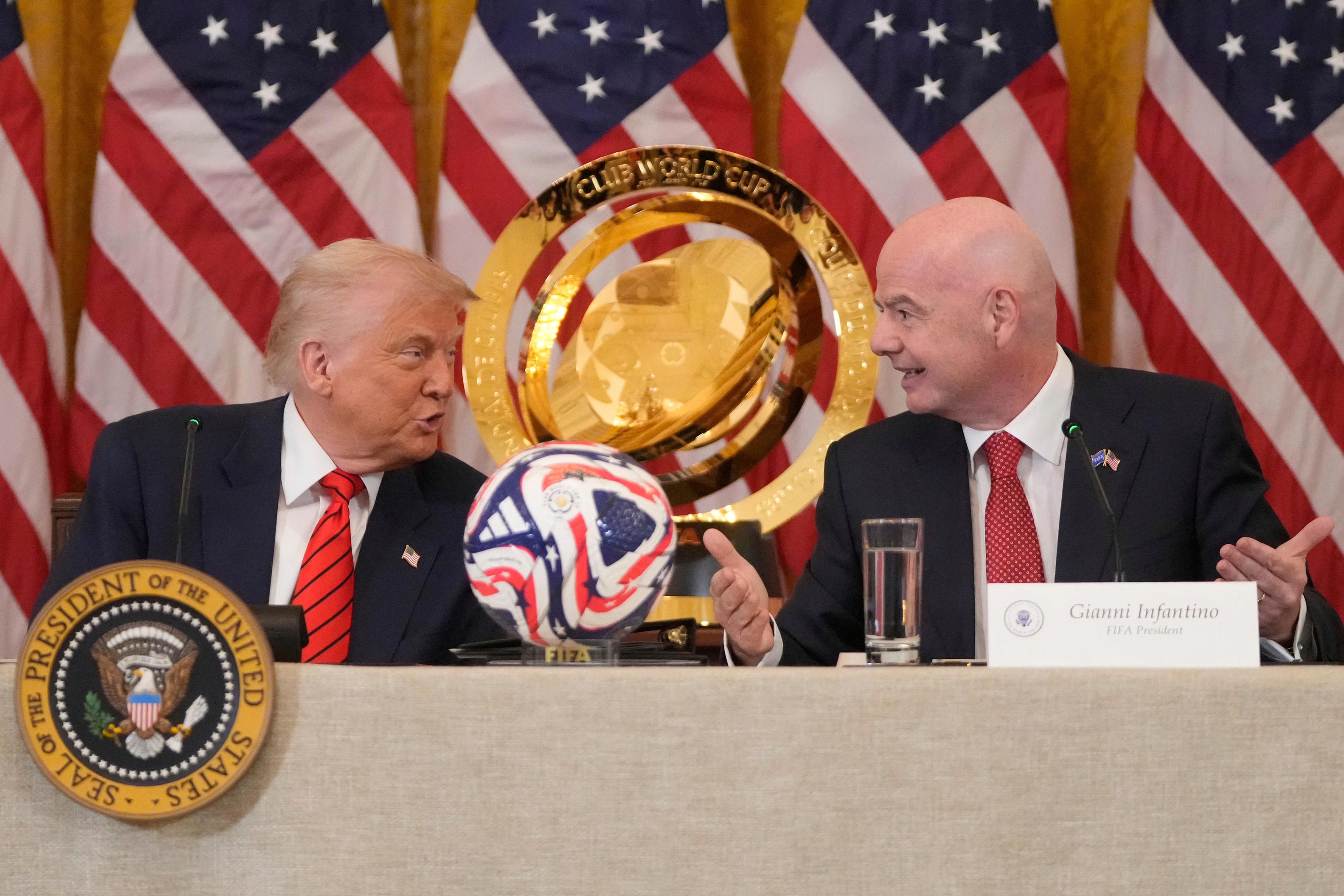
The last time Trump truly dedicated time to it was on December 5th. He has met numerous times with Gianni Infantino, recently answered questions about ticket prices, but almost in passing. In December, however, he was fully engaged. That day, FIFA organized the draw to establish the groups, and it took place at the Kennedy Center in Washington. Or rather, at the Trump-Kennedy Center, which in the last year has become one more of the US president's attempts to colonize institutions. That day, football was not the protagonist. Trump, as always, stole the spotlight, and his friend Infantino seemed delighted with it. The president overshadowed the leaders of Canada and Mexico, Mark Carney and Claudia Sheinbaum, respectively. Now, all eyes are back on the White House. The Tournament of Chaos. Trump's World Cup.