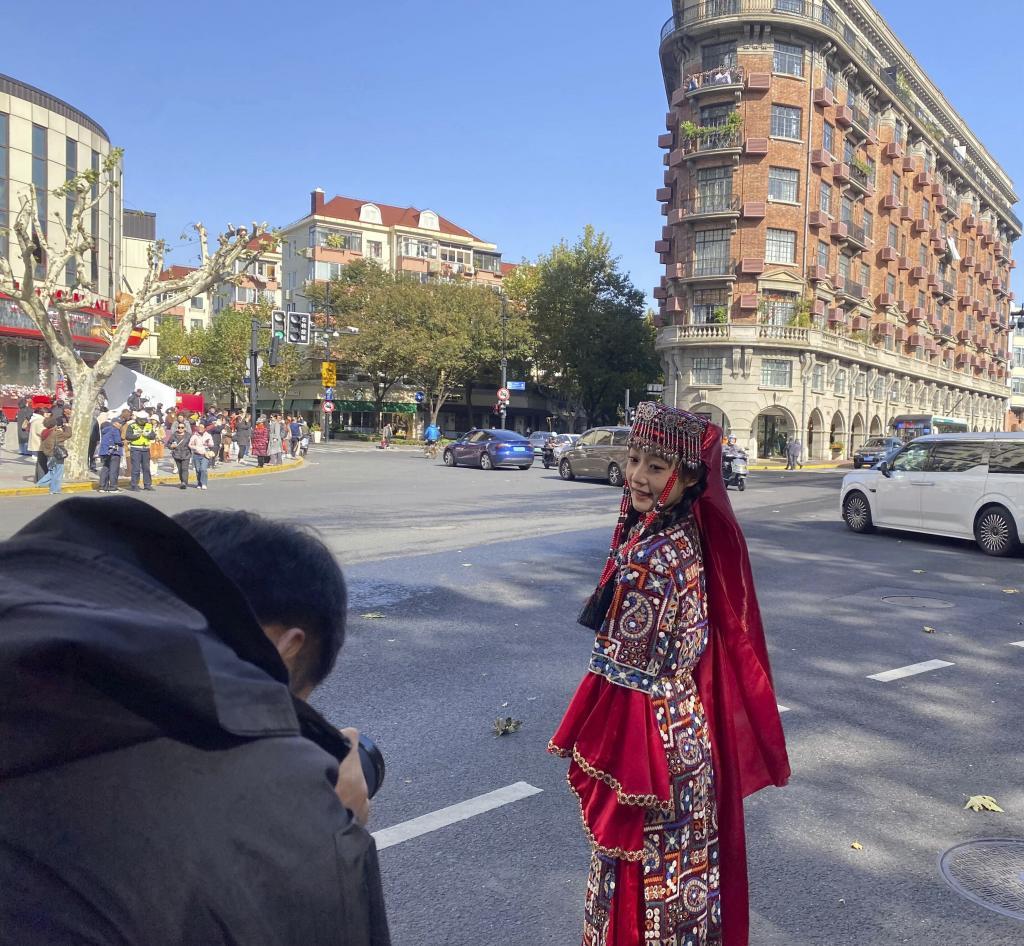
At the corner where six streets of the former French Concession converge, the silhouette of Wukang Mansion emerges like the bow of a ship that ran aground in the middle of Shanghai. Daily, from early morning, thousands of Chinese tourists appear around the corners to take pictures in front of the brick facade. Many influencers also show up with their phones placed on small tripods.
All visitors seek the best angle of a building with curved balconies and large windows that has become a vintage icon of the financial capital. But what the vast majority do not know is that behind this elegant postcard of modern Shanghai, there is a very dark history hidden.
A couple of lovers in front of Wukang Mansion.L. DE LA CAL
Some elderly neighbors of the former French Concession still remember when Wukang Mansion had another nickname: "the springboard". But it is not easy to find someone willing to talk about it. "There were several suicides. People who jumped from the balconies," says Mr. Zhang, a retiree who has been living in a nearby housing complex for over 70 years. Another veteran resident, surnamed Hui, adds more context: "Many famous actors, writers, and artists lived there. But during the Cultural Revolution, many were persecuted and lost everything. Some could not bear it."
The building was erected in 1924 by the Hungarian-Slovak architect László Hudec, the great designer of cosmopolitan Shanghai between the wars. Inspired by the French battleship Normandie, Hudec took advantage of the triangular shape of the plot to create a sharp construction, as if the building were making its way through the avenues.
At that time, Shanghai was a colonial anomaly where British bankers, Chinese mobsters, French diplomats, Russian refugees, and Jewish magnates coexisted. Wukang Mansion - then known as Normandie Apartments - was designed for wealthy expatriates: apartments with heating, two elevators, private bathrooms, and balconies, at a time when most Chinese still lived in communal houses without running water.
After the civil war and the communist victory in 1949, the building changed hands and names. Several local movie stars moved there, attracted by the prestige of the building and the cultural aura that the former French Concession still retained. That glamour lasted until 1966, when Mao Zedong launched the Cultural Revolution and Shanghai ceased to be the sophisticated city that had fascinated foreigners and writers, to become one of the epicenters of revolutionary fury.
The walls of Wukang, now restored and turned into a real estate desire, witnessed purges and suicides. The authorities dubbed the building the "Anti-Revisionist Tower" due to its Western connections and because it housed artists, intellectuals, and professionals suspected of sympathizing with bourgeois values.
Mao's Red Guards burst into apartments to publicly humiliate actors, writers, and musicians. "After the first deaths, there was a time when people thought the building was haunted," says an elderly neighbor in the neighborhood. "People told stories about ghosts, about the spirits that had remained trapped there."
Tourists take photos in front of Wukang Mansion.Lucas de la Cal
Some writings from the last century, now censored in Chinese bookstores, recounted the story of Shangguan Yunzhu, a popular actress who jumped from the balcony of her seventh-floor apartment on November 23, 1968. Researchers claimed that this woman had caught Mao's attention, who visited her quite frequently in Shanghai. The rumor of the romance circulated for years among the Communist Party elites.
The publications, based on testimonies collected later, suggested that Jiang Qing, Mao's last wife (a second-rate actress who became a guardian of Maoist orthodoxy, leading many of the most ferocious revolutionary campaigns), sent the Red Guards to Shangguan's home to interrogate and psychologically torture her. They wanted her to confess to having a secret relationship with Mao. She could not withstand the pressure.
This May marks 60 years since the beginning of the Cultural Revolution, when Mao, weakened after the disaster of the Great Leap Forward and the famine that caused millions of deaths, decided to regain absolute control of the Party. He presented the campaign as an ideological offensive against "capitalist" elements infiltrated in the system. In reality, it was also a gigantic political purge. He mobilized millions of students to attack the so-called "Four Olds": old ideas, old culture, old customs, and old habits.
The cult of personality reached almost religious levels. The Little Red Book (quotes and speeches of the communist leader) became a kind of mandatory bible. Schools and universities closed. Free trains transported Red Guards from one city to another to spread the revolution. In the summer of 1966, Beijing fell into a spiral of violence: teachers killed by their students, houses looted, temples destroyed, books burned...
Shanghai did not escape the chaos either, with different Maoist factions ending up clashing over their different views on the "purity" of the system.
Violence spread throughout the country. In the Guangxi region, public executions were documented. In Inner Mongolia, thousands of people were tortured under false accusations of separatism. Historians estimate that between half a million and two million people died during that decade.
Not even the families of the Communist elite escaped. Xi Zhongxun, a veteran revolutionary and father of the current Chinese president, was purged and publicly humiliated. His son, Xi Jinping, was only 13 years old when the Maoist campaigns began. Like millions of urban youth, the current leader would end up being sent to the countryside for "reeducation."
Today, next to the main entrance of Wukang Mansion, a small shop sells artisanal ice creams and postcards of the building. A few meters away, couples pose for wedding photo sessions. In one corner, there is a Starbucks, and in another, a luxury French restaurant.
The memory of what happened remains buried under layers of prosperity and consumption. The darkness of the Cultural Revolution, unlike other episodes like the Tiananmen Square massacre, has not been covered in the revised history books circulating in schools. The Communist Party came to define the Maoist campaign as a "serious mistake", although it never allowed a deep public examination of that decade, and any academic research on the subject is strictly supervised. Lest the historical legitimacy of the system and, above all, the figure of Mao, who still presides over the entrance of the Forbidden City from his huge portrait in China's political heart, be questioned.