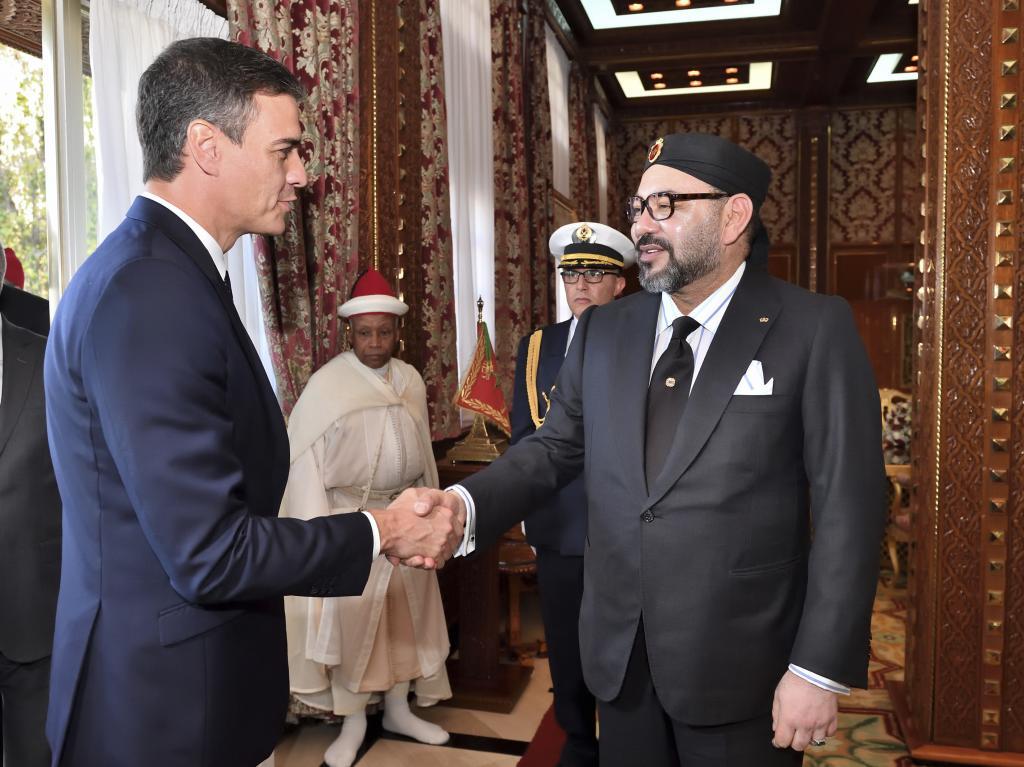
"The king of great diplomatic maneuvers." This is how Le Monde defined Mohammed VI in a deep analysis last August, where the French newspaper detailed the almost silent but very astute international activism of the Alaouite sovereign, centered around the two fundamental issues for the throne in recent years: the Moroccan identity of Western Sahara as an irrevocable principle and the normalization of relations with Israel. From the latter, of course, Rabat has derived such transcendental advantages as consolidating itself as the darling of the Trump Administration in the Maghreb, with unlimited and clearer support than ever for the annexation of the former Spanish colony.
Despite the internal weaknesses of the authoritarian Moroccan regime -the last major social outburst occurred in the fall with the youth revolt demanding improvements in health and education, and future opportunities, while many see with indignation how a good part of the most recent investments are directed towards pharaonic mega-projects like the football stadiums for the 2030 World Cup-, Mohammed VI has managed to transform diplomacy into a true instrument of power that has so far succeeded in keeping the Monarchy out of any questioning of the system's failures, which are becoming increasingly evident.
The authorities of the Kingdom have seen in the Sahara claim not only an old flag, waved uninterruptedly since the Green March of 1975. It is also the issue that most effectively galvanizes Moroccan nationalism, instilling in the citizens the best deception to keep ranks tight beyond the economic, social, high unemployment, and rampant corruption in the Administration that afflicts the Maghreb nation. In the diplomatic battle, in November, Trump handed Western Sahara to Mohammed VI on a silver platter, with a UN Security Council resolution that de facto legitimized Rabat's control over the immense and resource-rich territory in the process of decolonization, according to the United Nations itself. Therefore, it is not surprising that the Moroccan regime is also stepping on the accelerator in the military battle, as evidenced by its latest strike against the Polisario with drone attacks, which is a clear warning to all in the new reconfiguration of the geopolitical chessboard and a display of impunity from someone who feels so strengthened by the undisguised support of Washington and Tel Aviv, while Rabat has quickly seen how Spain, France, and several African powers succumbed to its territorial demands.
It is worth noting that attacks in Western Sahara have been occurring too frequently since 2020 -although the death of leader Lahbib Mohamed Abdelaziz, son of the founder of the Sahrawi independence organization, is more than a qualitative leap-. We are facing a latent and entrenched conflict, in which the clashes between the two contending parties intensified after the end of the ceasefire by the Polisario, especially in the vast desert areas located east of the so-called Moroccan defense wall, the fortified barrier of over 2,700 kilometers that divides the space of the former Spanish colony. Rabat's surveillance capacity and effectiveness in attacks have multiplied with the armament support and tools such as drones from the US and Israel.
Morocco became the fourth Muslim country to normalize relations with Tel Aviv on December 20, 2020, following the United Arab Emirates, Bahrain, and Sudan, within the framework of the Abraham Accords promoted by the White House. The Israeli military offensive in Gaza, following the brutal attacks by Hamas and Islamic Jihad on October 7, soon became a source of tension in Moroccan streets, with a population generally not inclined towards rapprochement with the Jewish state. However, Mohammed VI has managed to hold his ground all this time. Except for some large demonstrations in Rabat and other major cities, the regime has resorted to strong repression, as denounced by NGOs on the ground, to prevent mobilizations in support of Gazans and Palestine. The Alaouite Monarchy, despite Mohammed VI presiding over the Al-Quds Committee (Jerusalem), an organ created by the Organization of Islamic Cooperation to protect the holy city, has completely set aside the Palestinian cause in exchange for the valuable contribution that Tel Aviv and Washington are making to impose the Moroccan identity of Western Sahara.
And, in parallel, the entire rearrangement of the Muslim world puzzle following the multi-sided war in the Middle East, with the offensive against Iran in particular, is being well exploited by Mohammed VI to advance his interests in the diplomatic alliances that are now charting new influence strategies. One of the most fruitful tactical moves for Rabat is the strengthening of its pact with such relevant actors in the ongoing conflict as the United Arab Emirates. The Alaouite monarch presents himself as a mediator between Abu Dhabi and Riyadh, thanks to his excellent relations also with Saudi Arabia, another of his old strategic allies. And for Mohammed VI, the current struggle between the two Sunni powers of the Gulf -their interests are irreconcilable in Yemen or in the war in Sudan, but they also diverge due to the offensive against Iran in significant economic matters, with the UAE's exit from OPEC- is a great opportunity to position Rabat as a "balancing power," as various analysts have dubbed it, suddenly gaining significant weight in Muslim world diplomacy. The visit last week by the President of the UAE, Sheikh Mohammed bin Zayed Al Nahyan, to meet Mohammed VI emphasized the rise of this prominence of a Morocco that, we insist, focuses all its efforts on not letting go of the coveted prize of Western Sahara.
In this sense, almost silently, Rabat is gathering extraordinary African allies in its territorial claim through active diplomacy that also includes financial incentives. In April, the Polisario received another blow with Mali's decision to sever ties with the self-proclaimed Sahrawi Arab Democratic Republic, 40 years after its recognition. Bamako followed the steps of other Sahel nations and the rest of the continent, such as Zambia and Ghana, who already applaud the autonomy plan for the Sahara defended by Morocco. Rabat offers Sahel countries that support it access to the Atlantic Ocean and with the substantial benefits of the mega-contracts exploited in the area, it is eroding the resistance of the most stubborn.
The jihadist advance in North Africa is also a weighty argument that crowns Rabat in its role as a gendarme both towards its neighbors and fearful Europe. Today, Mohammed VI is already known, for all these reasons, as the king of Western Sahara.