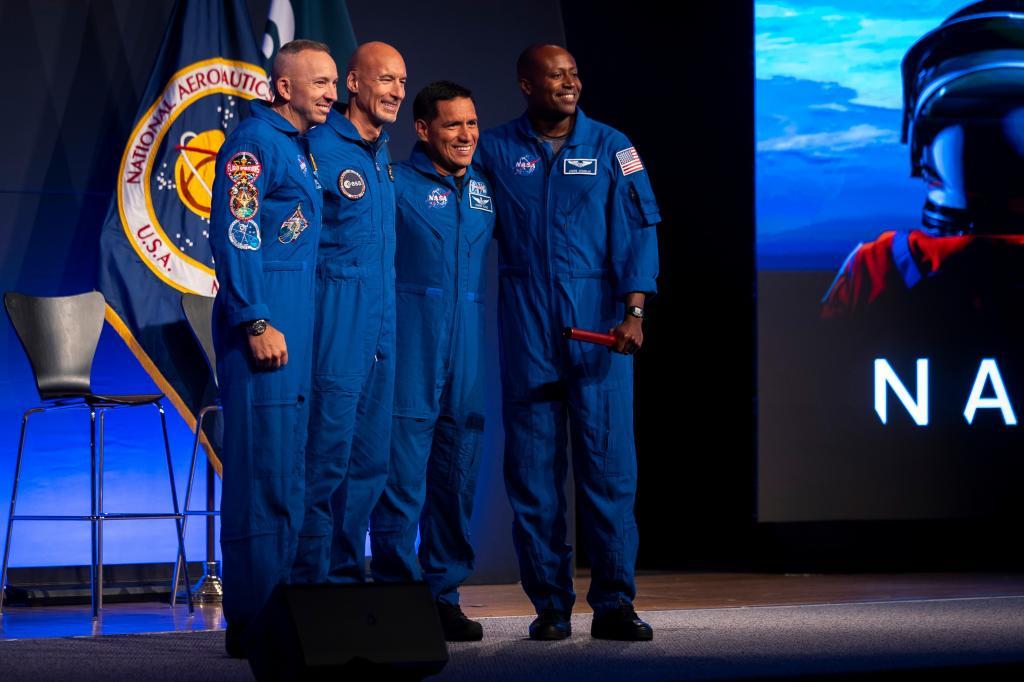
NASA has finally revealed the names of the four astronauts chosen for the upcoming lunar program mission, Artemis 3, scheduled for 2027. For the first time, there will be a European Space Agency (ESA) astronaut: the Italian Luca Parmitano. This experienced 49-year-old astronaut, who has spent 366 days on the International Space Station (ISS), will be the pilot of this two-week mission, as detailed by Jeremy Parsons, one of NASA's officials, during the presentation.
The other selected astronauts are American astronauts Randy Bresnik, who will serve as commander, and mission specialists Andre Douglas and Frank Rubio. Test pilot Bob Heintz has been designated as the backup astronaut. All of them have a military background.
Randy Bresnik (58 years old) has been an astronaut since 2004 and has spent 149 days in space. Artemis 3 will be his third mission. Frank Rubio (51 years old) is not only an astronaut and pilot but also a flight surgeon who spent 371 days in space on a single mission, while for Andre Douglas (40 years old), it will be his first space journey.
If the ambitious schedule is met, these four men will have just over a year to train for this complex mission, which, like Artemis 2, will prepare for the future moon landing of astronauts, scheduled for Artemis 4 in 2028.
They will succeed Americans Reid Wiseman, Christina Koch, Victor Glover, and Canadian Jeremy Hansen, the astronauts who made history last April by becoming the humans who have traveled farthest from Earth. During their orbit around the Moon, they took thousands of images and saw areas that had never been seen by any human before. Artemis 2 was the first lunar mission since the return of Apollo astronauts in 1972.
The crew of Artemis 3 will also travel in the Orion spacecraft, developed jointly by NASA and ESA, with the European Service Module, one of the two parts of this spacecraft. While Artemis 2 lasted 10 days and orbited the Moon, Artemis 3 will orbit Earth for two weeks aboard the Orion spacecraft and practice docking with one or both of the two lunar modules in development: SpaceX's Starship HLS (Elon Musk's company) and Blue Origin's Blue Moon (Jeff Bezos' company).
"These four astronauts will continue testing the Orion spacecraft and practice docking with Blue Origin and SpaceX lunar modules... and preparations are underway," stated NASA Director Jared Isaacman during the presentation.
However, the explosion that occurred on May 28th at Blue Origin's New Glenn, the super rocket, during a routine engine test in Cape Canaveral, partially destroyed the company's only launch platform.
The 98-meter-tall New Glenn rocket will be used to launch one of the lunar modules for Artemis 3, as well as the first robotic mission of the lunar base that NASA aims to start building this fall. Although Blue Origin claims that the fire caused less damage than initially estimated, the accident complicates the schedule, as it will require rebuilding damaged infrastructure and equipment in record time.
According to the company, the damaged tower can be repaired, and the explosion did not affect the fuel tanks, water tank, a booster, and other rocket parts. When similar explosions have destroyed launch platforms, reconstruction has taken at least a year - SpaceX took 15 months to repair a Florida platform after the Falcon 9 rocket explosion in 2016. However, Blue Origin believes they can rebuild it in a few months.
On the other hand, the investigation to determine the causes of the rocket explosion is still ongoing. John Coulouris, Blue Origin's vice president, reiterated during his speech at the event on Tuesday the plans to rebuild the damaged platform. "We will redouble our efforts [to be part of the lunar program]," stated this executive, ensuring that their lunar module will be ready by 2027.
NASA, on its part, has made it clear that it continues to rely on Bezos' company, as highlighted by Jeremy Parsons, one of the officials of the lunar program at the agency: "We trust that New Glenn will be ready for Artemis 3."
Meanwhile, Jessica Jensen, SpaceX's vice president, announced that their company is constructing three more launch platforms for Starship in Florida and Texas.
Until a few months ago, NASA planned for SpaceX's lunar landing module to transport astronauts to the Moon, but due to delays in its development, they opened the possibility of also using Blue Origin's module, which had won contracts for more advanced Artemis missions.
Parmitano, an Experienced Pilot
Among the recent changes made to the Artemis program was the cancellation of the lunar Gateway orbital station, where ESA had a significant role. The missions assigned to three European astronauts last November to go to Gateway were uncertain, but NASA has now included a European in Artemis sooner than expected. The presence of ESA's director, Josef Aschbacher, and representatives from the Italian space agency already hinted that an Italian astronaut would be among the crew of Artemis 3.
Luca Parmitano, 49 years old, has completed two long-duration missions, named Volare and Beyond, of 166 and 200 days, respectively. He has conducted six spacewalks totaling over 30 hours and served as ISS commander.
Since his return to Earth, he has worked as an ESA liaison at NASA's Johnson Space Center in Houston, acting as a CapCom and training ESA astronauts for spacewalks and robotic operations. Last year, Luca participated in NASA's 12th Open Ocean Recovery Test off the coast of California to simulate the splashdown and recovery of Artemis astronauts from a full-scale model of the Orion spacecraft, which will be their home during the two weeks of Artemis 3.
Born in Paternò in 1976, although he has always considered himself from Catania. As he has mentioned on several occasions, he grew up dreaming of becoming an Olympic athlete or an astronaut. Although he never lost sight of his dreams, he preferred to focus on more realistic goals, such as becoming a pilot. "As a test pilot, this is truly a dream mission, as we will be able to help test systems and develop procedures so that future crews can go further and, ultimately, lead humanity back to the Moon," stated Luca Parmitano, who studied Political Science at the University of Naples Federico II and later trained in spaceflight engineering at the Institut Supérieur de l'Aéronautique et de l'Espace in Toulouse.
For Josef Aschbacher, the head of the European agency, the choice of Parmitano as a pilot "reflects Europe's extensive experience in manned space flights and is based on his broad operational training in high-pressure situations." In fact, the Italian astronaut experienced one of the most serious situations on the ISS on July 16, 2013: he was close to drowning during a spacewalk when his spacesuit began to fill with water due to a technical failure. Fortunately, the incident ended without harm.