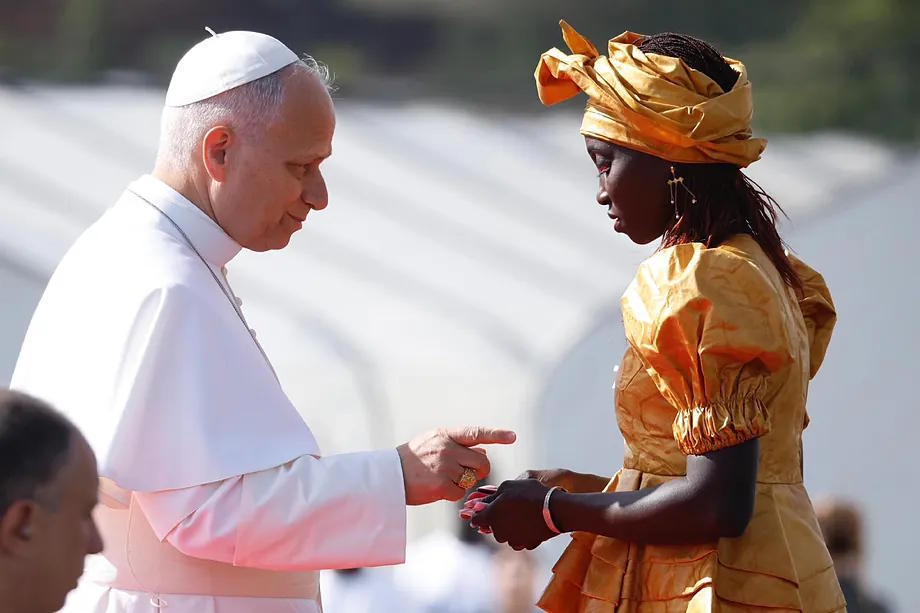
"In some way, we are all migrants, we are all pilgrims on the way to the heavenly homeland. Let us help make this journey a more humane place for everyone, contributing what each one can." Pope Leo XIV once again showed his closeness to migrants at the Emergency Reception and Referral Center of Las Raíces, his first stop on the visit to the island of Tenerife, marking the end of his seven-day stay in our country.
"Seeing their faces, hearing their testimonies, I also think of their hearts, wounded by so many difficulties and also comforted by the love received thanks to other open, generous, and merciful hearts," emphasized the Supreme Pontiff.
Robert Francis Prevost was moved by Bousso's speech, a Senegalese woman who fled her country "due to war, violence, and persecution." "Thank you for being here, in this land that for us has meant the first place of hope after a path of suffering," said Bousso, who recounted the fear she experienced on her journey on a makeshift boat "surrounded by cold and death." "Pray for those who lost their lives at sea," she emphasized before greeting him alongside her daughter Adama. Taiwo, from Nigeria, also expressed gratitude to the Pontiff despite being nervous: "May God bless you always!".
The Pope highlighted the name of the complex. He did so by mentioning his predecessor again, whose legacy he did not hesitate to make his own by prioritizing a visit to Spain and particularly to the Canary Islands. "I was struck by the name of this Reception Center, which is called 'Las Raíces' (The Roots). My Predecessor, the beloved Pope Francis, who longed to be with you, liked to use the image of roots to indicate the need to not forget one's origins, to remain united, and to trust in the Lord. 'For the one who trusts in the Lord is like a tree planted by the water, that extends its roots by the stream. It does not fear when the heat comes, and its leaves are always green'."
In 2023, the archipelago closed the year with the arrival of 39,910 immigrants in 610 boats. The reactivation of the Canarian route, considered the most dangerous in the world, led to a 154% increase in arrivals by sea compared to 2022, surpassing the number reached during the so-called cayuco crisis of 2006. In 2024, the figure rose even further, reaching a historical record of 46,843 people arriving irregularly by sea. So far in 2026, 233 boats with nearly 3,000 migrants on board have arrived on the islands.
The Emergency Reception and Referral Center of Las Raíces opened in 2011 as an emergency solution due to the arrival of makeshift boats. It was built on the site of a former military camp next to Los Rodeos Airport and became a symbol of the Canarian immigration route, the deadliest on the planet. It currently houses 753 people, mostly Muslims, but over 70,000 migrants have passed through its vicinity. Located at 1,000 meters above sea level and surrounded by eucalyptus trees, it was known in the military for the damp cold experienced inside for years.
Its opening was controversial. In April 2021, a fight between Moroccans and sub-Saharan Africans left a trail of blood on the stairs leading to the infirmary, resulting in ten injured, three of whom were hospitalized. The National Police had to enter the compound, and the altercation ended with eight residents being detained. Many Moroccans left the center and camped around the military base for weeks. Two years ago, the center underwent a complete renovation. Migrants no longer sleep in flimsy tents that suffered from the contrast between the trapped heat inside and the external humidity. The tent roofs no longer 'weep'. Nevertheless, the complex still has 10,000 blankets for the coldest nights.
On the runway of Los Rodeos Airport, on his second day of the visit to the Canary Islands, the Pope was welcomed by the regional president, Fernando Clavijo, the Minister of Social Inclusion and Migration, Elma Saiz; the Spanish Ambassador to the Holy See, Isabel Celaá, and the President of the Canary Islands Parliament, Astrid Pérez. Also present were the President of the Tenerife Island Council, Rosa Dávila, and the Mayor of La Laguna, Luis Yeray Gutiérrez.
About a hundred migrants waited for nearly an hour and a half for the Pope's arrival in the area set up for the event. Aliou and Seikou, 18 and 19 years old, managed to sit in the front row. They arrived a month ago from Gambia and were eager for the arrival of Leo XIV, although they admitted that "a few days ago we didn't know who he was." They protected themselves from the cold with two hats. Aliou put his hands in his pockets, and Seikou wore green pruning gloves. Many migrants wore flip-flops. These are part of the kit that the NGO Accem provides upon their arrival at Las Raíces. After some time, some manage to get sneakers. "You can tell how long they've been on the island by the footwear they have," explained a former complex worker.
The wait seemed long for some. Mamadou sat in the back row and used the time to listen to music on his phone. Ousmane used it as a mirror to tidy up. He also took numerous photos of the stage and the journalists. Both arrived from Senegal and were amazed by the presence of so many media outlets. "We didn't expect something this big."
Samba practiced chanting "Pope, Pope!" numerous times. He arrived in El Hierro a month ago from Gambia. He has no family or acquaintances in Europe but wants to stay "as a footballer." "I play very well, as a midfielder, which is what my team, Real Madrid, lacks," he emphasized.
The Pope concluded his speech by mentioning the two Canarian saints, who "were also migrants": Saint Brother Peter, from his sanctuary in Vilaflor, a missionary and apostle of charity in Guatemala, and St. Joseph of Anchieta, from La Laguna, a missionary, apostle of Brazil, and the first saint canonized by Pope Francis.
Afterwards, he greeted the migrants present, where he spent time with little Amina, four years old, who had already caught everyone's attention before his arrival by leaving the cordoned-off area. She arrived in Tenerife as a baby, from Mali. "Thank you, Papa, heart," her mother, Fatma, 32 years old, had taught her to say. And that's what she said to a smiling Leo XIV.