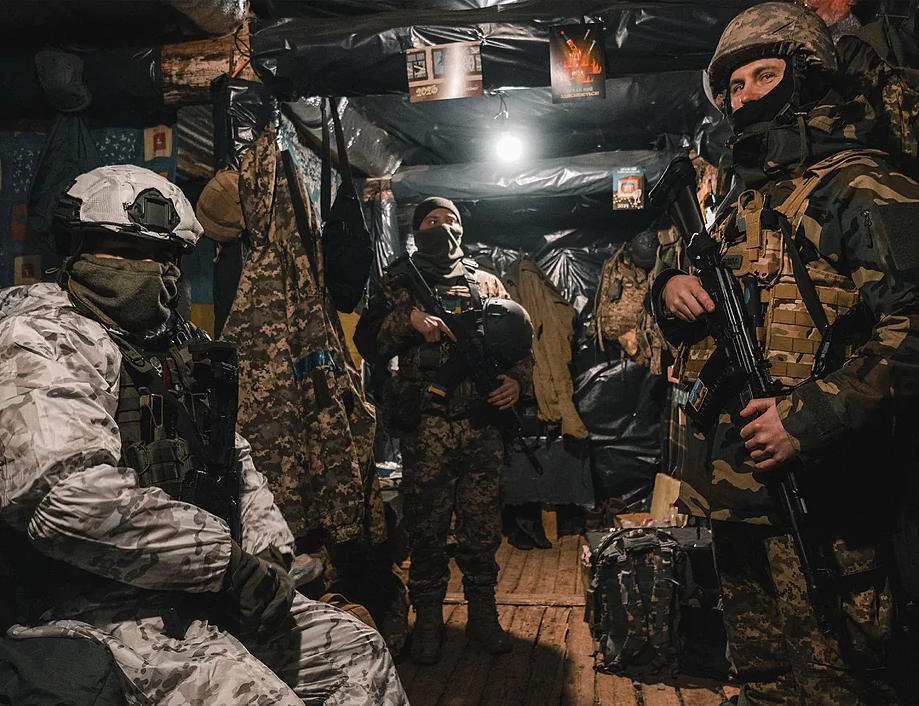
The past suddenly meets the future. This same week, the Russian invasion of Ukraine has exceeded the duration of World War I, with 1566 days of carnage. Although we are talking about conflicts of very different sizes, both share a similar development: all major advances occurred in the first months of combat, before technological evolutions revolutionized the battlefield and turned the front lines into a bloody war of positions with no progress, but with many casualties.
In the years leading up to the summer of 1914, European royal houses had married their children to each other with the absurd belief that these alliances would prevent wars. King George V of England, Kaiser Wilhelm, and Tsar Nicholas II of Russia were cousins and grandchildren of Queen Victoria. World War I meant, in many ways, the end of the "world of yesterday," as writer Stefan Zweig called it, and the beginning of the "age of catastrophes," as British historian Eric Hobsbawm termed it, a chain of events that changed the planet forever.
All wars before 1914 had been wars of movement. Napoleon won battles by moving faster than the enemy. In 1914, European general staffs planned for short, maneuverable wars. What no one calculated was the combined effect of technologies that made attacking almost suicidal.
Of the four technologies that paralyzed Europe, the most decisive was the Maxim machine gun, which fired 600 projectiles per minute and could be operated by two men. A single machine gun nest could halt the advance of thousands of soldiers. On the first day of the Somme, July 1, 1916, the British army suffered 57,000 casualties in a few hours, most in the first minutes of advancing across no man's land towards the German lines. It was literally impossible to cross no man's land under machine gun fire. Today, Maxim machine guns can still be seen in Ukrainian hands to shoot down Russian drones near Kiev. The $500 FPV drone in Ukraine has done what the Maxim machine gun did in 1914: made moving more dangerous than staying still.
Barbed wire, an invention of American livestock farming in the 1870s, turned out to be the cheapest and most effective obstacle in military history. It stopped soldiers long enough for machine guns to mow them down. And it was almost impossible to cut under fire.
Long-range artillery allowed the destruction of troop concentrations kilometers away. But paradoxically, artillery bombardments preceding assaults did not destroy enemy positions but warned the enemy of the imminent attack and destroyed the terrain, turning the battlefield into an impassable cratered maze.
The telegraph and the railroad, which seemed like offensive advantages, turned out to be defensive weapons. The defender could move reserve troops by rail much faster than the attacker could advance on foot. Every time a breach opened in the front lines, the enemy closed the gap before it could be exploited.
Ukraine began timidly using observation drones during the first weeks of the invasion, but revolutionized warfare out of sheer necessity. In 2024, as European artillery arsenals were depleted and Russia turned to North Korea to buy hundreds of thousands of new projectiles, Ukrainian soldiers had to settle for the cheap but lethal FPV drones to replace their cannons. That step marked the greatest revolution in defensive warfare since the construction of thousands of kilometers of trenches in Verdun, Gallipoli, or the Somme.
Beyond the serious planning mistakes of the invasion of Ukraine by Vladimir Putin and his generals, Russia faces a serious technological problem in advancing. With thousands of drones monitoring the front lines and thousands more waiting to hunt down any soldier trying to move with a kamikaze flight, a strip of land has formed between both armies known as the "kill zone," where the only way to advance is by moving alone and assuming enormous risks to life. Most are detected and eliminated within seconds. They may try to hide under trees, but new thermal cameras detect body heat. Very few succeed, occupying a hidden position and waiting for others to do so. Thus, we have soldiers from both armies surviving like moles in a hole from which they cannot stick their heads out.
In a way, the kill zone is the same as what prevented the Western Front from moving almost at all for three and a half years, from late 1914 to early 1918, but in the Great War, it was dubbed "no man's land," that is, the strip of hundreds of meters between the trenches of both sides. In that inert space, hundreds of thousands of soldiers and horses' corpses accumulated for three years, water-filled craters, tree stumps felled by shrapnel, and rat plagues.
Also then, just like now with Russia, troops tried to break the static front lines with absurd charges of tens of thousands of young men thrown against enemy trenches. Passchendaele is perhaps the most perfect symbol of the madness of positional warfare. That town was on the last ridge east of Ypres, eight kilometers from a German-controlled railway junction that was the main supply route for the 4th German Army. The goal was to advance just eight kilometers. After three months of battle, on November 6, 1917, the allies declared victory over the Kaiser: they had taken Passchendaele, just eight kilometers from where the offensive had begun in July. The toll was devastating: 325,000 allied soldiers killed and 260,000 among the Germans.
Russia captured barely 14 square kilometers in May 2026 and suffered about 35,000 casualties just that month, according to DeepState. The ratio of territory gained per unit of casualties is comparable to that of the Somme. Bakhmut, the Ukrainian city Russia captured after months of fighting in 2023, was completely destroyed. Moscow took almost a year to take it and suffered tens of thousands of casualties. The strategic result was almost nil: a city in ruins with no real military value.
Before 1914, wars killed tens of thousands. World War I killed between 15 and 20 million people. The difference was not only technological but industrial: for the first time, factories produced weapons faster than soldiers could die. Over a billion shells were fired on the Western Front throughout the war.The Somme consumed more steel in a few months than all the world's industrial production in previous decades.
The current war of attrition has ground down the old Soviet warehouses from the Cold War, but also the Western ones, handed over to Ukraine for defense. Both wars have generated the same desperate responses to the stalemate. In World War I, it was poison gas - first used by Germany in Ypres in 1915 - British tanks at the Somme in 1916, and massive artillery bombardments preceding assaults. None worked decisively. The tank promised to break the trenches but was slow, mechanically fragile, and easily neutralized by artillery.
In Ukraine, the equivalent was the major counteroffensive of 2023, which failed for exactly the same reasons as the major assaults of 1916 and 1917: minefields, concentrated artillery fire, and, above all, kamikaze drones that destroyed armored vehicles before reaching enemy positions. The German Leopard 2, the weapon that was supposed to break the front lines, proved as vulnerable to drones as the British soldier to the machine gun.
A War for Weeks
Military historian John Keegan described it perfectly for World War I, but it would also apply to the Russian invasion of Ukraine: "The technology that was supposed to shorten the war was what prolonged it." As Barbara Tuchman described in "The Guns of August," all European general staffs planned for a war of weeks. The technology they had built to win quickly was exactly what turned it into a four-year massacre.
Russia was not militarily defeated by Germany, but by internal collapse. It was the Bolshevik revolution of October 1917 that took Russia out of the war, when the czarist regime disintegrated: hunger, massive casualties, popular discontent, and an army that stopped obeying. This is exactly the scenario that Zelenski describes in his letter to Putin as a possibility for present-day Russia. As a consequence of the defeat, Russia recognized the independence of Ukraine as a sovereign state in 1918.