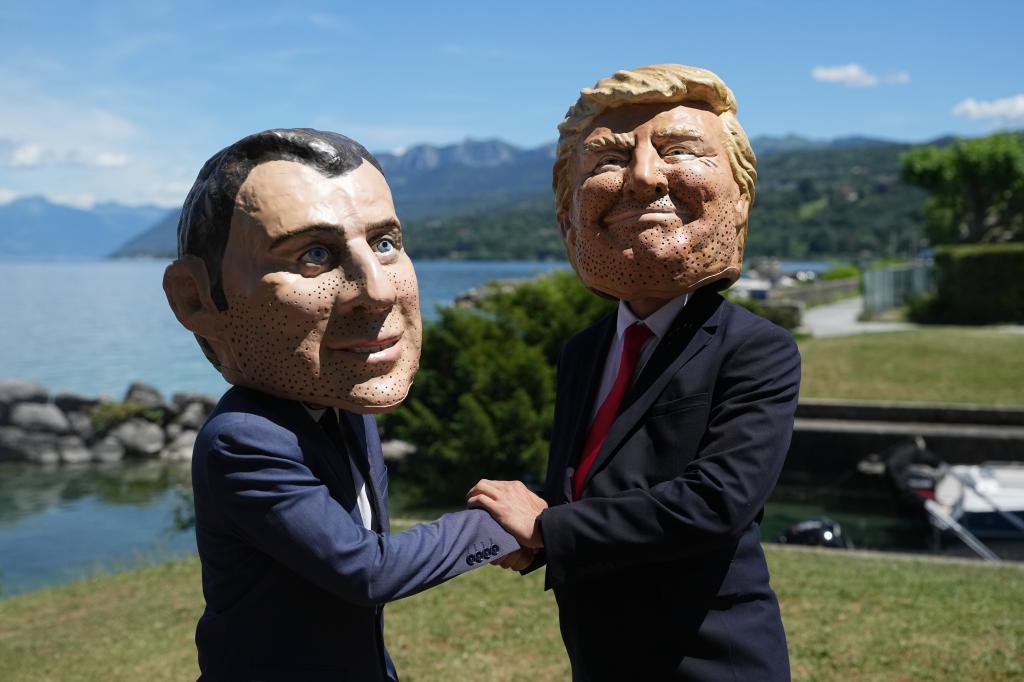
France, the United Kingdom, Germany, and Italy have already shown their willingness to "accompany" the United States in "the urgent and unconditional reopening of the Strait of Hormuz," as stated by President Emmanuel Macron, as the host of the G7 summit in Evian. The first transatlantic meeting since the Iran war begins on Monday in the French spa town, where the arrival of Donald Trump is expected at five in the afternoon, ready to capitalize on the agreement with Iran following the social media slogan: "Let the oil flow!".
Macron called on the United States and Iran for "a rapid and complete implementation" of the "memorandum of understanding" signed between the two countries, which should allow the reopening of the Strait of Hormuz starting on June 19. "A solid and lasting ceasefire is essential for the international mission," Macron emphasized.
In a video recorded on the shores of Lake Geneva and shared on social media, the French president anticipated that the G7 summit will serve "to analyze the consequences of this agreement, the support for Lebanon, the long-term reopening of Hormuz, and obviously the conclusion of an agreement on Iran's nuclear and ballistic capabilities."
"The resumption of maritime traffic, without restrictions or tolls, is an essential condition for regional stability and for the global economy," Macron stressed. "We will also explore ways and means to diversify the energy routes leaving the region to reduce our dependence."
"All of this has been the result of a diplomatic effort to which several partners have contributed," recalled the French president, who emphasized the need to simultaneously reach a peace agreement in Lebanon after the latest Israeli operations that almost derailed the negotiations between Tehran and Washington.
"France will continue to give its full support to the determined efforts of the Lebanese authorities to restore the sovereignty of the state, which is the only one capable of guaranteeing the stability and territorial integrity of Lebanon and meeting the needs of the people," added the French president.
British Prime Minister Keir Starmer welcomed the announcement of the agreement with Iran as "a highly significant moment." "We have been calling for de-escalation for some time, and this is finally an opportunity for all parties to ensure the stability of the region and restore freedom of navigation in the Strait of Hormuz."
A joint statement from the E4 countries (France, the United Kingdom, Germany, and Italy) meanwhile warned of the readiness to lift sanctions on Iran in exchange for its commitments. The memorandum of understanding sealed with Washington apparently leaves the nuclear issue for a later round of negotiations.
"Iran must never acquire nuclear weapons," warned the E4 members. "We are ready to work with the United States, Iran, and the IAEA to achieve this goal. We are willing to lift relevant sanctions in response to clear and verifiable measures regarding Iran's nuclear program."
From Brussels, the EU's foreign policy chief, Kaja Kallas, hailed the agreement between the US and Iran as "a potential breakthrough." "From its economic influence to its nuclear expertise and its long-standing relationship with Gulf partners, the EU is ready to contribute to a lasting resolution of the conflict," Kallas wrote on her X account.