The thermal waters of Evian-Les-Bains will serve as the backdrop for the first transatlantic summit since the war in Iran, with the announcement of the peace agreement and the mission to mend the strained relationship between the United States and European allies. Donald Trump will make his appearance this Monday, a day after his birthday, and all signs point to him not leaving French-style this time, as he did at the last G-7 meeting in Canada. To ensure that he stays for dessert, President Emmanuel Macron has prepared a gala dinner for him on Wednesday in Versailles, "for his high value in Franco-American friendship."
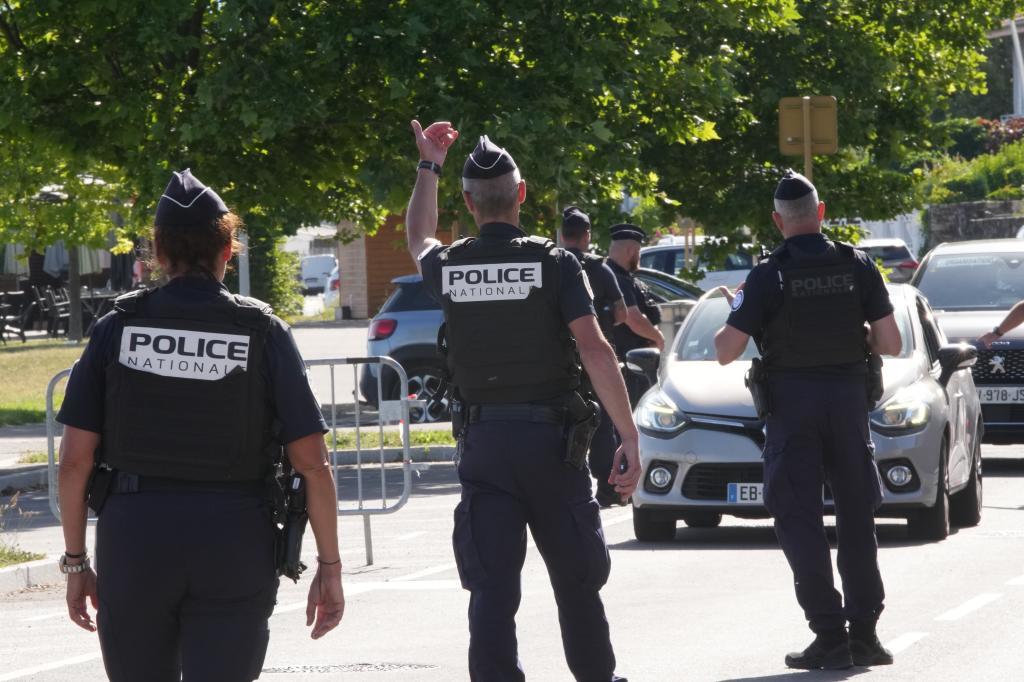
More than 12,000 police officers and 900 military personnel have taken positions in the peaceful spa town of 9,000 inhabitants on the shores of Lake Geneva, transformed this week into a fortress to host the leaders of the "rich club," who will also discuss the war in Ukraine, the tariff war, and a "new consensus on international solidarity."
Meanwhile, about 15,000 protesters marched through the streets of Geneva, with a giant Trump puppet at the front and slogans "against fascism and imperialism." The police cordon around Evian, where serious incidents occurred during the G-8 summit in 2003, has practically prevented protests on French soil, prompting a formal complaint from the Swiss police. The demonstration in Geneva ended with a violent clash involving bottles and flares with riot police, resulting in several arrests. There were scenes of street violence, and a Tesla was set on fire on the spot. The French police, meanwhile, have set up a special operation to prevent actions by far-left groups in the vicinity of Evian.
The Evian summit will also serve as a test of the resilience of transatlantic relations following the harsh exchange of accusations between Trump and his European allies and Japan over the lack of support in his war against Iran. It is not ruled out that the American president, as his Secretary of Defense Pete Hegseth did last week in Normandy, may make a direct reference to immigration in Europe, an issue not initially on the agenda but likely to be addressed in bilateral meetings.
According to some accounts, Donald Trump mentioned a supposed agreement with Iran more than 40 times to end the war initiated by the United States and Israel on February 26. The American president himself tried to speed up the countdown in view of the G-7 summit and with the aim of capitalizing on the peace agreement during his visit to Europe. Israel's bombings in Lebanon threatened on Sunday to once again thwart the ceasefire, although the expected agreement was eventually announced.
The summit will be marked by pressure from G-7 partners for the urgent reopening of the Strait of Hormuz. Delegates from Egypt, Saudi Arabia, the United Arab Emirates, and Qatar, exceptional guests on the second day of the G-7, will also put forward a regional strategy for the Middle East (Palestinian and Israeli civil society groups have issued a joint call to address the future of Gaza).
American sources informed Le Figaro that there has been a rapprochement between the Trump Administration and France and the United Kingdom to contribute to the "demining" efforts in the Strait of Hormuz. Macron, for his part, will propose a possible collaboration of naval forces coordinated by the aircraft carrier Charles de Gaulle in surveillance and security operations in Hormuz, once the ceasefire is guaranteed by Iran and the US.
Ukraine peace negotiations
Volodymyr Zelensky has been invited to the Evian summit for a multilateral meeting on the war in Ukraine. Although a bilateral meeting is not yet on the agenda, it is possible that he will come face to face with Donald Trump for the first time since last January. The Ukrainian president recently secured the support of Emmanuel Macron, Keir Starmer, and Friedrich Merz for his latest diplomatic push to "engage in direct dialogue with Russia with the involvement of the United States and Europe."
After more than 1,570 days of war, Russia has increased bombings on the civilian population, with devastating scenes in Lukianivska Square, while Ukraine has intensified drone attacks on Russian soil. Zelensky has acknowledged the lack of troops in his army and has announced that he will step up efforts to recruit foreign volunteers.
The G-7 summit coincides with the start of the first phase of talks with Ukraine and Moldova to progress in their EU membership. "Ukraine is doing everything necessary, but it is important that the EU keeps its word," Zelensky wrote on Telegram.
A protester holds a banner reading "G7: the anger within me" during a protest last Friday in Lausanne, near the town of Evian, where the summit is taking place.Fabrice COFFRINIAFP
France, the driving force behind the G-7 following the 1973 oil crisis, aims to use its presidency this year to build "a new consensus on fairer, more effective, and better-coordinated international alliances." In this sense, Evian will be a test of endurance, with the goal of trying to bring Donald Trump on board the multilateral ship, after the unilateralism that has characterized his second term so far (and with the sting of the lack of support from his allies in the Iraq war).
As a counterpoint, the image of the last meeting in Evian of the then G-8, with Russia's participation and Putin alongside Bush, Blair, Schröder, and host Chirac back in 2003, emerges these days in a very different international landscape. Trump may use the summit to call for the return of Russia in the near future in a "remake" of the old G-8.
Tariffs, imbalances, and critical minerals
Trump's tariff war remains ongoing and will dominate the economic discussions. The US president's new plan, which has turned economic coercion into a foreign policy tool, includes additional tariffs ranging from 10% to 12.5% on 60 economies, including the EU and the UK.
France will bring up the "reduction of global macroeconomic imbalances." The massive deficit and protectionism of the United States, the lack of investment and innovation in Europe, and China's industrial overcapacity (the world's second-largest economy despite not being part of the "rich club") are some of the highlights of a recent report prepared by the presidency.
Critical metals and rare minerals will also receive special mention, with a call to strengthen the value chain, from extraction to refining, given "the dominant position of a small group of actors" (read China). France aims to use the Evian summit to forge alliances to ensure the supply of essential resources for renewable energies, batteries, semiconductors, and digital equipment.
Digital regulation will likely be the final battleground, with France's commitment to promoting the protection of minors on social networks. The fight against drug trafficking and port security has also been added to the agenda, as well as, for the first time, the fight against cancer.