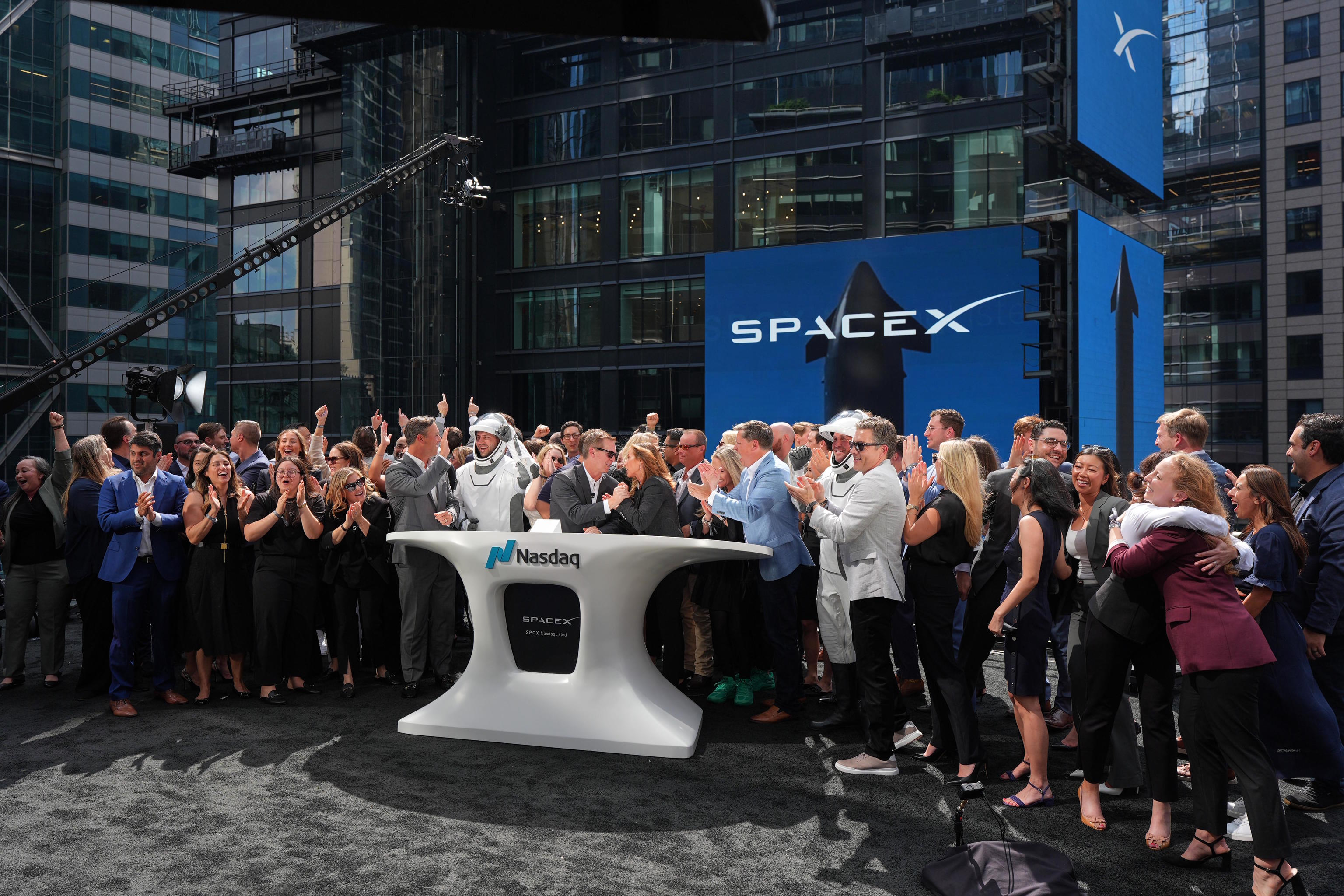
After closing the largest IPO in history on Thursday, SpaceX's shares appreciated by almost 20% on its first trading day, immediately placing the company's value above $2.1 trillion and making Elon Musk the first trillionaire in history. The shares closed at $161.11, generating a massive trading volume of around $80 billion in just a few hours.
Musk owns a 42% stake in the aerospace and telecommunications group, now valued at over $800 billion, in addition to his $280 billion fortune from Tesla. An unimaginable amount of money that would allow him to spend almost $30 million a day for a century before going bankrupt.
Prior movements suggested that SpaceX's shares would open 29% above the IPO price on its debut, around $175 per share, but gradually adjusted to $150. Within minutes, the shares began to rise, reaching $168 and closing at $161.11 at the end of the day, an extraordinary figure.
Musk, speaking from SpaceX's headquarters in Texas before the market opened, said it was "hard to believe that a small company... is going public in the largest IPO in history (...) If someone had told me this was going to happen, I would have thought, 'Dude, you must be smoking something really good, because I think this company is going to fail,'" he added.
It's all about records in this operation. It is the first time a U.S. initial public offering is distributed to retail investors in the United Kingdom, the European Union, Australia, Canada, and Japan (but not China), through the banks that underwrote the offering and brokers. The IPO has generated the highest demand in history from institutional and retail investors, exceeding the number of available shares by more than four times. Goldman Sachs and Morgan Stanley will each earn around $100 million in fees from the IPO.
The operation has also made nearly a third of SpaceX's workforce, over 4,000 people, millionaires, subject to a 180-day lock-up period before selling, but they will have some opportunities to sell part of their shares during specific periods. Additionally, key executives and investors of SpaceX have also become very wealthy after the IPO. Gwynne Shotwell, President and COO of SpaceX, holds a stake valued at around $1.8 billion, according to Bloomberg's Billionaires Index. Bret Johnsen, the company's CFO, holds a stake of $1.2 billion. Luke Nosek, PayPal co-founder and early SpaceX investor, holds shares valued at $4.1 billion.
There are some doubts about the financials of the company, which is much more than a space venture but still losing money. Analyzing U.S. IPOs of over $5 billion since 2000, the best-performing in the long term have been Visa and Meta, explains Bloomberg. Visa's shares have risen over 2,800% since its IPO in 2008, and Meta's (formerly Facebook Inc.) shares have risen around 1,400% since going public in 2012. The worst performer in this group is Rivian Automotive Inc., whose shares have fallen 81% from its IPO price at the end of 2021, according to Thursday's closing price.
The Nasdaq's performance in the coming days will be a decisive test of investor appetite for two more massive IPOs in the coming months, those of Anthropic, creator of Claude, and OpenAI, developer of ChatGPT. But there are more elements in the market. According to The Wall Street Journal, perpetual futures linked to SpaceX are the second most traded asset on the decentralized cryptographic exchange Hyperliquid, with a 24-hour trading volume exceeding $1.3 billion.
Perpetual futures are derivative contracts that never expire and allow traders to use leverage. These instruments have become very popular this year, following the Iran war, as traders take advantage of their 24/7 availability to trade derivatives linked to oil on the platform.