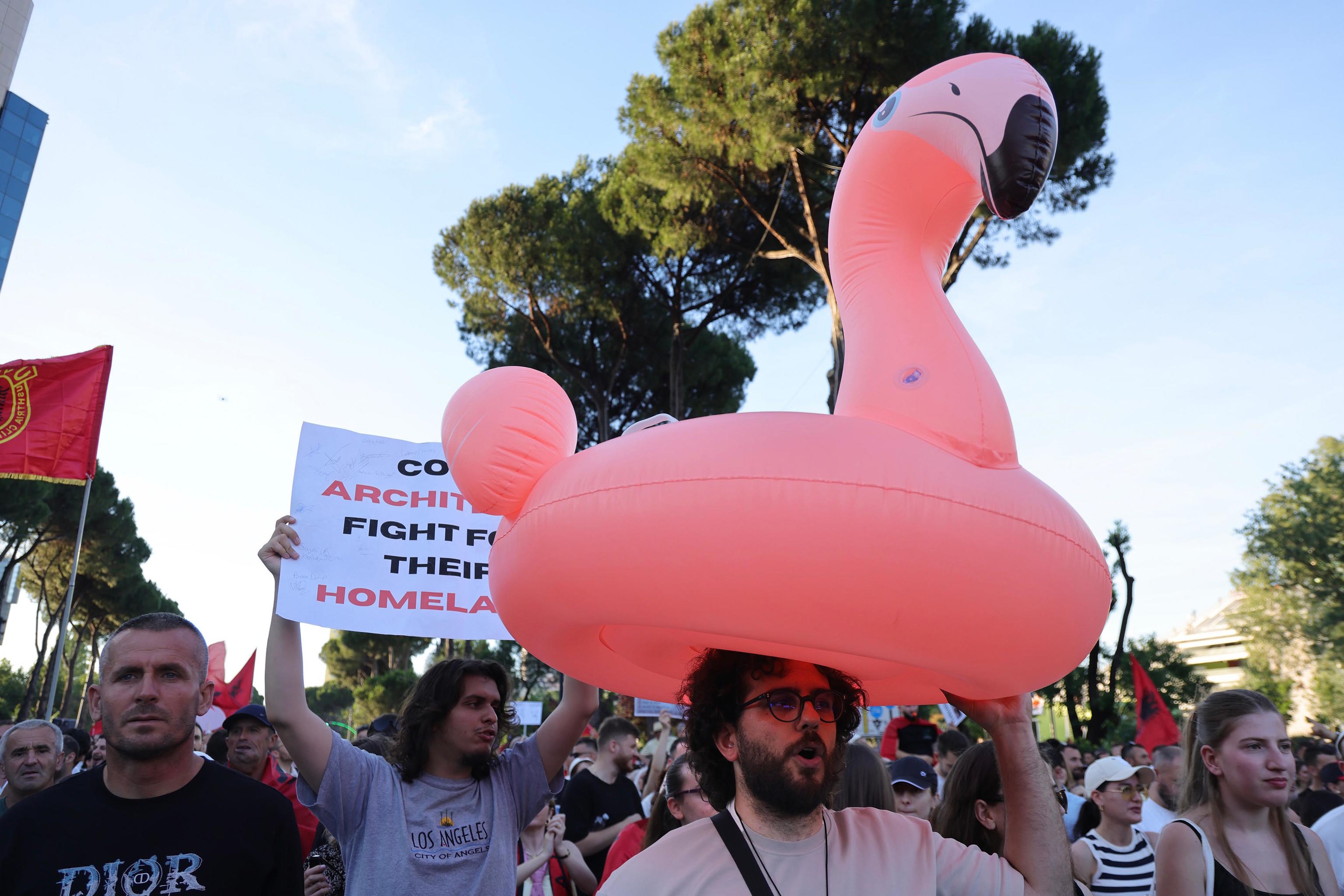
The route of the flamingos used to stop at the Narta lagoon, in the Albanian region of Zvërnec, between March and May. The return was always from September to November. Until climate change caused many of these birds to no longer migrate and have turned this corner of the Balkans into their permanent residence, a large strip of land surrounded by a wetland ecosystem. But, by the end of May, their characteristic honks were overshadowed by an even louder rumble of the excavators.
Jared Kushner, Donald Trump's son-in-law, plans with his company Affinity Partners a large luxury complex there and another one in front, on the island of Sazan, a former military base from the time of dictator Enver Hoxha (1944-1985). Ivanka Trump's sugar-coated description of her discovery, "barefoot," in a podcast further fueled the anger. Although the urban developments in these pristine locations had been known for a couple of years. The protests in the streets of Tirana began in early June with the flamingo as a symbol, which has baptized this revolution. The chants have varied from the cry of "Albania is not for sale" in the early days to the more direct "Edi Rama, resignation".
The prime minister, however, insists that the resorts will go ahead. This despite the protests, the investigation opened by the Albanian Anti-Corruption and Organized Crime Agency (SPAK) into the origin of the funds used to purchase the land, and even the firm warnings from the European Commission. Albania, which changed an environmental regulation in 2024 to make these luxury developments possible, recently made significant progress on its path to accession, expected, according to its calculations, by 2030. But with the protests came a reprimand and the temporary halt of the works.
"Albania is expected to fully align with EU legislation" on the Environment, "repeal incompatible provisions (adopted through amendments to the law on protected areas), and end the 2015 legislation on strategic investments," a Commission spokesperson told Afp. "We expect the Albanian authorities to act promptly", he concluded. Nevertheless, Rama does not give in: "I tell you it will be a beautiful project, that we will do it, and that we will be proud to contribute to Europe," he stated this week in an interview with Reuters at his office in Tirana, located a few meters from where the protests take place every night.
"I was elected to make these things happen. Not to be guided by people who have a different idea of how to develop the country," said this former basketball player, in power since 2013. The prime minister confirmed the astronomical budget of 4 billion euros between the two projects: "It's a big dream, and big dreams have always faced controversy," he emphasized.
"Platform to express discontent"
"The protests have become one of the most significant citizen mobilizations that Albania has experienced in the last decades," explains Albanian journalist and TV presenter Lufti Dervishi. He points out that, while international media have focused on Jared Kushner and the environment, "within the country, the issue is perceived more broadly".
This outrage has connected with young people not affiliated with any party and with the diaspora (more than 1.2 million direct emigrants, compared to the country's 2.4 million inhabitants): "Many no longer see the protests as something that only affects a protected lagoon or the flamingos. Increasingly, they consider them a platform to express broader discontent with the political system and how major decisions are made," he highlights.
Because Zvërnec has been a trigger. Political scientist Klaudia Koxha agrees that the movement has evolved into "an expression of distrust towards institutions". For this analyst, the catalyst for this anger occurred alongside the fences of the Zvërnec lands when private security personnel dragged a citizen in front of the passive Police: "It reinforced the perception of a total imbalance between the ordinary citizen and the political-economic power."
Furthermore, Rama's staunch defense, accusing the protesters of responding to "foreign interference," has only fueled the fire. "As a result, demands have expanded. What started as opposition to a specific project has evolved into a political protest, with increasing calls for the resignation of Prime Minister Rama," Dervishi points out.
"The protests are politically significant because they reveal how environmental conflicts can evolve into broader democratic conflicts affecting institutional trust, political representation, and democratic legitimacy," Koxha concludes. Who would have thought that the flamingos of the Narta lagoon would play such a role.