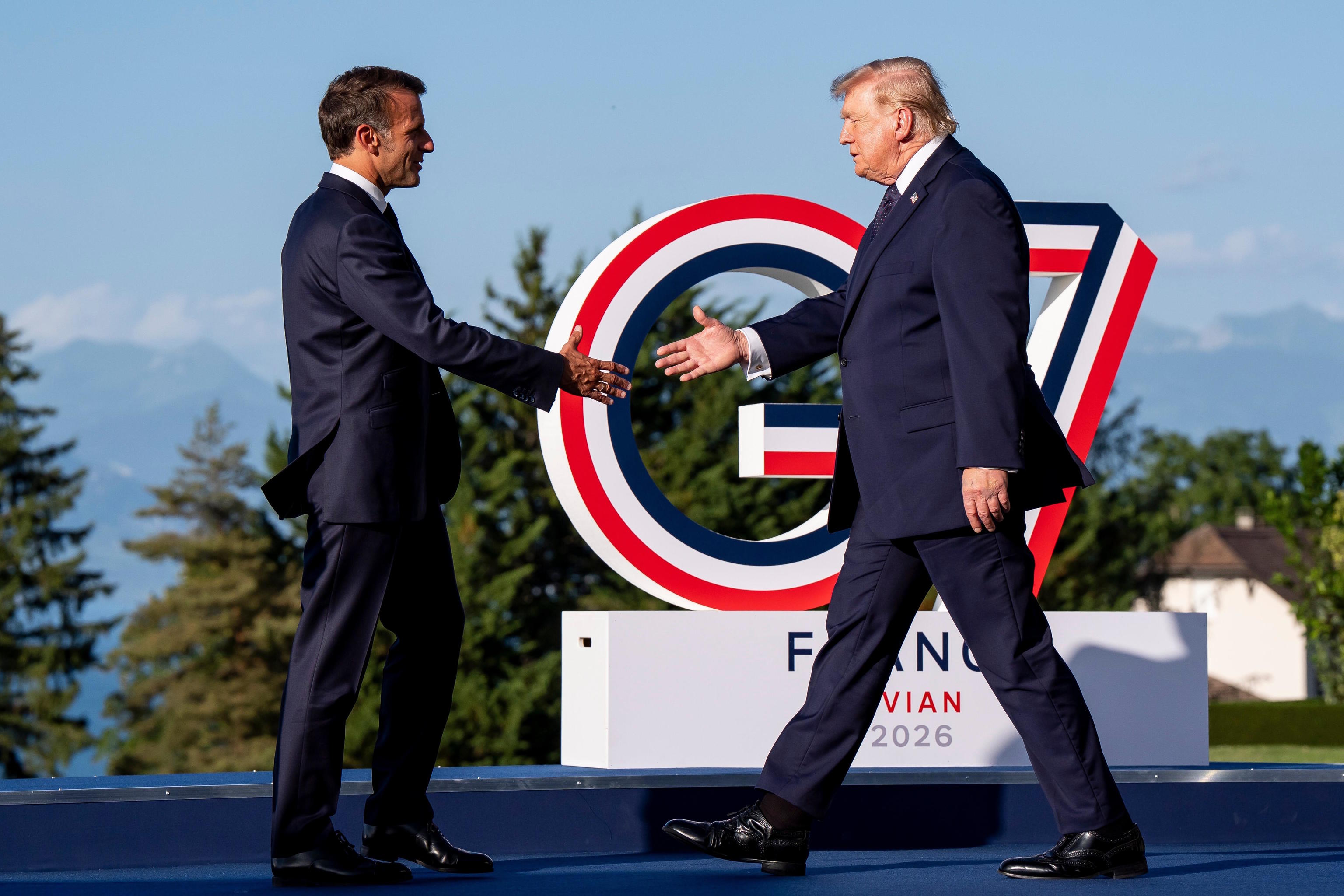
The G-7 summit in Evian rolled out the red carpet on Monday for Donald Trump, eager to capitalize on the agreement with Iran and announce that the Strait of Hormuz will be "fully open" starting Friday. The US President displayed his triumphalism in the presence of Emmanuel Macron, who expressed his willingness to "cooperate" to ensure freedom of navigation with the international mission composed of France, the UK, the Netherlands, and Italy.
Trump responded without much enthusiasm, stating that he won't need "much help" to achieve the reopening of the Strait. "But I don't think it's a bad idea to have one or two ships from some countries - his country would be ideal for this - because you never know," he pointed out.
"As the President has said, perhaps it is not a desired or necessary measure, but in any case, it demonstrates our willingness to help," Macron replied, emphasizing the "availability" of the Charles de Gaulle aircraft carrier: "It could be operational in two or three days once the conditions are created."
"The Strait is partially open," Trump clarified after the bilateral meeting with Macron, sealed with the traditional handshake at the photographers' request. "We are removing the few remaining mines, and ships are starting to sail."
"Ships of the world, start your engines. Let the oil flow," was the announcement Trump made upon his arrival in Evian, a day after his birthday celebration. "Oil prices are plummeting to levels that have not yet returned to pre-crisis levels, but we are getting close."
"And most importantly: Iran will never have a nuclear bomb," Trump concluded, boasting of an agreement much better than the one sealed by Obama. "They accepted it and will not have it: that was the goal of this action. They would have it if we had not intervened."
Macron simply listened and honored his guest during their first joint intervention. The French President deployed his persuasive arsenal to mend his relationship with Trump and ensure he stays until the end of the summit (with a closing dinner in Versailles).
The two leaders used their first bilateral meeting to approach the situation in Ukraine. Trump admitted that he can do "something," after having spoken on the phone with Zelensky and Putin on his birthday. Zelensky will participate in a multilateral meeting on Ukraine in Evian on Tuesday with Trump. The Ukrainian President even proposed a meeting with Vladimir Putin within the G-7 context, but the offer was apparently rejected by the Kremlin.
The Iran agreement and the reopening of the Strait of Hormuz will be the central theme of the summit. The G-7 has expressly invited Egypt, Saudi Arabia, Qatar, and the United Arab Emirates to a meeting on Tuesday, where a peace strategy for the Middle East will also be discussed. Macron emphasized the need to include an agreement on Lebanon and reiterated France's support "for the determined efforts of the Lebanese authorities to restore the sovereignty of the State."
British Prime Minister Keir Starmer welcomed the Iran agreement as "a highly significant moment." "We have been calling for de-escalation for some time, and this is finally an opportunity for all parties to ensure the region's stability and restore freedom of navigation in the Strait of Hormuz," he stated.
A joint statement from the E4 countries (France, the UK, Germany, and Italy) warned, in the meantime, of their readiness to lift sanctions on Iran in exchange for its commitments. "Iran must never acquire nuclear weapons," they pointed out. "We are ready to work with the United States, Iran, and the IAEA to achieve this goal. We are prepared to lift the relevant sanctions in response to clear and verifiable measures regarding Iran's nuclear program."
From Brussels, Kaja Kallas celebrated the agreement between the US and Iran as "a potential breakthrough." "From its economic influence to its nuclear expertise and its long-standing relationship with Gulf partners, the EU is ready to contribute to a lasting resolution of the conflict," wrote the EU's chief diplomat on her X account.