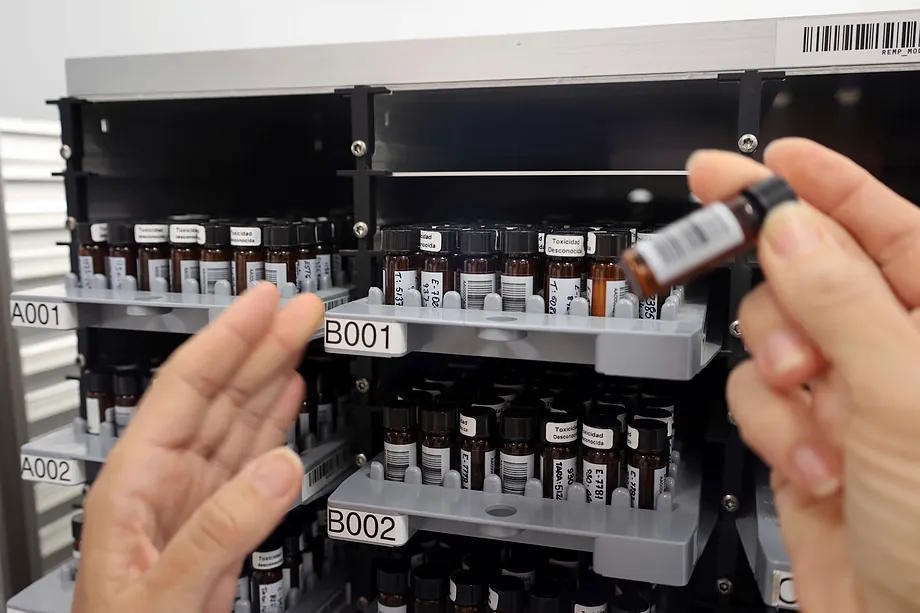
Artificial intelligence is already emerging as the new global pharmaceutical laboratory. China aims to lead in this field. The country has just introduced GalaxyVS, a drug discovery platform powered by AI and fueled by a new generation of supercomputers capable of reducing the initial phase of searching for candidate molecules from years or months to just seconds. Chinese researchers have stated this in an announcement that also symbolizes how the superpower has transitioned from being a cheap factory for generic drugs to becoming one of the main global centers for bio-pharmaceutical innovation.
The project, developed by the National Supercomputing Center in Tianjin, represents a huge leap in one of the slowest and most expensive stages of pharmaceutical research: molecular screening. Traditionally, scientists have to analyze millions of chemical compounds to find molecules capable of binding to a specific biological target associated with a disease. This process can take years and consume billions of dollars even before a drug reaches clinical trials.
According to Li Peishun, a researcher at the center, the new platform can complete a search on chemical libraries of up to 100 billion molecules in less than a minute. "Its daily performance reaches a speed that multiplies by a million the previous record of supercomputing applied to drug discovery," he says. Li adds that all this will accelerate the discovery of treatments for tumors, neurodegenerative diseases, rare diseases, or future emerging infectious diseases.
In the new era of AI, in the race to compress years of research into a matter of hours, China has a head start: it controls a large part of the pharmaceutical supply chain and has a huge ecosystem of clinical data, qualified researchers, substantial state funding, and enormous industrial capacity.
Just 15 years ago, Beijing held a marginal position in pharmaceutical innovation. Its role mainly involved manufacturing cheap generics and supplying them to Western multinationals. However, a couple of years ago, it surpassed Europe for the first time as a generator of new active ingredients. In 2010, the Asian country represented less than 8% of global clinical trials. It has now surpassed the United States and Europe in the annual number of registered studies.
Western pharmaceutical companies are increasingly relying on Chinese laboratories to discover new molecules. Yanzhong Huang, a senior health researcher at the Council on Foreign Relations think tank, argues that "China dominates the global production of generic active ingredients in key therapeutic categories and has become an indispensable pillar of the supply chain."
The industrial dominance is overwhelming. Nearly 80% of the chemicals used to manufacture pharmaceutical active ingredients are produced in China, which accounts for 70% to 80% of the global production of antibiotic active ingredients and around 80% of the global supply of heparin. An analysis by the US Pharmacopeia revealed that almost 700 drugs approved in the US market depend on at least one component manufactured exclusively in China.
A Silk Road of Medicine
European dependence is also deepening. In Germany, three-quarters of the active ingredients used in imported antibiotics come from China. In Spain, the Real Instituto Elcano warned years ago about the growing vulnerability of pharmaceutical supply chains to Beijing. Chinese companies like Techdow Pharma or Qilu Pharma have entered the Spanish market while European companies move production to the Asian giant unable to compete with its costs.
"China is no longer just the world's pharmaceutical workshop; it is becoming one of the main drug developers," summarizes researcher Huang. Last year, Pfizer agreed to pay $1.25 billion to license a cancer immunotherapy developed by the Chinese company 3SBio, the largest initial payout ever made for a Chinese pharmaceutical asset. Another Chinese laboratory, Akeso, had its antibody outperform a German giant Merck's in a phase 3 clinical trial for lung cancer, an unprecedented achievement at that time.
"China's rise is explained by massive state investments, regulatory reforms to accelerate clinical trials, tax incentives, a huge domestic market, and a long-term industrial strategy," explains Huang. All of this is accompanied by an increasingly sophisticated academic and technological ecosystem that now incorporates AI as a decisive accelerator.
Beijing's ambition goes beyond business. Official media have been promoting the idea of a "medicine Silk Road" for years, aimed at expanding Chinese pharmaceutical influence in the Global South. Africa plays a central role in this strategy. Chinese companies are already building insulin, antibiotic, or antiretroviral production plants in countries like Nigeria, Senegal, or Ivory Coast.
However, China's rise also raises concerns in the West. This year, the European Union introduced an Essential Medicines Law to strengthen local production of over 200 critical drugs and reduce dependence on Asian suppliers. Because the risk is no longer just economic. "China's control over the supply chain creates structural vulnerabilities," warns Huang. "Any significant disruption, whether due to geopolitical conflict, a pandemic, or export restrictions, can quickly and unpredictably spread throughout the global healthcare system."
Meanwhile, China is accelerating to ensure that the next major pharmaceutical revolution speaks Mandarin. And it does so by leveraging a combination that no other power currently possesses on the same scale: supercomputing, artificial intelligence, industrial control, and state muscle.