The ultimate goal of the Russian invasion was and still is to eliminate the Ukrainian state and russify Ukraine, as Vladimir Putin himself acknowledged months before the invasion in a text published on the Kremlin's official website on July 12, 2021. Titled On the Historical Unity of Russians and Ukrainians, it was the ideological manifesto used to justify it. Putin began by stating that "Russians and Ukrainians were one people, a unique whole," and claimed that "modern Ukraine was created by Bolshevik and Communist Russia." In other words, for Putin, the Ukrainian state is "artificial" and therefore was the target for elimination.
Today, four and a half years into the invasion, Ukraine still exists, and Russia still cannot erase it from the map, but the objectives remain the same: the elimination of Ukrainian identity. Yesterday, Vladimir Putin's army, personally leading the war, left a few examples of how they intend to achieve it.
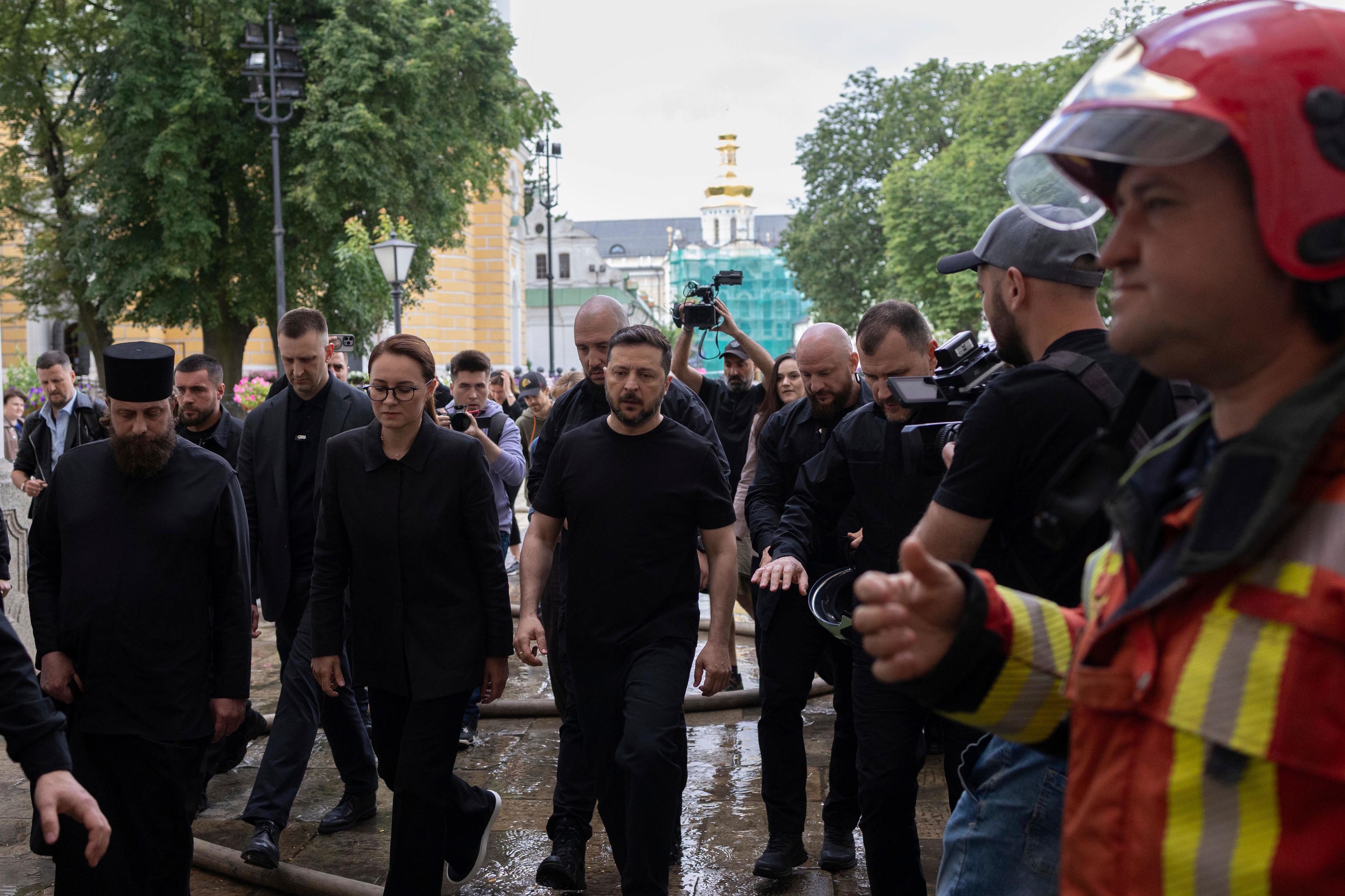
In a single bombing, the Russian regime launched drones and missiles against the Pechersk Lavra Monastery, over 1,000 years old (like Notre Dame in Paris) and protected by UNESCO; the Mystetskyi Arsenal, a museum and exhibition complex with 60,000 square meters of exhibition space; the Dovzhenko film studios, the birthplace of Ukrainian cinema since the 1920s, with a vast archive and entire warehouses filled with thousands of costumes and other props; the Palatz Ukraina concert hall in Kyiv, the Kharkiv Art Museum, and the Organ and Chamber Music House, the most prominent architectural and cultural building in the city of Dnipro.
In total, the Russian troops have already attacked 141 museums across Ukraine. The Russian destruction is industrial, systematic, and carried out by a state with the military resources of a nuclear power. While firefighters sprayed water on the ruins of Pechersk Lavra, its bells rang, reminiscent of when the Mongols entered Kyiv to sack it in the year 1240.
As of May 2026, a total of 1,783 cultural heritage sites have been destroyed or damaged since the beginning of the war, according to the Ukrainian Ministry of Culture. Among them, 161 are of national importance, 1,460 of local importance, and 162 have been recently identified. 46 heritage monuments have been completely destroyed by Russian bombs. As Ian Fleming, creator of the James Bond novels, once said, once is a coincidence, twice is a coincidence, and three times is enemy action. The insistence on ending Ukrainian cultural heritage, typical of imperialist regimes, is a strategy. According to the Smithsonian Institute in Washington, cultural objects are 20% more likely to be destroyed than other civilian buildings like hospitals, indicating that Russia is deliberately targeting these types of places.
The Moscow regime, with its usual cynicism, claimed that the Pechersk Lavra Monastery was hit by a defective Patriot missile from the anti-aircraft defense, a lie easily verifiable: what was found among the ruins of the building were remnants of a Russian Shahed drone, including the engine and propeller.
Putin's Russia has presented itself during this invasion as the staunchest "defender of Christianity" while bombing Christian churches in Ukraine. Up to 600 temples have been attacked in four years, including the impressive Transfiguration Cathedral in Odesa.
Therefore, once the attack pattern by the Russians was recognized, it is less understandable why museums like the Kharkiv Art Museum did not evacuate their works from their halls. As a result of the bombing, over 1,000 pieces were damaged.
Archaeologist and heritage expert in conflict zones Amr Al-Azm, who documented the destruction by the Islamic State (IS) in Syria and now studies the Ukrainian case, pointed out the essential difference: "IS destroyed to show that the past should not exist. Russia destroys to appropriate it or to show that it was never Ukrainian. They are two different forms of the same war against memory."