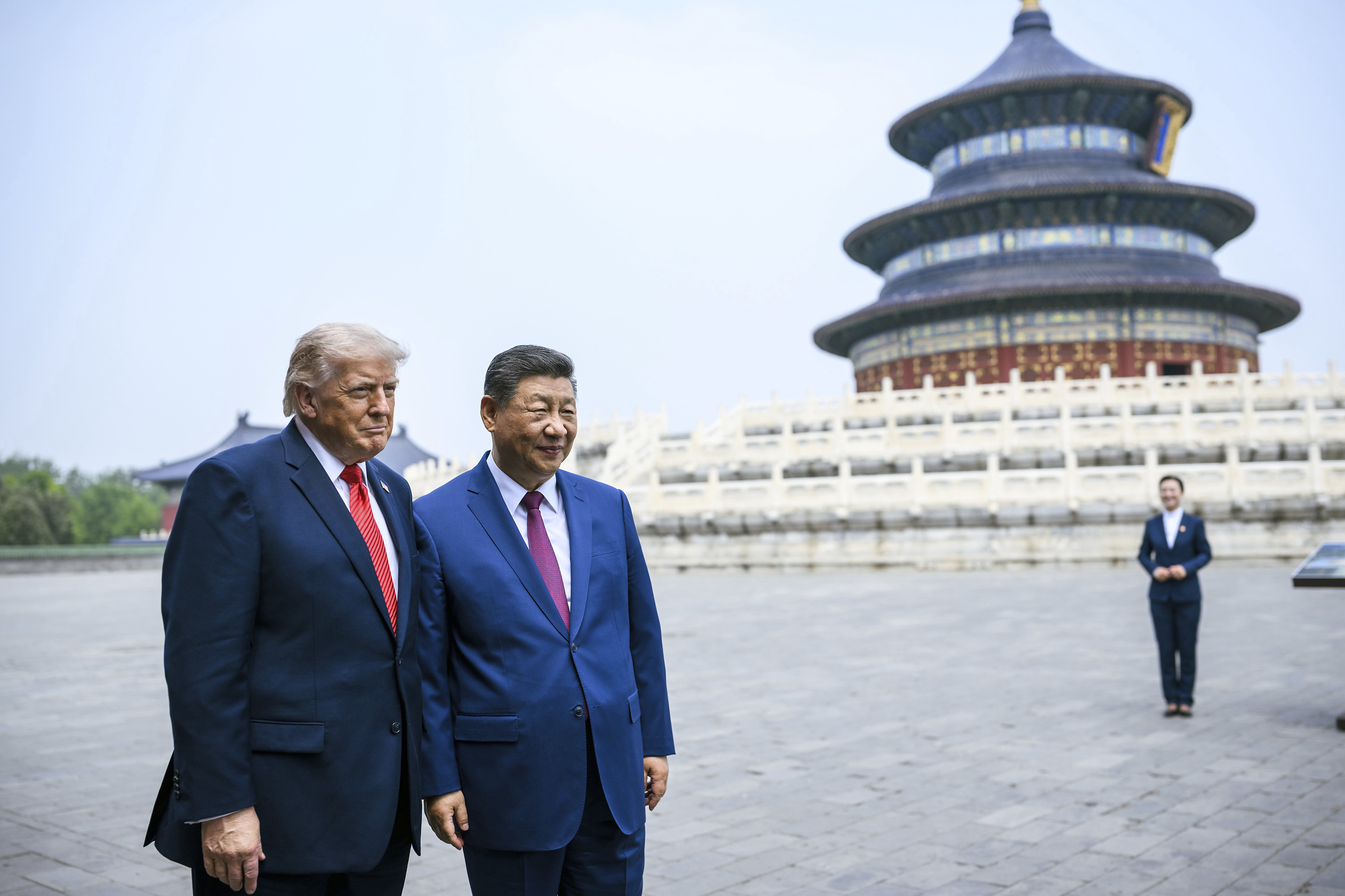
Half a century after the major industrialized democracies began meeting in a castle outside Paris to try to rescue a global economy shaken by the oil crisis, China, the world's second-largest economy, the main trading partner of over a hundred countries, and an essential player in virtually any global challenge, still does not belong to the G-7.
The leaders of the United States, Japan, Germany, France, the United Kingdom, Italy, and Canada are meeting this week. And although China is not at the table, part of the discussions revolve precisely around the pulse that Beijing maintains with the West on many fronts: exports, trade surplus, control over strategic minerals, technological advancements.
The absence of the Asian superpower has a historical explanation. When the then G-6 was born at the Rambouillet castle (France) in 1975, the nation was immersed in the final years of Maoism. It was an isolated country. At that time, it was unimaginable for Mao Zedong to sit at the table with Gerald Ford to coordinate global economic responses.
However, the world changed much faster than the institutions created to govern it. After the reforms promoted by leader Deng Xiaoping from the late 1970s, China opened up to the world and led the largest industrialization process in modern history. Today it represents about a fifth of the world's GDP, is the world's largest exporter, and has a decisive weight in critical supply chains ranging from rare earths to electric batteries.
If the criterion for joining the G-7 were solely economic, Beijing would have joined long ago. But this group, as some analysts point out these days, besides being an economic forum, has always functioned as an exclusive political club of liberal democracies.
Reasons for the Absence in the G-7
The founding leaders advocated membership in "open and democratic societies," committed to individual freedoms and shared values. Under that parameter, the Xi Jinping regime is left out. The increasing concentration of power in the hands of the ruling Communist Party, the tightening of political control, or the continuous repression of press freedom make any serious debate about inclusion difficult. Although US President Donald Trump mentioned the possibility of expanding the club to include China last year.
From the Asian country, state media pose a question these days: Can global economic governance be addressed without considering the world's second-largest growth engine?
Some experts believe not. Quoted by the AP agency, Canadian specialist John Kirton, one of the leading scholars of the G-7, has gone as far as comparing a summit without China to "a World Cup without Brazil". Other analysts consider keeping Beijing out a strategic mistake: it fuels the perception that the West intends to preserve post-war structures incapable of reflecting the new balance of power in the 21st century.
China has exploited that argument. For years, Beijing has denounced that the G-7 represents an increasingly narrow view of the world. Its leaders often present the group as a relic of the Cold War and an exclusive mechanism dominated by a handful of developed countries that no longer monopolize economic growth or influence capacity.
Groups Where China is Present
In this context, President Xi Jinping has accelerated the construction of alternative platforms. The BRICS - originally composed of Brazil, Russia, India, China, and South Africa, and recently expanded with new members - have become the main showcase of the so-called Global South. Although they maintain divergent interests internally, they serve Beijing to promote an international architecture less dependent on Washington.
The same happens with the Shanghai Cooperation Organization (SCO), initially conceived as a regional security mechanism in Central Asia and progressively transformed into a broad political forum where China and Russia coordinate positions alongside emerging powers like India, Pakistan, or Iran. The close partnership between Xi and the Russian Vladimir Putin, reinforced after the Russian invasion of Ukraine, is part of that counterbalance strategy against the West. Both autocrats publicly advocate for a "multipolar" world where no power can unilaterally impose the rules of the game.
This narrative was reflected this week in a harsh editorial in the Chinese nationalist newspaper Global Times, a usual spokesperson for the most combative positions of the Chinese establishment. The newspaper states that the G-7 is going through "an undeniable decline" and describes the group as a "hypocritical," "selfish," and "disconnected from the world" club. According to this media outlet, the growing multipolarity has exposed "chronic problems of mispositioning, cognitive distortion, and functional erosion," exacerbated by slow economic growth, indebtedness, demographic aging, and internal divisions among its members.
"Beijing distrusts the G-7 because it considers the group structurally aligned with Western power led by the United States and increasingly as a forum where China is discussed as a challenge or a threat," said Chinese analyst Wang Zichen this week.
Another state media outlet, the China Daily, accuses the group of using China as a "scapegoat" to hide its own contradictions. In an editorial, it argues that challenges such as energy security, financial governance, or the fight against climate change "cannot be achieved without the participation of China and other countries from the Global South" and calls for "more equitable and representative multilateral mechanisms." The text concludes by urging the G-7 to abandon its "leadership illusion" and "replace block logic with more inclusive cooperation."
Beijing does not appear this week in the official photo of the summit held in Evian (France), but conditions much of the conversations taking place within it. More than half a century after Rambouillet, the big question for many is no longer why China is not part of the G-7, but whether the international system can continue to function as if the world's second-largest economy remained outside the room.