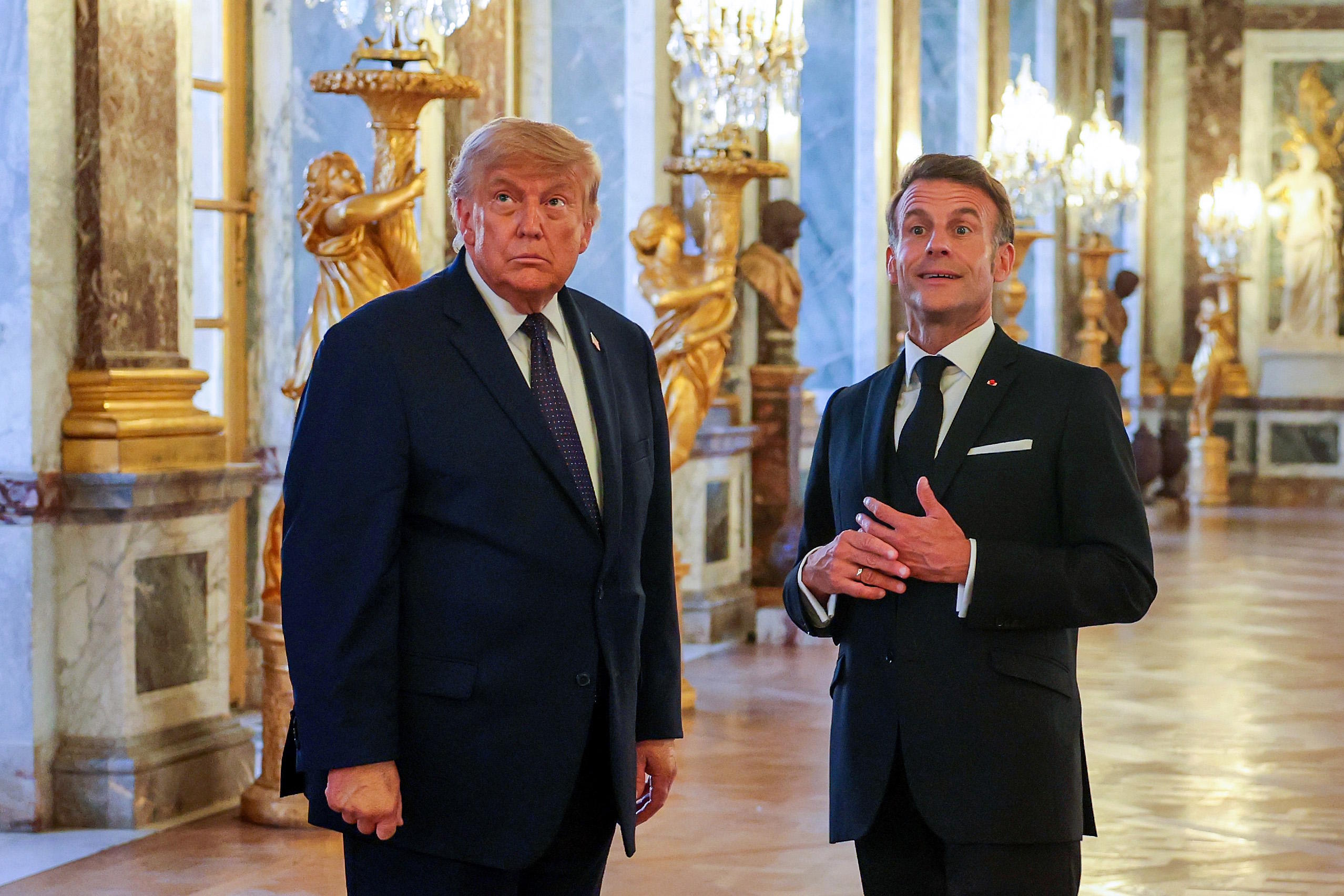
Donald Trump and the President of Iran, Masoud Pezeshkian, signed the "memorandum of understanding" on Wednesday night to end hostilities and allow free navigation in the Strait of Hormuz, as acknowledged simultaneously by sources from the White House and Iranian state media. The "electronic" signing of the document took place after the dinner in Versailles of the American president, preceding the official ceremony that was initially scheduled for Friday in Bürgenstock, Switzerland.
The 14-point memorandum, leaked hours before to American media, includes Iran's commitment to "not produce nuclear weapons" (the fate of enriched uranium will be decided in subsequent negotiations). The U.S. lifts its sanctions on Iran and supports a reconstruction plan with its regional partners of at least $300 billion. Both parties commit to negotiating a final agreement within a maximum period of 60 days.
"I just signed it," Trump told reporters as he left the palace. Shortly after, a White House official posted a video showing him signing the agreement alongside Macron, giving a thumbs-up and smiling.
The document was also signed by the President of Iran, Masud Pezeshkian, declared the spokesperson for the Iranian Foreign Ministry, Esmaïl Baghaï.
With the signing, the Strait of Hormuz will be reopened "instantly," and the U.S. blockade of Iranian ports will be lifted "immediately," Pakistani Prime Minister Shehbaz Sharif, who has acted as a mediator, indicated on Thursday.
One-fifth of the world's oil transits through the Strait of Hormuz. Its closure during these more than three months of conflict has affected the global economy.
Sharif also confirmed that a ceremony will take place in Switzerland on Friday to "commemorate this outstanding event and give the initial boost to technical negotiations."
Iran's President, Masoud Pezeshkian, holds the peace agreement signed with the United States.AFP
The memorandum of understanding reached by Washington and Tehran is intended to end the conflict triggered on February 28 by attacks from the United States and Israel against the Islamic Republic, which spread to the region and caused thousands of deaths, mainly in Iran and Lebanon.
The Secretary-General of the pro-Iranian Lebanese movement Hizbullah, Naim Qasem, described the agreement as a "great victory" for Iran, a country he thanked for insisting on including the Lebanese front.
Lebanon was drawn into the conflict when Hizbullah fired rockets on March 2 against Israel in support of Iran.
Hizbullah's leader also urged the Lebanese government to end direct negotiations with Israel initiated since April under the auspices of Washington.
The Lebanese President, Joseph Aoun, had previously stated that this process is "independent" of the agreement between the United States and Iran.
The text of the agreement was released on Wednesday by the United States and Iran. It stipulates that Washington will suspend, from the signing, its sanctions on the sale of Iranian oil and the blockade of Iranian ports.
During these two months, both countries will discuss a mechanism to address Iran's enriched uranium reserves, at the center of U.S. accusations that Tehran aims to develop nuclear weapons.
For this, a method of in-situ dilution will be used under the supervision of the International Atomic Energy Agency (IAEA).
Iran must allow, within 30 days, the full restoration of maritime traffic in the Strait of Hormuz.
But according to Iran's chief negotiator, Mohamad Baqer Qalibaf, the strait "will not return to the situation before the war."
"Iran has sovereignty rights over Hormuz, and of course, we will charge a toll for these services," he stated on Iranian state television.
He also considered that "the agreement constitutes the failure of the United States." "People will know it and draw their own conclusions," he said.
In the case of a definitive agreement, the United States commits to facilitating, "with its regional partners," a $300 billion fund for the reconstruction and economic development of Iran, without any U.S. financial participation.
In a joint statement, the members of the G7 (Germany, Canada, United States, France, Italy, Japan, and the United Kingdom) hailed the agreement as "a historic opportunity to prevent Iran from acquiring any nuclear weapons and address threats related to its regional and ballistic activities."
China, for its part, deemed it "essential" that "all parties" scrupulously apply this agreement and avoid external "interference," during a phone conversation between its Foreign Minister, Wang Yi, and his Iranian counterpart, Abbas Araqchi, according to Beijing.
The Chinese Foreign Minister, whose country heavily depends on Gulf oil imports, stressed the need for the navigation in the Strait of Hormuz to be "properly managed, responding prudently to the deep concerns of the international community."
Oil prices saw a momentary 5% spike on Wednesday, reflecting market unease before the agreement's signing, but the global benchmark, Brent crude, closed the day near $80 per barrel.