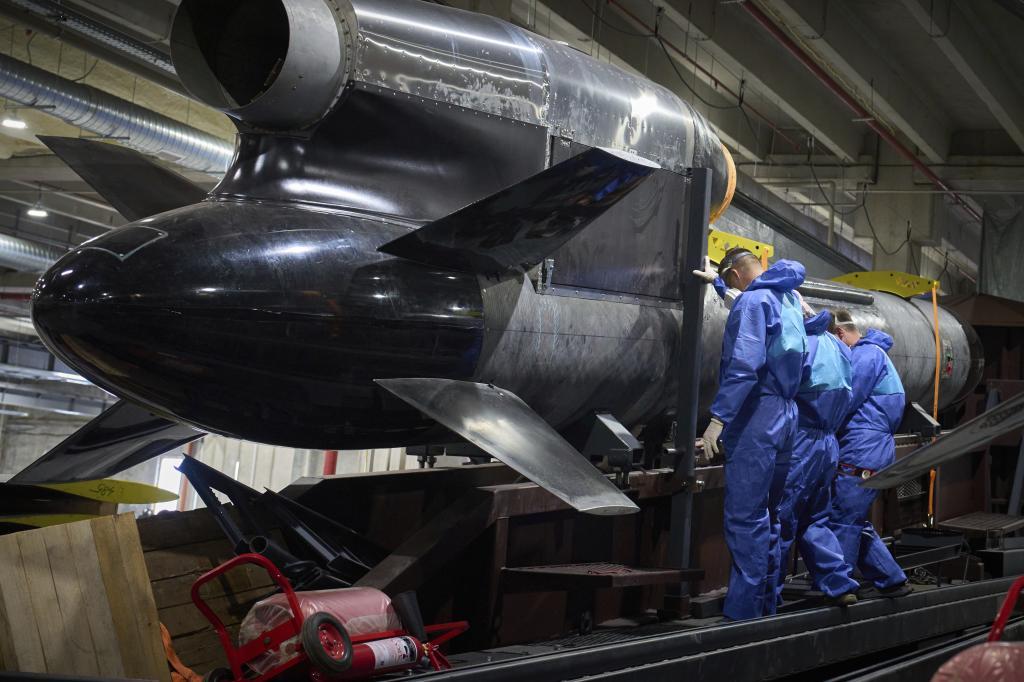
The Strum Blade drone is the latest Ukrainian innovation in the incessant technological race that its conflict with Russia has plunged into. It aims to combat the infamous Zhdun drones, made of fiber optics, which remain hidden on the sides of supply roads. These unmanned aerial vehicles (AUVs) wait for hours as they use minimal battery and attack passing vehicles.
AUVs have become a ubiquitous presence in this war. Those guided by pilots connected to the device via fiber optics are immune to interference. "The only way to stop them is to cut the cable. It is a serious problem because currently 90% of our casualties occur during the supply or troop replacement process (when traveling along the Zhdun's target roads)," says Yevgeny Semenov, the director of the company that produces the Strum Blade.
The quadcopter rises carrying a coil equipped with a metal cord wound inside, which ends in a weight. The pilot lowers the filament until the counterweight drags on the ground and then advances to collide with a tangle of fiber optic cables tied to two poles. It cuts them easily.
"The idea is to drag the metal cord along the routes and thus 'clean' them. If we cut the fiber optic, the Russians lose control of the drone and cannot attack. It can 'clean' 10 kilometers per hour. It costs about $1,500," explains the young executive and former aviation pilot, 34 years old.
It might seem like something out of a science fiction script, but in Ukraine, it is a daily reality. Drones against drones, robots against robots.
In the same tent erected in the testing center -a large outdoor space, full of groves and polygons, where internet Wifi service is available, thanks to the small Startlink antennas-, the company led by Semenov showcases one of the unique flying "suppositories" (as some experts call them) that have been developed in this country in response to the Shaheed drones, of Iranian origin. It is the Interceptor Strum.
"The latest designs we have already include cameras and are connected to a radar system. Each team covers an area of 25 kilometers. Since 2024, we have deployed around 7,000 interceptors, and our calculation is that we have needed about three to shoot down each Shaheed," adds the Ukrainian.
Semenov plays with the same equation that inspires most creators in this country: cost and effectiveness. The price of a Strum is around $1,000. A Shaheed exceeds $20,000. And the interception missiles that make up the basis of the Western shield, the famous Patriots, cost close to four million.
The technology exhibition held at the Ukrainian Training and Testing Complex (Uttc) includes all types of ground robots, mostly specialized in mine clearance.
The event began with a unique parade in which a dozen small mobile platforms of this type "paraded" through the venue, each followed by the pilot driving them, as if they were their pets.
Other companies, such as Mikhailo Visarsky's engineering firm Uadamage, have chosen to develop ecosystems that integrate drones, sensors, cameras, and artificial intelligence, contrasting with traditional mine detectors.
"Until the invasion of Ukraine began (in 2022), mine detection experts were using the same technology from 70 years ago. They can recognize 10 square meters in a day. Our drone can recognize a hectare in an hour. It is 100 times faster. The West continues to improve horses. We are designing cars," proclaims the young man, who like most present is around thirty years old and comes from the IT sector.
The so-called Technology Week at Uttc held this week in the Lviv region -which brought together nearly fifty companies specialized in demining and other war-related technologies- was another showcase of the spectacular evolution of the Ukrainian military industry that the conflict has generated, placing this nation among the leaders in the development of drones of all types -aerial, ground, and maritime-, thus subverting the dynamics of a state that survived in part thanks to European assistance after 2022.
The event coincided with the presence of nearly 60 Ukrainian companies at Eurosatory-2026 in Paris, one of the main fairs for military technology worldwide, where they presented the latest innovations in the country's sector: from ballistic missiles to a new kamikaze underwater drone -capable of carrying 1,000 kilograms of explosives- or the dozens of designs of unmanned aerial vehicles (UAVs) and ground "robots" that local companies are producing.
Defense reference for the EU
Kiev has decided to promote itself as one of the references for the new European Union Defense system, taking advantage of the experience gained in this conflict, moving away from the simple role of aid recipient it had maintained since the start of the general Russian offensive in 2022.
The conflict has dramatically reversed this trend to the point that Kiev announced last May that it would no longer send more military personnel abroad for training. For many months, Ukrainian soldiers had complained that the training they received in Europe was completely outdated for the technological and drone warfare being fought on their territory.
At the end of April, President Zelenski announced that Ukraine was once again exporting military equipment after noting "an excess production capacity of certain types of weapons reaching 50%".
Ukraine still remains the nation that imports the most weaponry globally, but the local industry now covers about 50% -it was 10% in 2022- of its requirements, as explained by Zelenski.
According to Ihor Bezkaravainyi, Deputy Minister of Economy in charge of demining in the country, present at the Lviv event, "Europe needs to start seeing us as partners. The technology that Ukraine is developing is effective and inexpensive. It represents a radical change in the rules of the game. Meanwhile, Europe continues to spend millions on a defense system that can be surpassed by drones that cost hundreds of euros."
In February, Zelenski stated that his country plans to open a dozen arms export centers in various European cities this year.
"We have around 450 companies in Ukraine manufacturing drones. Between 40 and 50 are leaders in that market. Everyone wants to invest. 2026 will be the year of investments in our technology," the head of state had declared around the same time.
"The development of the military industry is the logical way out for Ukraine's economy in the future. It is what happened with Japan after World War II. The economic miracle (as that phenomenon that allowed the Asian country to recover from the devastation it suffered in the conflict was dubbed) was based on helping the US army (during the Korean War) by manufacturing good and cheap vehicles. Yes, now we produce drones for war, but in the future, we can use them to deliver pizzas," added Bezkaravainyi.
Ihor Fedirko, director of the Ukrainian Defense Industry Council, the association of this sector, estimated that this year alone the country could export weapons worth $2 billion. That is, 10 times more than in 2021, just before the Moscow offensive.
According to the local Ministry of Defense, of the 175 new models of weapons and military equipment approved in May, 93% are already fully produced by local companies.
"This confirms the rapid development and increasing autonomy of Ukraine's Defense industry," emphasized the aforementioned department in a statement.
Kiev has signed in recent months multibillion-dollar contracts with military sector companies such as the German Quantum Systems, the American Auterion, or the giant Airbus Defense and Space.
On the 12th, this latter company announced a "strategic" agreement with the Ukrainian drone manufacturer Skyfall to establish the much-discussed "multi-layered air defense" that the EU intends to implement to confront this new technological era.
Just two days earlier, the European corporation MBDA—which manufactures the Taurus cruise missile—signed a similar alliance with the Ukrainian company Armor for the production of long-range drones and an interception system for these unmanned aerial vehicles.
The Iran-Contra conflict has also led Gulf countries to request assistance from Ukrainian experts in defense against Iranian UAVs.
According to Yevgeny Semenov, the very dynamics of warfare have taught them that "in this era, technology changes every three months. What worked yesterday is obsolete today." That's why, when Ukrainian experts like him hear the figures for drones handled by the most capable European armies - which don't exceed thousands - they burst out laughing.