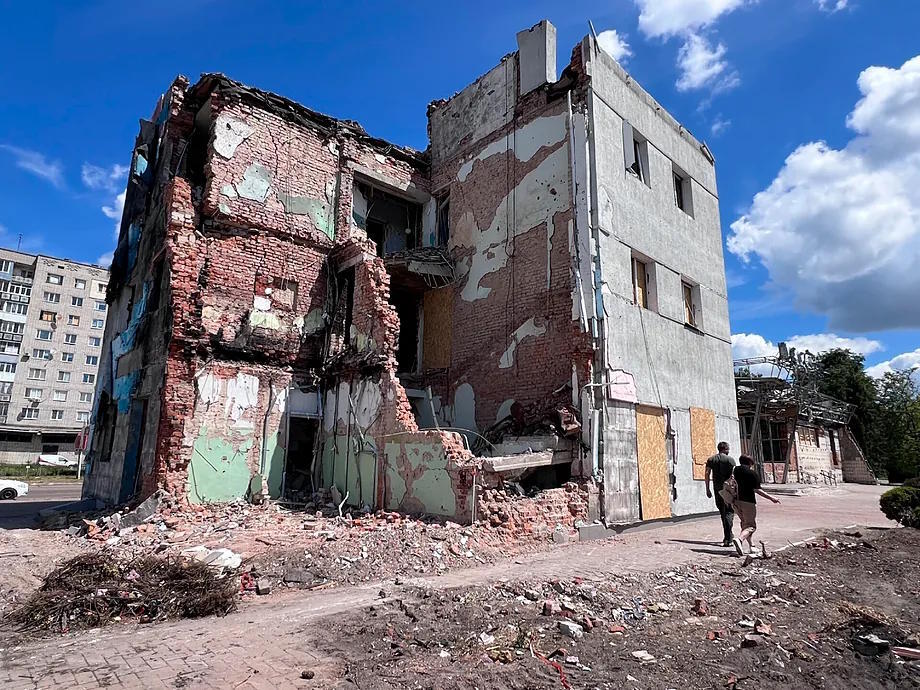
The general invasion launched by the Russian army on February 24, 2022, allowed the creation of an epic narrative around Shostka (Ukraine) where for several weeks it was a sort of "free republic" - that's the term used by its mayor, Mykola Noga - that could not be captured by the neighboring country's troops surrounding it.
"On the first day, we blew up the bridge over the Desna River and that halted the Russian advance southward (towards Kiev). They tried to set up a pontoon, but we destroyed it. In the end, the Russian tanks had to go around Shostka. We were left as if we were an island in the middle of all the territories occupied by the Russians," recounts the Ukrainian mayor.
The population and the thirty villages under its administration were blocked in what they remember as a "siege" similar to what the provincial capital, Sumy, also endured. The region, bordering Russia, was one of the axes chosen by Moscow's army to advance towards the Ukrainian capital, located over 300 kilometers to the south.
"We had to bring food from Dnipro, and I even had to go pick up 76 million hryvnias (1.5 million euros) in cash, which we passed through Russian checkpoints, hidden in bags covered with beets. We had run out of cash," recalls the municipal official.
The legend of the "resistance" of Shostka - located just 50 kilometers from the Russian border - reached such a point that many residents of the capital sought refuge in that pocket, adds the mayor.
The 74-year-old official speaks in an office where the windows have been replaced by wooden panels. Many nearby offices have their doors torn off. A Russian drone exploded meters away from the municipal building on May 4. It did not crash into the building because it hit a cement pole.
The huge crater it left in the asphalt can still be seen. And a piece of a wing from the unmanned aerial vehicle (UAV) that Mayor Noga kept at the municipal headquarters.
The Russians failed to capture Shostka four years ago, but now, according to the local official, they have decided to "turn it into a ghost town", repeatedly attacking it with waves of UAVs, as part of the renewed military effort that has been maintained this year after President Vladimir Putin himself ordered the creation of a "buffer zone" in the Sumy province - where Shostka is located - and the adjacent Kharkiv province.
The president's directive began to materialize immediately, and in the same month of December, the Russians occupied the village of Hraboske. Ukrainian sources like Deep State, a group specialized in conflict analysis, have acknowledged that Russian military control a series of small enclaves along the border, but a spokesperson for the local armed forces, Viktor Trehubov, stated in April that these advances are "unpleasant, but do not exceed 1.5 kilometers from the border".
Most experts agree that a lightning offensive like the one seen in the region in 2022 is now unthinkable.
"People remember that the Russians were on the outskirts of Sumy at noon (on the 24th). On the 25th, the siege of Sumy began, lasting a month. The war has changed. That is not possible today (due to drones)," said analyst Viktor Bobyrenko in a local publication.
At the same time, the Russian effort has resulted in an intensification of the action of the Shahed (Iranian-origin UAVs) and flying bombs (called kab) against various urban centers in the province
This past Saturday, the Russian aviation launched at least seven of these bombs against Sumy, damaging around twenty private homes. The bombs left huge craters, one dead, and numerous injured.
"The attacks have increased tenfold compared to last year. Putin wants to terrorize us, make people flee. Most of the attacks occur in waves. The first one attracts the rescue teams, and then the second one arrives," says Noga, the head of the Shostka municipality.
The latest example of this tactic occurred just two days ago, he adds. According to him, a 69-year-old resident of the city came across a Shahed lying on the road. He was riding his bicycle.
Noga says that "the rescue services told him to flee, that a second Shahed could come. He didn't listen, and indeed, a second one came and killed him. He was a former liquidator of Chernobyl (the groups of workers who had to extinguish the fire at the nuclear power plant during the 1986 disaster). He survived the nuclear disaster but was ultimately killed by the Russians."
Signs of repeated aerial assaults on the town and the surrounding villages, where 85,000 people still live, are evident when walking through the streets. The train station was devastated by another wave of UAVs on May 29. Half of the main building collapsed.
Just like the extensive sports center built in 1976. "It burned for hours," says one of the employees while showing the charred facilities.
Provincial authorities, in this case Governor Oleh Hryhorov, also accuse Moscow of intensifying actions against "civilian targets" and using the northern region as "a kind of training ground" for their drone pilots.
According to Hryhorov, since the beginning of the year, the enemy forces have been deploying "mothership drones" in this territory carrying smaller drones that are activated over the metropolis. Sumy should be beyond the range of action of the so-called FPVs, the smaller but most effective and feared drones. This tactic has put the city under the action of these devices.
"This year, we have already detected 52 FPVs," Hryhorov claims.
"They have developed a technique that interferes with our radars with false signals. It looks like there is a drone, but it's a ghost, it doesn't exist. They make us launch interceptors for nothing," he adds.
The increase in actions by these FPVs has forced the use of roads covered by nets - they have already protected 400 kilometers - which is now the norm in the eastern part of the country. Also, many gas stations in Sumy are protected in the same way.
The town - located 30 kilometers from Russian territory - has also been the scene of aerial assaults reminiscent of the infamous "human safaris" that the Russians began implementing in the southern town of Kherson and later extended to many other enclaves.
Natalia Stratiy and her friend Olha witnessed one that targeted a funeral procession on May 23. The two nurses were attending the funeral of a colleague's husband along with dozens of others. They formed a procession of nearly a dozen vehicles, including a bus carrying uniformed soldiers, comrades of the deceased who served in the local army.
"At first, we thought it was a bird. It looked like a black spot in the sky," recalls Natalia. It wasn't. The UAV began flying around the procession as the cars tried to escape in the midst of panic. Eventually, it swooped down on the soldiers traveling in the bus.
«The explosion killed one person instantly and amputated both legs of another. He died shortly after arriving at the hospital. Thirteen other people were injured», said Dr. Victoria Voloshyna, who was on duty at the main hospital in Sumy.
The healthcare center is currently treating more than a dozen victims of the Shahed's actions. «Every day we receive three or four injured people from these drones», said the director, Tetyana Senko.
Not far from the hospital, the head of the local equestrian center, Oleksandr Salatenko, was busy this weekend evacuating the last victim of the aerial attack that hit the club on the 16th.
A few kilometers from the healthcare facility, despite his age of 71 years, Oleksandr was one of the half-dozen workers trying to drag the body of Yangtze, a ten-year-old award-winning animal, injured by shrapnel after the UAV impact on the stables. «We tried to keep him alive but he died on Friday».
The Shahed explosion pierced the roof, destroyed four stables, and instantly killed three other horses, out of nearly a hundred living in this complex.
«The eyes of all the horses tell us the same thing. Why? Neither they nor we understand why an equestrian club has to be attacked, why horses have to be killed», Sofia Zakorko, a 16-year-old equestrian champion, wonders, who came to bid farewell to Yangtze.
Like Shotska or Sumy, the Russian onslaught of 2022 left aside the city of Baturin, on the border that marks the separation between this province and the neighboring Chernihiv.
The symbolism that Shotska acquired at that time cannot match the significance that Baturin holds in the collective imagination of Ukraine. This was the capital of the Cossack proto-state that controlled a large part of the current territory of the European state in the second half of the 17th century. Even now, in the midst of war and despite the fact that the border with Russia is about an hour's drive away, Ukrainians continue to pilgrimage to this place, to visit the reproduction of the castle that served as the kingdom's headquarters or the memorial that commemorates the victims of the 1708 massacre.
That year, Tsar Peter the Great's troops captured the square, defended by the Cossacks, allies of the Swedish army. The Russians killed thousands of people in an event that for Ukrainians echoes the somber significance of the bombing of Guernika for the Spanish.
In the underground of a chapel that houses several dozen small coffins with the supposed remains of some of the victims of that massacre, a statement from former Ukrainian President Viktor Yushchenko can be read, who promoted the restoration of Baturin's remains. «This is the 24th war that Russia has launched against us. Three centuries ago it was Peter the Great. Now Putin. The enemy is the same. The goal is the same. Nothing has changed».