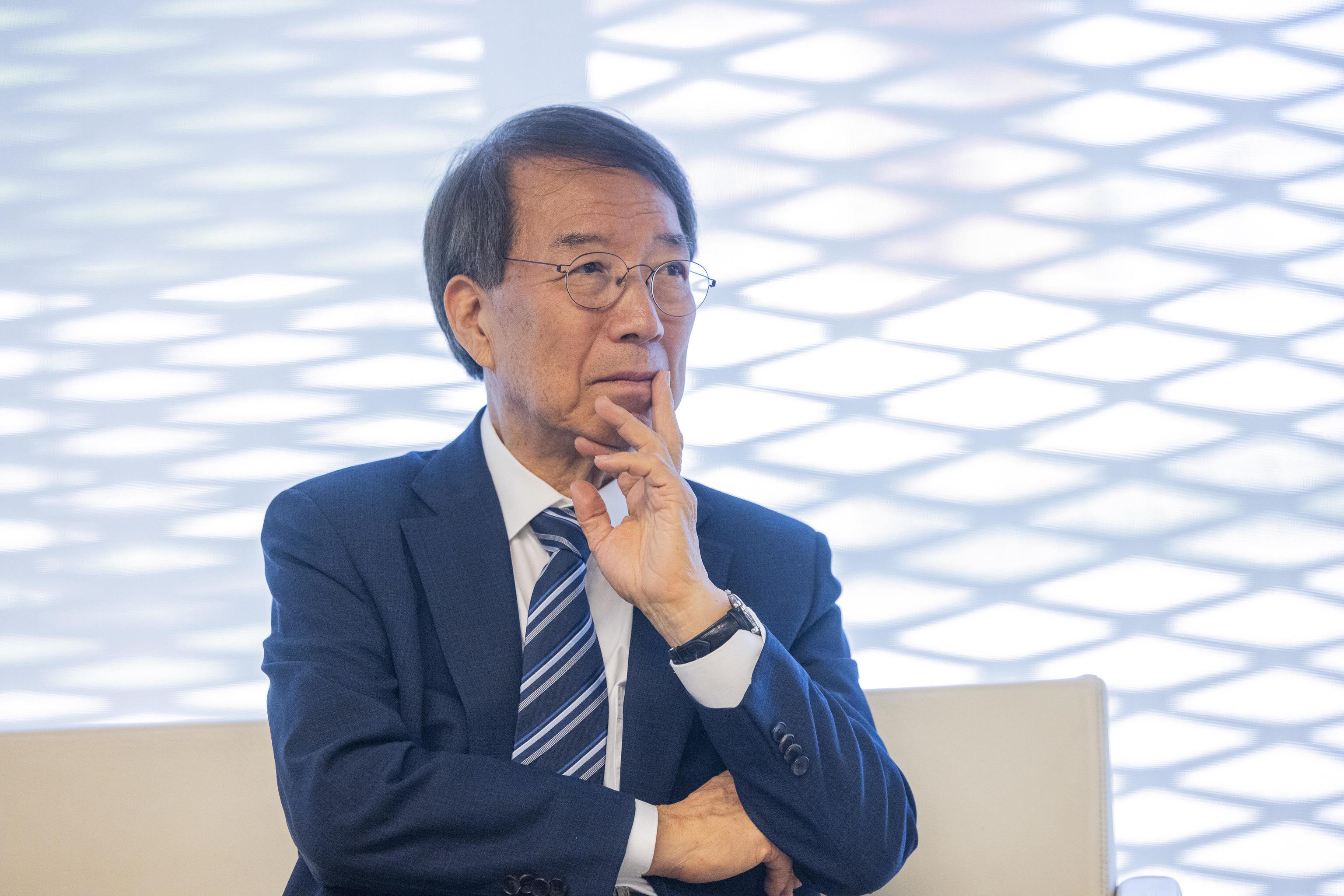
Chung Un-Chan (Gongju, 1947) was the Prime Minister of South Korea between September 2009 and August 2010. A Ph.D. in Economics from Princeton University, during a visit to Zaragoza for the 150th anniversary of the Ibercaja Foundation, he analyzes the development issues of one of the most important technological powers in the world.
South Korea is one of the most powerful economies in the world thanks to the significant presence of companies like Samsung, LG, or Hyundai, among many others; however, its growth seems to have stagnated in recent years, despite the boom in global demand for semiconductors. Where should South Korea be heading?
Although South Korea has long been known for its successful economic growth, it is currently facing challenges. It has been experiencing slow growth since the mid-1990s. Every time there has been a change in the political regime, the growth rate has decreased by one percentage point. At the same time, there is a very serious level of inequality. This can happen for many reasons, but I want to highlight the lack of investment, especially from large companies. Over the past 30 years, they have been able to accumulate astronomical amounts of money, but they have not invested it in developing new technology. I believe this is something they need to do, and it is partly what is causing South Korea to experience a very low growth period.
Should South Korea explore other markets to reduce its dependence on Chaebols?
It is not a market issue. Large companies have a lot of money and they need to pay small companies enough for the services they provide. However, for a long time in Korea, the relationship between large and small companies has been known as an A-B relationship. Small companies do not challenge the large ones because they depend on them. Therefore, if there were shared growth, small companies would have more money, leading to more investment, more production, more employment, more income, more consumption, and thus, the economy would progress.
Is it possible for a young person to thrive in South Korea if they do not secure a job at one of the Chaebols?
Chaebols offer good salaries and many additional benefits, making them very attractive to young people. They do not want to go anywhere other than large companies or the public sector, and the only thing the government can do to change this situation is to encourage them to take a different path by improving regional and rural areas. It is not desirable for the country for all young people to want to work in large companies.
Why is there so much inequality between older and younger people in South Korea?
Older people earned a lot of money when the economy was doing well and decided to save it for the future because they now have no way of generating income. Inequality is not a desirable scenario for any country, but I see it as natural for there to be some economic disparity between the young and the old.
Do you think the solution to this problem could be the establishment of a pension system similar to Norway's, where, in the case of South Korea, the surplus income from semiconductor sales is allocated to a common fund to support the population?
I do not believe that private companies should be obligated to contribute a portion of their income to the state's coffers. Companies are not non-profit organizations; when they act, they seek profits. The state economy must survive, but I do not think it is appropriate to base its development on the results obtained by external companies.
Spain and Korea share some structural problems, such as access to housing. How do you think they should address this?
I have to say that I am not an expert on housing issues. I am trained as an economist and do not know much about housing, but based on the Korean experience, what I have observed is that democratic or liberal governments have tended to fail in the housing issue. Conservative governments have been more successful, or at least have not failed. Progressive governments do many things to control housing prices, and in South Korea, the current administration is trying many measures, yet the trend continues to be rising housing prices. So my answer is: we should not work too hard to solve housing problems. Why not let the market solve them?
What do you think of the expansionist policy being pursued by Donald Trump?
I think it is due to the upcoming midterm elections.
Do you consider his figure a risk to global stability?
It is a significant risk because everyone is affected by his decisions.
The failures of Trump in Iran, Putin in Ukraine... do you think these are good precedents to deter China from invading Taiwan?
I believe it is a positive sign, without a doubt. The Chinese have been deterred from considering an invasion of Taiwan, at least for the time being.
We have discussed during this interview the paths that South Korea should take to develop its economy and achieve stability, but is that possible while sharing a border with a country like North Korea?
Of course. It is true that in the last two years, the situation has worsened in the sense that Kim Jong-un does not want to engage in discussions with certain individuals. However, South Korea has thrived over the past 70 years or so. So, I do not believe that the deterioration of relations between the South and the North has decisively affected the situation.
One of the biggest differences between the two Koreas is the openness to the rest of the world, which has been expanded with the significant growth of the Hallyu culture. How does the image portrayed by K-Pop and similar movements benefit South Korea in its international development?
It has been very beneficial, without a doubt. Let me share a story: in ancient times, the Chinese did not respect the surrounding peoples. They called them barbarians, but they always noted that the Koreans enjoyed music and dance. I think that is a good description of who we are, and now it represents a movement that I believe will continue for a long time. Today, Seoul, Busan, and some other areas are filled with people who are not from Korea. Our image has improved because for decades we were only known for being diligent and achieving a certain level of economic success. With the emerge