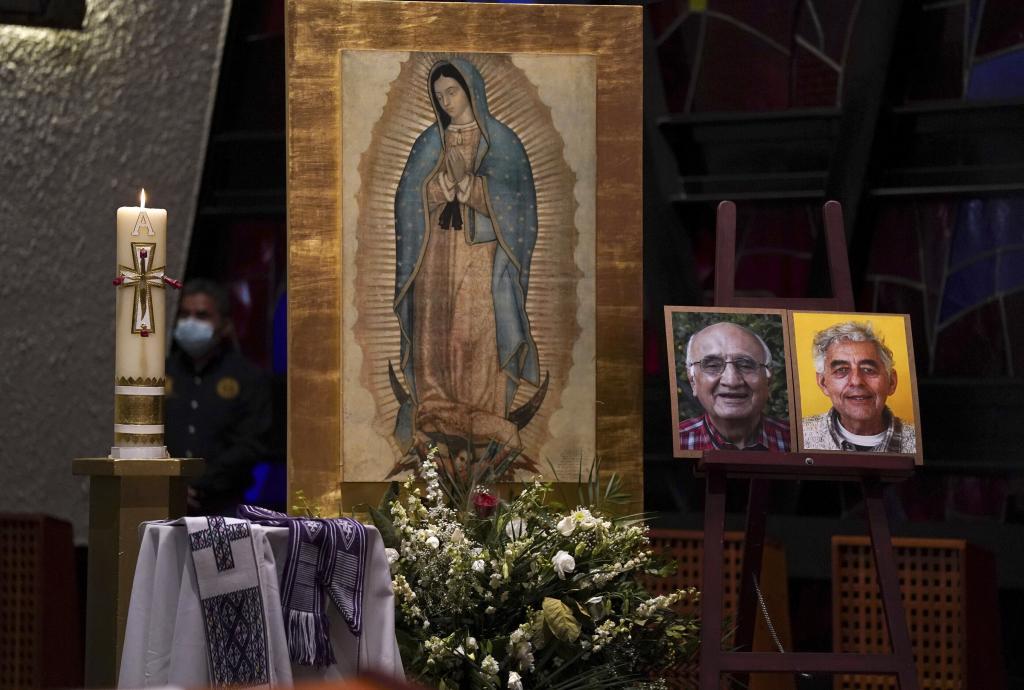
For the past 10 years, Fernando de Haro, journalist, writer, and filmmaker, has traveled the world creating a series of documentaries that depict the lives of Christians in hostile places: Egypt, Syria, Lebanon, Iraq, China, Pakistan, India, Nigeria, Palestine, Israel... The latest installment of his work has a particular focus on Mexico, a country with an immense Christian majority.
We turn to him to learn about this unknown violence in Spain, which he portrays in the documentary Life in Mexico. "In many parts of Mexico, the State is a failed state. The Republic's monopoly on violence does not exist, and it has been taken over by the drug cartels. The State also cannot guarantee the protection of individuals, and that's where the priests come in. And that's where the danger lies," explains De Haro.
The filmmaker continues: "Mexico was founded with an anti-clerical revolution and the persecution of some priests. But I wouldn't dare to connect that historical confrontation with the current situation," says the journalist. "Religious freedom is complete despite some remaining laws. There is no persecution or continuity from the anti-clericalism. In fact, the great paradox is that many of the hitmen who kill priests are Catholics. It's violence from Catholics against Catholics that began in the 90s when organized crime became a social entity that structured Mexican society, and the priests acted as a brake on its expansion," he recounts.
"I saw it in the Sierra de Guerrero. People told me: life is normal, we dedicate ourselves to opium poppy. The cartel controls the territory, redistributes wealth, and manages some social benefits... Like anywhere else. But it's not normal, everything is debased from the moment the agent sustaining the community is a person involved in the business of terror. There is no freedom. People have to get involved with the cartel because there is no other alternative than being a victim and victimizer. That poisons relationships," details De Haro. "Someone dies, someone kills. It happens all the time. The staging of death is constant. They don't just kill you: they kill you, decapitate you, and display your head in a taxi. And all citizens are judged by their relationship with the cartel."
"The persecution of priests is not ideological," De Haro continues. "Hitmen target the Church because priests stand up for the people, for the indigenous, as happened with the encomenderos and religious orders centuries ago."
This church policy, almost instinctive, was taken at ground level. "There was another option for the Church, mediation. Some bishops have tried it amid civil wars between cartels. There was a very strong internal debate. I can tell you that it went terribly for the Church. There is a third level of response, an institutional response denouncing the narco-state. The Church does not directly confront the State but points out its contradictions. An example: President Sheinbaum boasts of reducing the number of deaths from the cartel. The reality is that they are disaggregating disappearances and deaths. The Church has denounced that as manipulating statistics," De Haro asserts.
"Someone dies, someone kills. It happens all the time."
-Can I ask about Protestant communities in Mexico?
-Some evangelical pastors face persecution like Catholic priests. There is an evangelical tradition that has confronted the cartel and suffered for it. Another thing is Pentecostalism coming from the United States, which merges politics and religion and spreads the MAGA ideology. They do not identify with the cartel, but since they limit themselves to praying and do not engage in any social issues, they stay out of trouble. There is no social dimension in their religious life, so the cartel doesn't target them.
"In the cartel territory, the person is presumed guilty. A moderately healthy society is based on bonds of trust. The other person won't steal from you, kill you, deceive you. In Mexico, that is inverted. If your child disappears, you think it's because they were involved with the cartel. Why believe in such a landscape?" "Because there are people who live in a luminous way amidst this darkness and support others. And faith is based on that humanity that defends people."
Additionally: "The cartel has changed since fentanyl conquered the market. Now, they focus on controlling territory through any illegal business." The cartels have evolved. Their new target is illegal mining and the profitable rare earth minerals business. Of course, they also engage in kidnapping and human trafficking, sexual slavery, and forced labor. "For them, there is no contradiction between being a hitman and following a popular religiousness, almost mythical, based on ritual and pilgrimage. That cannot be the essence because ritual can coexist with anything. The essence is to question what it means to be a Christian," De Haro concludes.