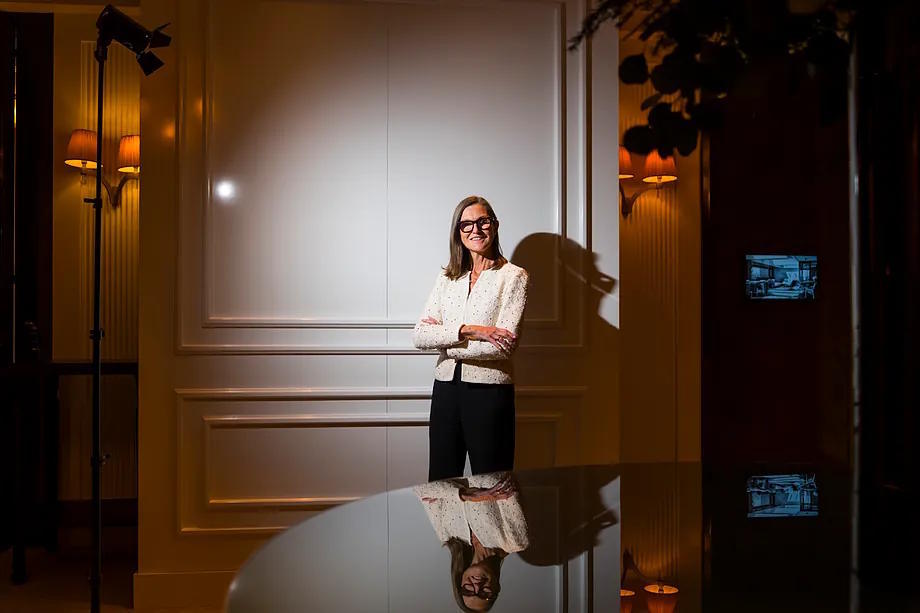
Cathie Wood (Los Angeles, 1955) is to value management what Warren Buffet is to; the oracle of the most disruptive companies, from the early days of Facebook - whom she supported from the beginning - to blockchain technology and, now more than ever, in the era of the AI boom. As the founder of Ark Invest, her vision goes beyond being one of the benchmark funds for those looking to invest in US technology with over $7.3 billion in assets under management. And yes, she attended SpaceX's IPO as a staunch supporter of Elon Musk and his vision of the future.
This week, Wood visited Madrid to meet with over 100 investors in the city center, in that impasse between the visit of Pope Leon XIV and the start of the World Cup that brought together thousands of people just a few streets away in the fan zone on Spain's debut day. The American investor states that this will not be the last time she comes to Spain, in an attempt to expand her business to Europe. The idea is to attract investors beyond the US, to expand, even though her funds are freely bought and sold (Capital Strategies helps with their commercialization here). ARK Invest was founded in 2014, and from the early years, Wood confesses that she was surprised by the interest they received from across the Atlantic. "25% of the visits to our website [a decade ago] came from Europe," and "we thought: we have to find a way to reach there (...) even though we always thought it was very difficult," and the first thing that comes to her mind is excessive regulation. But now the situation is different in this European attempt to create "deeper and more relevant markets."
QUESTION. In fact, it is becoming more common for this bridge between the US and Europe to be crossed. SpaceX, which debuted on the US stock exchange last week, also reserved a portion of its placement exclusively for European retail investors, which is also striking because in Spain we are not used to...
ANSWER. I know. It's not common. Elon Musk is very grateful to the retail investor who helped him start Tesla.
Q. Did you attend SpaceX's IPO?
A. We were shareholders of SpaceX when it was a private company, and it was our largest position, with 11% of the assets invested there. Following our experience as investors with Tesla, we know Elon Musk and his team very well. They changed the company's business model without even thinking about it before, nor did we, until they started to get frustrated with the problems generated by the data centers they had in Tennessee or Memphis. Electricity prices are rising, coupled with bureaucracy, delays, regulation... and then he [Musk] said to himself: 'I have to change this.' And that's how the idea of data centers on Mars or in space orbits started. It wasn't in the model, not in a public one. We are still working on how relevant the new model can be, but the $1.8 trillion valuation makes sense to us.
Q. So, did you attend the IPO?
A. Yes, with around $500 million, which is wonderful. No one knows how both companies [Tesla and SpaceX] will evolve. In the prospectus [S1] in which SpaceX announced its IPO, the forecasts they published are even higher than ours. Their view of the world goes far beyond telecommunications, broadcasting content... and the market behind it (which is massive). What they are telling us is that bringing all that connectivity to the most remote areas of the world will dramatically reduce its cost. They will do it through agreements with a 'teleco,' but eventually, they will be able to do it on their own. The other thing we learned from reading the prospectus is that they will be able to pay us more than we thought. I'll give you an example. And it's something I now begin to understand because I travel internationally more. Some planes have working Wi-Fi. Most do not. American Airlines has just announced an agreement with Starlink, and Delta will do so shortly. So as a traveler, I will be able to choose planes that have reached an agreement with Starlink, which is beneficial for airlines.
Q. Does Starlink have a monopoly on this business?
A. In terms of satellite-to-satellite connectivity or market share in this business, they hold 75% of the world's satellites, including those of governments. The reality is that SpaceX is 10 years ahead of any other company in the use of reused rockets and cost reduction to launch satellites into the sky with the aim of developing this opportunity in telecommunications. Let me explain how relevant this opportunity is. They started using reused rockets a decade ago, and no one else has been able to. They have a 75% market share, so they dominate communications from space and are considering having data centers there. The communications business is $1.6 billion; space data centers represent a $2.5 billion opportunity. But the big part is artificial intelligence with $22.5 billion. And I believe they will be able to achieve it because the secret to achieving it in frontier AI models lies in computing capacity, and SpaceX will have access, more than any other company, to storage (...) Companies like Anthropic have been desperate to get more capacity or Google, which surprised me because it already had a lot of storage, still needs more. There is an insatiable appetite.
Q. And will there be enough space on Earth?
A. There is space, but also a lot of overregulation, bureaucracy, and that does not exist in space.
Q. And then there is the endless use that will require raw materials to cool down, for example.
A. This is where SpaceX's aspirations to reach the Moon come in. There are materials there to which they have access, which do not exist on Earth, and that have properties that can help in the process.
Q. From everything I hear, would you say that SpaceX is 'the' company with capital letters?
A. I believe so. It is 10 years ahead of everyone else, and it all started with the use of 'recycled' rockets. If you can use them, your costs are dramatically lower than for other companies.
Q. In this race to lead the new wave of AI, do you think there will be winners and losers, Anthropic vs. OpenAI?
A. It's interesting. Anthropic withdrew Claude Mythos after the government's requirement that no non-US citizen could use their systems, even in the US. Anthropic said: 'You're not going to let my own workers use these models? Okay, we have to find a solution.' This gives OpenAI a chance to move very quickly. The question is: Will OpenAI confront the government over this ban? I think they have learned a lot about what not to do. These are concepts that we used to associate with financial issues and now with national security. There is a big question to answer as a result of this, and that is whether everything will slow down, giving other countries and companies the opportunity to solve the problem in a different way. This is the big question.
Q. Do you see it as an opportunity for Europe to join the race?
A. The problem in Europe is regulation. The way it is heading towards this opportunity is through sovereignty. The problem with AI is that it is a scale opportunity, and the more you scale, the lower your costs. So I think it will be successful in terms of national sovereignty, but not in the sense of creating a general-purpose technological platform that reaches everyone.
A. Yes, I believe there is a greater understanding of how much computing power is needed and why these mega US companies, with so much liquidity and cash, have decided, after years, to go to the bond market or the stock market. In December of last year, Anthropic launched a revenue estimate of $9 billion. Today it is $47 billion, six months later. That is, in half a year, Anthropic has been able to increase its revenue by the same amount as the total sales of Salesforce.com, with 25 years of history. Companies like Google or Amazon are also raising capital because the reality is that if they want to sustain their growth rates, their acceleration, they are going to have to spend.
Q. As a manager, are you not concerned about the size that these types of companies are reaching if something were to happen?
A. In terms of something going wrong, we just saw it with Claude Mythos. And that's why I pose the question of whether we will see everything slow down from now on. Will regulation start to hinder the pace of progress? I don't think so, at least not in the US. They are very focused on national security. This Administration revolves around deregulation and staying out of the business of companies, but it has a lot to do with defense and protecting the country. And then there is another lesson that some companies have learned, that their engineers were working on many projects at once. They are not carefully considering the most efficient way to leverage AI models. I think Uber was the first company to stop and see what they were doing when they had spent the entire AI budget in the first three or four months of the year. Now it's not that they want to stop, what they don't want is to waste it. Companies are in an optimization phase, that's the word, after years of spending a lot, hiring a lot. But this is good from my point of view. We don't want the behavior we saw during the dot-com bubble when money was thrown without thinking about efficiency. We are in a much more sensible moment.
Q. The truth is that I didn't want to ask about the 'bubble' until now because I knew the answer...
A. It may have gone too far too fast, but it doesn't resemble the bubble at all, precisely because another big difference is that everyone is concerned about it. And that's good. I lived through the 2000 bubble when I was a young fund manager and technology companies went public and multiplied their value by four or five times in a day, it was totally ridiculous. It's something we are not seeing now.
Q. Last question. As a strong supporter of Bitcoin, why would you say it hasn't acted as a refuge throughout the Iran war? Its price has fluctuated without an apparent reason behind it.
A. There could be several reasons... The first is the flash crash of October 10 last year. Another may be related to quantum computing [and its impact on the security of the bitcoin model], and then there is another reason: if you want to be bearish on something, you can, especially since AI has taken all the oxygen out of the room. It's the only thing people want to invest in and talk about. So yes, AI has become competition for Bitcoin. Nevertheless, we believe that Bitcoin is three revolutions in one. A global monetary system, private, without government control, mathematically measured with a cap of 21 million units. The second is that it is a new technology that brings currencies to the Internet. In the early 90s, no one thought digital commerce would take place, no one entered their credit card number to pay. I was one of them. And the third is that it is a new type of asset. It has no correlation with any other, not even with gold, although it is dubbed 'digital gold', and all managers always want an asset that will decouple their portfolio to improve profitability.