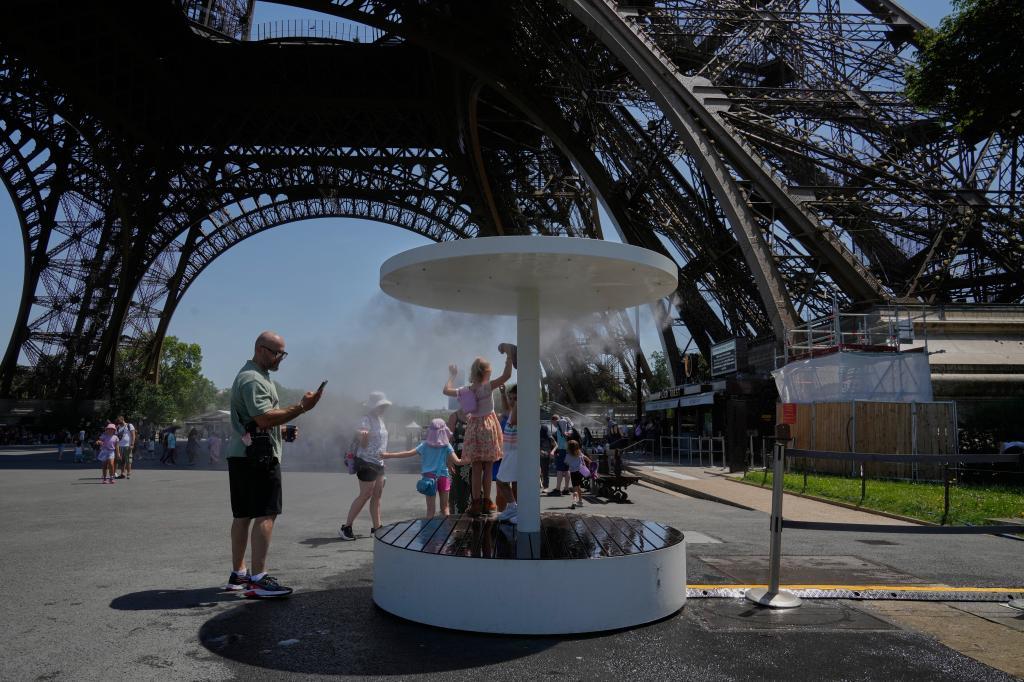
Irritability. Anxiety. Depression. Mental fatigue. Lack of sleep. Difficulty concentrating... Extreme heat not only affects physical health but also acts as a "mental stressor." The problem worsens in cities, where the concentration of human activity and lack of green spaces make temperatures up to three degrees higher than in the outskirts, and even more so at night.
"Extreme heat has a significant impact not only on physical health but also on mental health," Andrea Mechelli, a neuroscientist from King's College London, stated. "Only 9% of people consider that high temperatures affect their psychological well-being. However, they later acknowledge having trouble sleeping, inability to concentrate, or feeling exhausted, which are clearly symptoms caused by high temperatures."
Andrea Mechelli (Pistoia, 1976) refers to data, focused on studying mental health in cities with the Urban Mind project. An analysis of electronic medical records from the past 12 years in the UK has shown a 7% increase in the use of community services and a 6% increase in hospital admissions for mental health issues during heatwaves.
"Let's say that in these episodes, there are two parallel paths, the biological and the psychological," Mechelli adds. "High temperatures can cause dehydration, lack of sleep, and extra strain on the body, which can affect mood, concentration, and emotional regulation."
From a psychological perspective, he points out, "prolonged heat can be mentally exhausting." The symptoms, he adds, "range from irritability to mental fatigue. We feel that even the simplest tasks require more effort. And all these experiences can affect anxiety levels and low mood."
"When it's very hot, people tend to alter their routine," the Italian neuroscientist based in London explains based on discussions in focus groups. "We spend less time outdoors, exercise less, reduce social life... People living alone are even more isolated. And individuals with mental health issues are more vulnerable. There is also an underlying social justice issue: the impact is greater on people living in poorly conditioned neighborhoods and homes."
How to Avoid the 'Heat Island' Effect
Darkening and ventilating houses, drinking plenty of water, maintaining social contact, and adapting daily routines to cooler hours are some of the recommended strategies, as well as walking in shaded natural spaces where urban dwellers can combat the heat island effect early in the morning or late in the evening.
"Preparing for extreme heat does not just mean surviving the hottest days but creating conditions in which people and places can thrive," Mechelli recommends. "As summers get hotter, protecting mental health depends not only on how we individually adapt but on the type of spaces and cities we build throughout the year."
The scientist highlights the efforts of cities like Paris, Copenhagen, or Barcelona in renaturalizing their urban spaces and adopting the 3-30-300 rule conceived by Dutch researcher Cecel Konijnendijk: each city resident should see at least three adult trees from their home, live in a neighborhood with 30% tree cover, or reside within 300 meters of a green space.
"Contact with nature is vital for mental health," emphasizes the King's College professor, who is about to publish a book dedicated to the topic, Wild Minds, based on the popular blog of the same title. "Nature in cities is still perceived as something nice to have, but not essential or part of urban infrastructure, when its benefits are well proven."
With the help of two apps, Urban Mind and NatureBoost, thousands of experiences worldwide have been collected to assess the impact of nature contact on the mental health of urban dwellers: "We knew from previous studies that the risk of depression is lower in people living near green spaces. But one of our first discoveries was that living next to a large park is not necessary to notice improvement; sometimes just frequenting a small green space or filling a terrace with plants is enough."
"We have also discovered the prolonged effect of nature contact over time," warns the expert in urban and environmental health. "When people see trees or walk among them, the positive effects on their mental well-being can last for eight hours. A similar result is observed when someone listens to bird songs."
"Active participation," such as watering plants, planting a tree, or cultivating a community garden, proves to be the most beneficial in the long run. "But sometimes just opening our senses and paying attention is enough," Mechelli concludes. "Nature surrounds us even in the most unexpected places in cities."