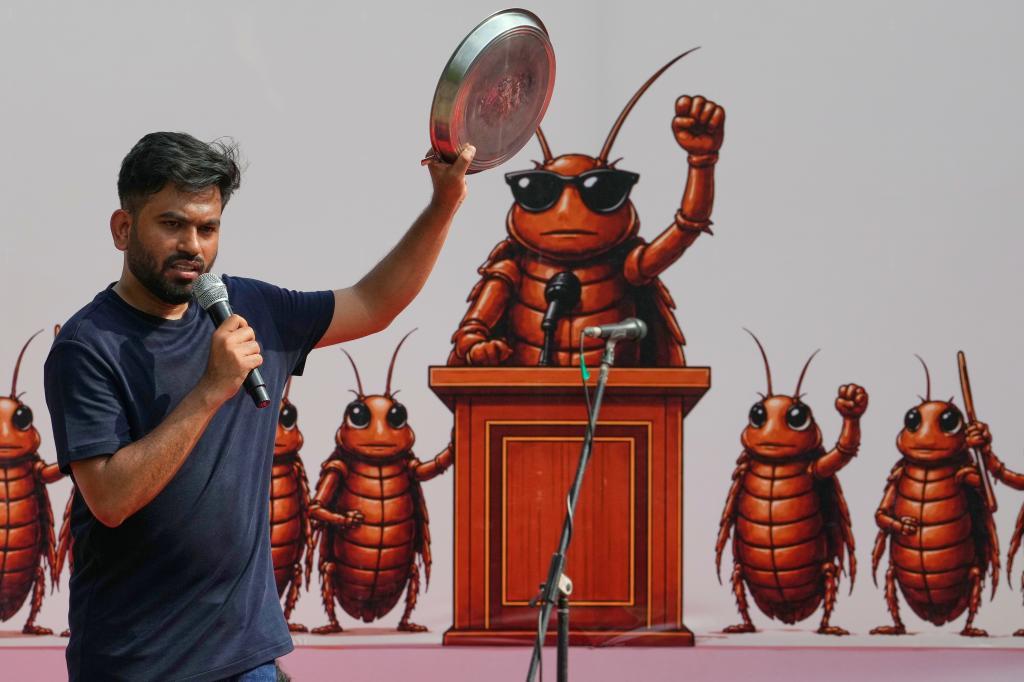
Under a whitish sky due to heat and pollution, hundreds of young people spend another night lying on cardboard, mats, and backpacks at Jantar Mantar, the traditional protest space in New Delhi. Some doze off leaning against the metal fences set up by the Police; others, wrapped in flags with the drawing of a smiling cockroach. A few meters away, officers monitor the entrances while organizers denounce temporary cuts in water and food to try to disperse the gathering. Amid hip-hop songs and slogans against the Government, the most unusual protest India has seen in years enters its fourth consecutive day. What started as an internet meme has turned into a movement capable of mobilizing thousands of young people and putting Education Minister Dharmendra Pradhan on the spot.
The spark of the protests has been the scandal surrounding the NEET-UG, the country's most competitive Medical entrance exam. Millions of students take the test every year. Accusations of leaks and irregularities in the scores sparked a wave of national outrage that forced authorities to cancel results and order new exams. For the protesters, the case became a symbol of something much deeper: the feeling that even sacrifice and merit can be nullified by corruption and bureaucratic chaos.
Riding on this accumulated discontent is the Cockroach Party (Cockroach Janta Party, CJP), a new social and political phenomenon. It all began in May when statements by a Supreme Court judge sparked a storm on social media. The judge stated that there were young people "like cockroaches" who, unable to find employment, ended up attacking institutions through activism and digital platforms. The comment was perceived by many as a display of contempt towards a generation trapped between enormous expectations and insufficient opportunities.
Among those who reacted was Abhijeet Dipke, a young graduate from Boston University and a digital communication expert. His response was an apparently absurd question posted on X: "What if all the cockroaches came together?". The joke took off. Within days, logos, satirical videos, viral campaigns, and a website emerged. Then came the millions of followers. The CJP's Instagram account surpassed 20 million followers, surpassing even the digital machinery of Prime Minister Narendra Modi's ruling Bharatiya Janata Party (BJP).
What initially seemed like another fleeting internet phenomenon began to take on real political dimensions. Dipke discovered that behind the memes was a massive audience waiting for a vehicle to express frustrations that had been building up for years. The cockroach, traditionally associated with dirt and contempt, was turned into a symbol of resistance.
In India, nearly half of its over 1.4 billion inhabitants are under 25 years old. Every year, millions of graduates leave universities and institutes to find themselves in a job market unable to absorb them. Youth unemployment remains one of the country's biggest structural challenges.
The CJP understood the youth's frustration. And the scandal related to the Medicine exam leaks fueled the protests in Delhi these days.
Analysts point out that while traditional parties remain trapped in old ideological discourses, the cockroach movement speaks the language of TikTok. It ridicules politicians through AI, uses humor as a political weapon, and turns every controversy into viral content. But beneath the layer of irony are very specific demands: transparency in selection processes, accountability in the education system, reliable employment data, and greater openness to criticism.
The current protests represent the first major test for a phenomenon born exclusively on the internet. Since Dipke returned from the United States and called for the first demonstration in Delhi on June 6, the movement has expanded its activities to cities like Mumbai, Bengaluru, and Nagpur.
The Modi Government has tried to contain the crisis by resorting to technical measures, including the temporary suspension of Telegram to hinder further leaks. Pressure increased even more after, according to local media, more than a dozen students committed suicide during the days of uncertainty between exam sessions.
The immediate demand of the protesters is the resignation of Minister Dharmendra Pradhan. But the political battle goes far beyond that. What is being fought on the streets of Delhi is whether a generation that has spent all its youth under the Modi era - over 12 years in power - can find a new form of political representation outside traditional structures.
The big question is whether these "cockroaches" can survive their own success. India's recent history is full of viral movements, digital campaigns, and outbursts of outrage that disappeared as quickly as they emerged. For now, Dipke insists that the immediate goal is not to run in elections but to pressure institutions to be accountable.
"What we are witnessing is not just a student protest or an internet trend. It is an expression of generational alienation," says political analyst Nilanjan Mukhopadhyay, one of the most recognized commentators on contemporary Indian politics. "The question is not whether the cockroaches will win elections tomorrow, but whether traditional parties are capable of addressing the frustrations that have allowed this movement to emerge."
Other experts are more cautious. According to Sanjay Kumar, a political scientist at the Centre for the Study of Developing Societies (CSDS), the main obstacle to any electoral leap is the nature of the movement itself. "Mobilizing followers on Instagram and mobilizing voters are two completely different things. Social networks generate visibility, but Indian politics still relies on territorial structures, local cadres, and on-the-ground organization," he explains. "The CJP has shown that there is enormous discontent among young people, but it is still far from becoming a competitive electoral force."