"Sooner or later the day will come when delivery workers are no longer needed." The phrase was recently uttered by Richard Liu, founder and chairman of JD.com, one of the Chinese e-commerce giants. In front of an audience of entrepreneurs gathered in Shenzhen, Liu voiced a concern that has been growing in the Asian superpower: what will happen when the world's second-largest economy materializes its major technological project and millions of workers discover that a machine can do their job better, faster, and cheaper.
JD.com employs around 700,000 delivery workers. Liu stated that the company is already working with about 120 schools to train these workers in new occupations, such as robot maintenance and repair. The message was intended to be reassuring. But the warning was impossible to ignore. If one of the largest private companies in the country publicly acknowledges that its couriers will eventually be replaced by machines, many Chinese wonder who will be next.
This issue comes at a delicate time. China is going through a prolonged economic slowdown, youth unemployment remains high, and the labor market has become increasingly precarious. According to estimates from Chinese research centers, around 320 million people work in the sectors most threatened in the short term - delivery workers and taxi drivers - by automation.
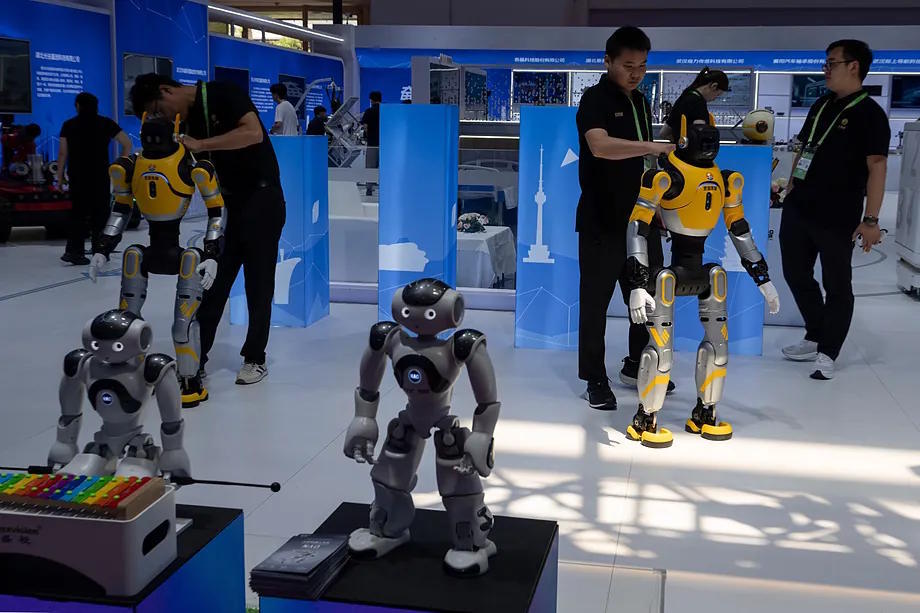
While the United States is leading the artificial intelligence race with advanced language models and chips, Beijing seems obsessed with bringing that intelligence into the physical world. The goal is for algorithms to leave screens and become mechanical arms, autonomous vehicles, and humanoid robots capable of transforming factories, warehouses, hospitals, and homes.
Robotics plays a central role in China's new five-year plan. For the authorities, it represents the next phase of industrial development and an essential tool to offset the aging population. But as the government aggressively promotes automation, courts are beginning to set limits on some of its consequences.
In May, a court in Hangzhou ruled that a technology company had illegally dismissed an employee after replacing his functions with an artificial intelligence system. The worker supervised quality control tasks until software took over much of his work. The company offered him an alternative position with a salary reduction. When he rejected the offer, he was fired.
The judges ruled in his favor. In an unusual statement, they pointed out that "the development of artificial intelligence should serve to free up work and improve people's well-being, not to erode their rights." This was not an isolated case. In recent months, several Chinese courts have supported workers displaced by AI, establishing that replacing employees with algorithms is a business decision aimed at reducing costs, but not an automatic justification for layoffs.
The balance between the new robotic revolution and social stability can be especially measured on the streets of Wuhan, the city that has become the world's largest robotaxi laboratory. There, Apollo Go's autonomous vehicles, Baidu's driverless driving subsidiary, are already part of the urban landscape. Driverless cars navigate crowded avenues, pick up passengers, and complete entire journeys without human intervention. But behind the technological showcase, taxi drivers have organized protests denouncing that autonomous vehicles are reducing their income.
This episode illustrates China's dilemma. On one hand, the country aims to become a global leader in autonomous mobility. On the other hand, authorities fear that too rapid job replacement may cause social instability.
Automation is also advancing in a less visible but equally important area: robot training. One of the major bottlenecks in the global industry is the scarcity of data. Robots need to observe millions of human movements before learning tasks as seemingly simple as folding a shirt, placing objects on a shelf, or picking fruit. Now, China is trying to solve this problem on a scale that is hard to imagine in other countries.
In Suqian, Richard Liu's hometown, JD.com is collaborating with local authorities to collect millions of hours of data for robot training. Residents, agricultural workers, and healthcare employees use cameras installed on their heads that record every movement of their hands. The goal is to build huge databases that allow machines to learn how humans interact with the physical world.
The initiative is part of a much broader strategy. Technology companies and manufacturers are deploying sensors, body cameras, and motion capture devices in factories, warehouses, and homes. Thousands of workers are involuntarily participating in what could be described as the largest robotic learning program on the planet.
From Beijing's perspective, the calculation is simple. The country needs to increase productivity, maintain its manufacturing advantage, and prepare for an increasingly aging society. Robots appear to be the perfect solution. But the question that runs through China today is not technological but social. There is no longer any doubt that robots will end up delivering packages, driving taxis, or performing administrative tasks. The uncertainty revolves around what will happen to the people who currently make a living from these jobs.
That's why Richard Liu's words resonated far beyond the logistics sector. They were a warning about the future that China is building: a country where the next major industrial revolution is no longer measured in factories or production lines, but in how quickly machines learn to do the work of humans. And where the real challenge for a country with over 1.4 billion people will not be to manufacture more robots, but to find a place for those who end up being replaced by them.