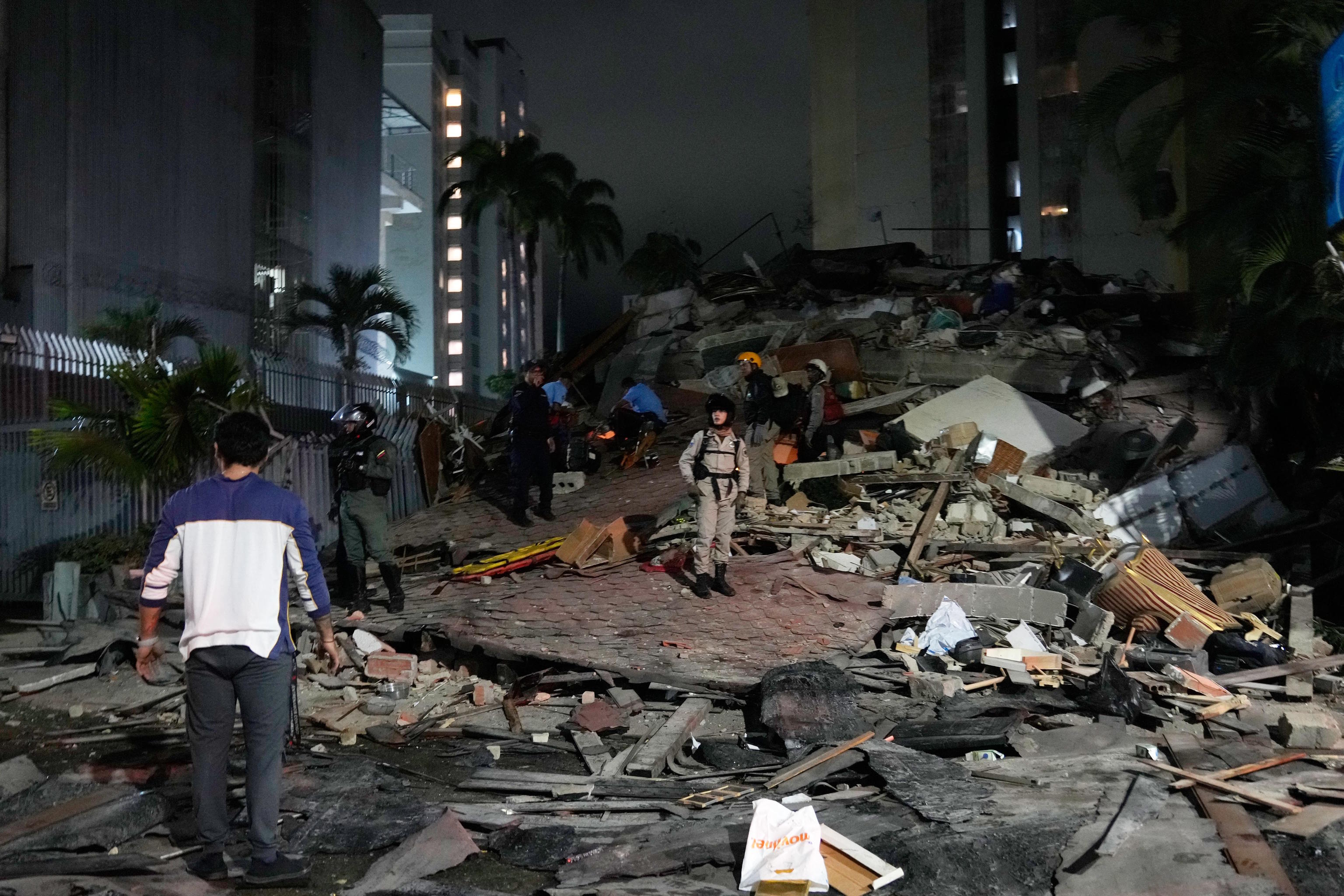
However, this is an initial figure and is considered very provisional because, according to the president herself, the state of La Guaira is a "disaster zone." At this hour, early morning in Venezuela, rescue teams are searching for survivors and the population in the hardest-hit areas spends the night on the streets.
The earthquakes occurred within a minute of each other just after midnight, Spanish time, near the coastal town of Morón in the northern part of the country. The US Geological Survey reported that the first earthquake had a magnitude of 7.1 -- later updated to 7.2 -- on the Richter scale at a depth of about 13 kilometers; the second one, 7.5 in magnitude and about 10 kilometers deep. The US Geological Survey estimates that, based on the data from these movements, the human tragedy could result in tens of thousands of deaths.
La Guaira, the Caribbean area of Venezuela hit again by a natural disaster
La Guaira, the coastal state of Venezuela located next to Caracas, declared a "disaster zone" after the powerful earthquakes on Wednesday afternoon, is once again the scene of a natural catastrophe following the tragedy of 1999 when a landslide left thousands dead in this Caribbean paradise that now shows dozens of destroyed buildings.
Formerly called Vargas until 2019, the now state of La Guaira is experiencing "a true tragedy," as stated by the interim president of Venezuela, Delcy Rodríguez. The territory, the second smallest in Venezuela's regional divisions, is located north of the capital - about 30 kilometers away - and maintains an average temperature of 27 degrees throughout the year, making its beaches popular among Caracas residents, who only need to travel a half-hour on a highway to reach the coastal area.
The earthquake occurred on a non-working day - as the country commemorates the Battle of Carabobo, which marked Spain's independence - resulting in a higher presence of visitors in the area. A humanitarian source informed EFE that there are reports of victims including a "considerable number" of fatalities in this region, where there have also been numerous injuries and damages to infrastructure.
China offers "all the help" within its reach to Venezuela after the earthquakes
The Chinese government expressed its condolences on Thursday for the two earthquakes of magnitude 7.2 and 7.5 suffered by Venezuela and indicated that it is willing to offer, according to the country's needs, "all the help" within its reach.
"We trust that under the leadership of the Venezuelan government, the Venezuelan people will be able to overcome this calamity and rebuild their homes as soon as possible," stated Chinese Foreign Ministry spokesperson Guo Jiakun during a routine press conference, who also expressed condolences to the population affected by the disaster. The spokesperson added that they maintain "close communication" with the Chinese embassy in the country and that so far no victims among their nationals have been reported.
Minister Albares contacts Venezuelan Foreign Minister and offers help from the Cooperation Agency and UME
The Minister of Foreign Affairs, José Manuel Albares, spoke on the phone with the Venezuelan Foreign Minister, Yván Gil, a few minutes before taking off with the King to Mexico, where they will meet with Claudia Sheinbaum and attend the Spain vs. Uruguay match.
According to sources from Foreign Affairs, the Spanish Foreign Minister wanted to "convey all solidarity and offer all the help from Spain, through AECID as well as the Emergency Military Unit (UME); proposed by the Ministry of Defense." As reported, during the stopover of the King and Albares' trip in the Dominican Republic for refueling, the diplomat will speak again with Gil to specify that aid, as reported by Marina Pina.
Consulate in Caracas advises the Spanish community: "If you see significant cracks or risk of collapse, evacuate to a safe place"
The Consulate General of Spain in Venezuela has issued a call to the entire Spanish community "to remain calm, act prudently, and follow the recommendations of civil protection" after the double earthquake in the Latin American country.
In a statement also disseminated on social media, it has asked Spanish citizens to verify the condition of all people in their environment, especially children, adults, and people with reduced mobility, and to check if their home or workplace "presents structural damage," as reported by Marina Pina.
"If you see significant cracks or risk of collapse, evacuate to a safe place," this statement ensures. It also asks to close, "if possible and safely," the gas and electricity supply "to prevent accidents," as well as to stay away from windows, facades, poles, trees, power lines, and any structure that may come loose.
The Spanish authorities have also emphasized not to use elevators in case of evacuation, but to use the stairs. Among the Consulate's recommendations are having a flashlight, water, essential medications, and important documents "in case of a possible aftershock."
In this context, it is recommended to use text messages or 'WhatsApp' to communicate with family and avoid congesting phone networks, as well as to stay informed only through official channels.
"All the neighbors in the area are in their cars"
Samir Jiménez lives on the outskirts of Caracas, in Guarenas, and had left his house when the earthquake began. Nancy Velasco has collected his testimony.
"I had gone out to drop someone off and stopped to buy bread when the earthquake started. People started screaming, and I grabbed the car to quickly go home because my mom was alone. I live on the top floor of a 5-story building, and the apartments on the ground floor and the penthouse are the ones that suffered the most damage as they are at the base and at the top of the building. All the neighbors in the area are in the parking lots and inside the cars. We will spend the night here waiting for the authorities to come and inspect the building. We have already felt some aftershocks while inside the cars, and they move from side to side with each aftershock."
What is the Richter scale and how is an earthquake measured
The Richter scale, also known as the local magnitude scale (ML), is a physical measure, a system that measures the energy released by the earthquake from its epicenter, that is, from the point on the surface above the point where the seismic activity originates (focus), regardless of the intensity.
It is often confused between magnitude and intensity. According to the National Geographic Institute (IGN), "magnitude indicates the size of an earthquake and does not change with the distance to the epicenter. Intensity indicates how an earthquake has been felt and the degree of damage it has caused in a specific location, decreasing with the epicentral distance."