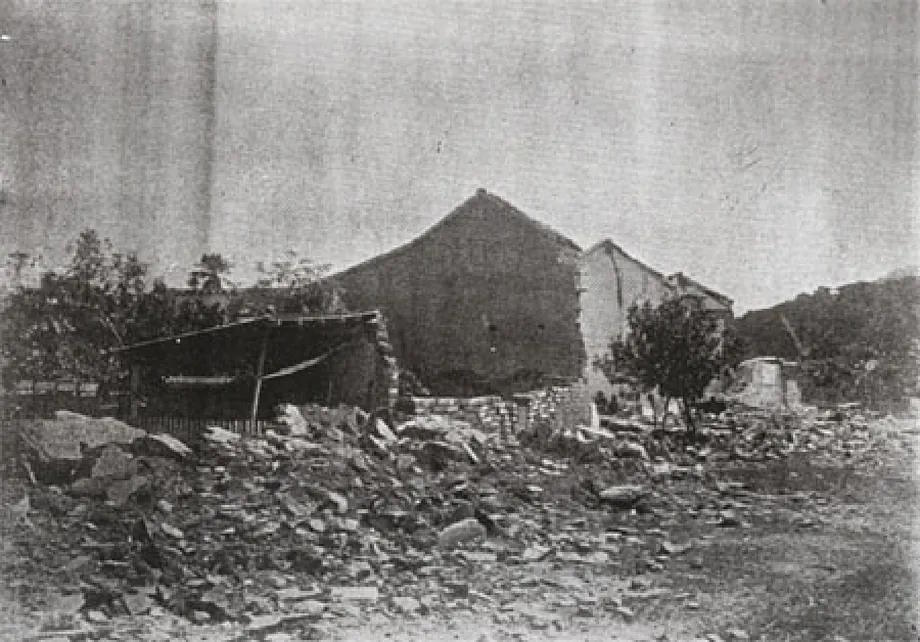
Long before the 7.5 magnitude earthquake shook Venezuela this Wednesday, the country had already experienced a comparable seismic event. It occurred on October 29, 1900, at 4:42 in the morning, when an earthquake with an estimated magnitude between 7.6 and 7.7 devastated Caracas and a large part of the central coast in an episode that would go down in history as the San Narciso earthquake, named after coinciding with the feast day of that saint.
According to the United States Geological Survey (USGS), that earthquake remains the largest instrumentally recorded in Venezuela and serves as the main historical precedent for the earthquakes that severely hit the coastal area of La Guaira yesterday and have struck Caracas and other states of the Caribbean country. Venezuela has declared a state of emergency, and the "number of deaths is devastating."
The Venezuelan Foundation of Seismological Research (Funvisis) attributes a magnitude of 8.0 to the San Narciso earthquake, while the United States Geological Survey and several scientific studies published in recent years have recalculated the event to a magnitude between 7.6 and 7.7. This difference is due to the modern review of historical data since in 1900 there was no instrumental network capable of measuring the earthquake to current standards.
The earthquake caused 21 deaths and more than 50 injuries, according to Funvisis and the historical report used by the USGS. The damages were enormous in Caracas. The Cathedral, the churches of San Francisco, Santa Capilla, San José, La Pastora, Las Mercedes, La Trinidad, Santa Teresa, and Santa Rosalía were severely affected, along with numerous public buildings and private homes.
In the central coast, the effects were also devastating. A fissure of about 300 meters opened in Camurí; in Naiguatá, the church was completely destroyed; strong waves affected Macuto; telegraph lines fell, and numerous landslides interrupted the railway between Caracas and La Guaira. In Guatire, the parish church, the Government headquarters, the courthouse, the Registry, and 237 houses collapsed, while in Guarenas, another 72 houses suffered serious damage.
The earthquake was also felt in Valencia, Aragua de Barcelona, Barcelona, Píritu, Upata, El Callao, Ciudad Bolívar, and San Fernando de Atabapo. Researchers also document numerous geological effects, such as landslides, rockfalls, seismic avalanches, sand and water ejections, and other phenomena associated with the intense ground movement.
"About 300 buildings collapsed"
The extent of the disaster took weeks to reach the rest of the world. On November 17, 1900, the New York Times published a dispatch received in Washington by the Venezuelan chargé d'affaires summarizing the situation as follows:
"About 300 buildings collapsed; the university tower and several bell towers fell, and Government buildings were more or less damaged. Much of the population now lives in tents."
The newspaper added that much of the population lived in tents, that the American legation had been rendered unusable, and that the then-president Cipriano Castro, surprised by the earthquake at the Yellow House, jumped out of a window and injured his ankle. The anecdote has remained in Venezuelan historical memory and is also mentioned by Funvisis.
The Venezuelan press also left testimonies of great strength. Journalist Armando Blanco wrote a few days later in the newspaper El Tiempo that "at 4:42 in the morning of the 29th, a sudden earthquake occurred that lasted about 25 seconds. The rattling was terrible, never felt or heard by the current inhabitants of Caracas."
Over 250 aftershocks and the birth of Venezuelan seismology
The earthquake did not end that morning. Funvisis documents that over the following months, more than 250 aftershocks were recorded, forcing many residents to live in squares and vacant lots for a long time out of fear of further collapses.
The disaster also marked a scientific turning point. Until then, Venezuela lacked seismological instruments. Just a few weeks after the earthquake, officials from the Cagigal Observatory requested the Government to purchase the country's first seismographs. The devices—known as the "Italian" and the "English," named after their manufacturers Agamennone and Ewing—were acquired in 1901 and inaugurated the instrumental observation of earthquakes in Venezuela, although their operation was still rudimentary.
Although Venezuela has experienced significant earthquakes since, such as those in 1967, 1997, or 2018, none had reached a magnitude comparable to the historic San Narciso event. More than a century later, the new earthquake once again places that episode as the main reference in the seismic history of the country.