When Mark Rutte was chosen as Secretary-General of NATO, many diplomats, ministers, and analysts wondered if he would be the right person to manage the Alliance in case Donald Trump won the elections again and returned to the White House.
Rutte, former Dutch Prime Minister for a decade, was known for his outspokenness, a trait his country is proud of, which means speaking his mind even if it is impolite or aggressive. He had clear advantages, such as his Atlanticism, anglophilia, English proficiency, and experience. But he also seemed too arrogant, lacking subtlety, and much less skilled than the outgoing Jens Stoltenberg to handle, from the background, someone as volatile as Trump. Time has shown that there was nothing to worry about. The question NATO members are asking now is if there is anything Rutte will not be able to do to please Daddy Trump, even if it means ignoring, offending, humiliating, and complicating the lives of other leaders.
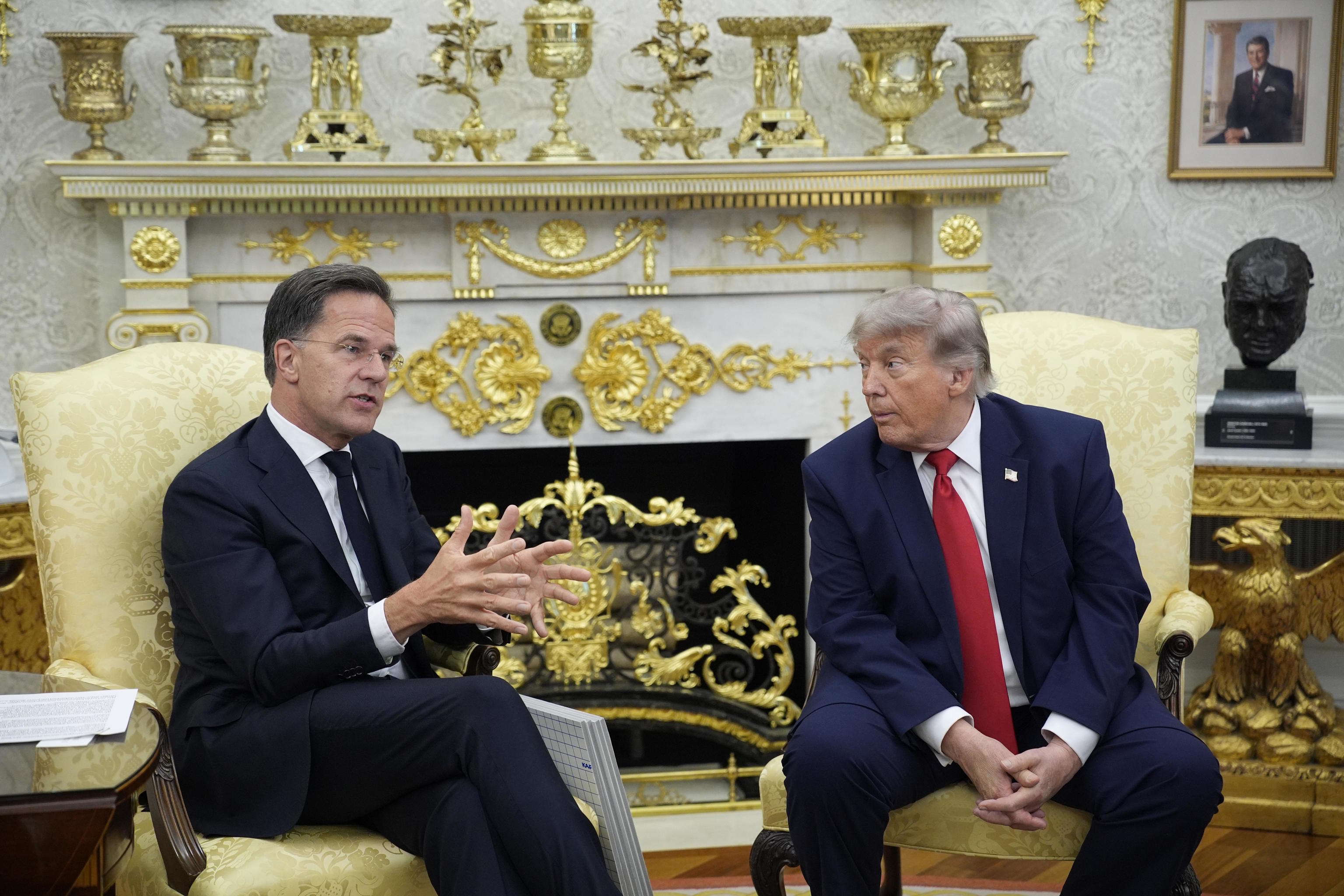
Rutte is back in Washington this week to smooth things over before the Alliance Summit in Ankara, in the first week of July. To do so, he has met with officials, senators, military personnel, and today he met with Trump, in a new attempt to flatter the US president, heal wounds, and avoid what seems to be an inevitable rift.
Trump has never been a fan of NATO. He has always thought that its members were smart people taking advantage of American generosity and wealth. In his first term, he shook the foundations by forcing everyone to accelerate to meet the spending and investment targets they had committed to in 2014 and were clearly neglecting. But in his second term, not even that has been enough.
The US President, following a tradition that has always existed in his country, believes that NATO is no longer necessary, not as it was conceived. He is not concerned about the Russian threat and says that is a European problem. He is concerned about China, as well as Iran, and wants allies to spend more on defense, buy American weapons, and be ready to mobilize if Washington activates them. That's why he doesn't forgive that almost none of them enthusiastically supported the war in Iran and did not rally to his aid.
If he used to think that Europeans were freeloaders, and Ukrainians were whiners and burdensome, now he argues that the former are also ungrateful and traitors, who even vetoed him from using their bases for the Epic Fury Operation. Hence his anger towards Spain, the announcement of troop withdrawal from Germany, or the harsh attacks in recent days on Giorgia Meloni, saying that she "begs for photos" together but does not deserve them for not being by his side when he asked.
This is where Rutte comes in, who has once again shown that his main and almost sole priority is the United States. He is willing to say whatever it takes, publicly, privately, or both, to please Trump and avoid a rupture. Even if it means throwing the others under the bus. He faced criticism towards Spain and is facing it again now. In an interview with Fox, Rutte said that in reality, Europeans did help Washington despite saying otherwise aloud for national political interests.
"Country after country, ally after ally, they made their bases available for the Epic Fury Operation," he stated, confirming that between 4,000 and 5,000 planes had taken off from European bases as part of the Epic Fury operation. "Looking at Italy, 500 US planes took off from US bases in Italy to support the Epic Fury Operation. This is huge", Rutte added.
His words, once again, have caused great discomfort, in Rome, Brussels, and other capitals. In a statement, the Defense Minister, Guido Crosetto, stated that Italy had acted in full compliance with its Constitution, international treaties, and agreements governing allied bases on its territory. "As already clarified in Parliament, the Government authorized exclusively technical and logistical activities", adding that his Government had rejected requests that exceeded those limits and criticizing the Secretary-General for presenting "a reconstruction that conveys a completely misleading message by confusing the type of authorized flights."
Rutte's interview, knowing perfectly well what he is saying and the consequences, comes as the leaders of Germany, France, Italy, Poland, and the United Kingdom are meeting in Berlin precisely to prepare for the upcoming allied summit. After the Trump administration announced last week the start of a six-month review of its military presence in Europe, including the bases that have defined its presence on the continent for eight decades.
And following the news that Defense Secretary, Pete Hegseth, who harbors the most animosity towards the Old Continent, has removed General Chris Donahue, the military leader who commanded the Delta Force in Iraq and Syria against Islamic State, who closed the evacuation of US personnel in Kabul in 2021 and who was until now the commander-in-chief of the Army in Europe, a key position to coordinate NATO's efforts to assist Ukraine.
In two weeks, NATO has its long-awaited summit in Turkey. Normally, these meetings, completely planned and measured, are just a staging of unity and strength. But this time there is real tension. Trump will attend, and the atmosphere is much gloomier than last year before the meeting in The Hague. Recent clashes and the publication of the US National Security and Defense Strategies have changed the playing field, and no one knows what to expect from Trump.
Rutte, nicknamed "the whisperer" by part of the American press for his ability, like his predecessor, to avoid direct anger, has not come to Washington to negotiate documents, statements, content but to manage Trump's mood. To agree with him as a seduction mechanism, trying to minimize dramas or surprises. To convince him that he is a unique leader who has managed to get Europe to increase its military spending and that a rupture with NATO would only benefit Russia, China, or Iran.