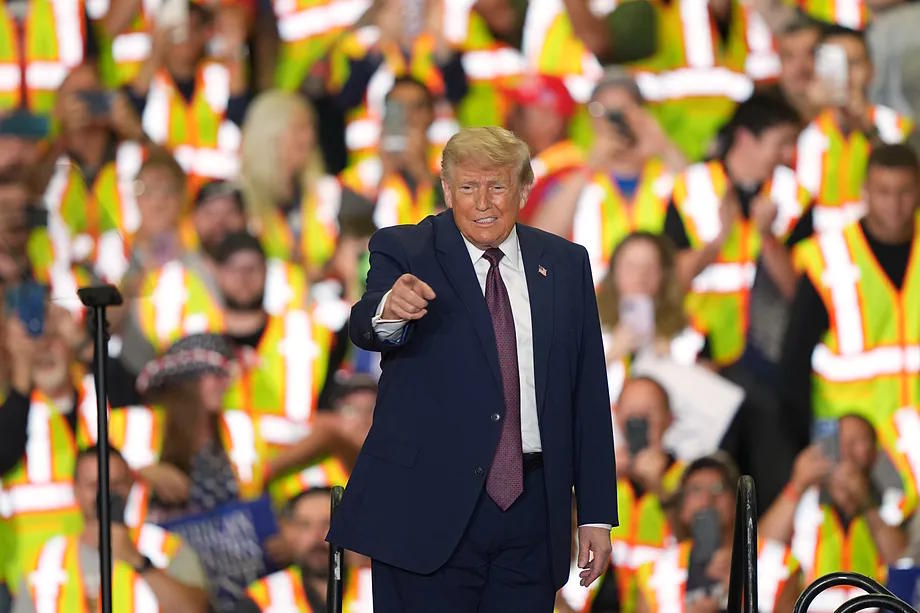
On Tuesday night, Donald Trump lost a vote in the Senate. Although the result is not binding, and at this point is actually sterile, a majority of lawmakers, including four Republicans, voted in favor of a resolution urging the Government to end the war in Iran, withdraw troops, and consult Congress if they want to maintain such a military operation on the other side of the globe. The defeat is symbolic but clear. It shows the concern of his party with less than five months left until crucial midterm elections. All congressmen are up for re-election, as well as a third of the 100 members of the Senate. Polls are devastating, indicating that Democrats are likely to regain control of the House of Representatives and possibly even both chambers, dismantling part of the power structure currently directed from the Oval Office.
Trump's reaction was swift. The Iran issue is secondary because theoretically, there is already a Memorandum of Understanding signed that should be the basis for a definitive peace agreement, although everything is up in the air. The digital signing of the document and his vice president JD Vance's trip to Switzerland have not prevented the president from threatening Tehran several times these days and writing on his social media how much he enjoys bombing them. But the main issue must be read in a national context and has to do with absolute control of the party and the agenda. A few weeks ago, the lower house approved a text in the same direction, the Senate endorsed it, and Trump is far from satisfied.
Wednesday morning, the president posted a message on his Truth social network announcing that the press conference and the signing of a law, agreed upon by both sides of the political spectrum, to boost housing construction and address the significant cost of living, "are canceled until we pass the urgently needed 'Law to Save America', which I consider a national emergency. Thank you for your attention to this matter!" Trump wrote.
The law had his support and was praised on Tuesday night by his spokesperson, Karoline Leavitt, as it will allow the conversion of vacant commercial buildings into affordable housing, unlock more federal funds for prefabricated housing construction, limit bureaucratic requirements, and streamline environmental procedures. But the message and strategy are clear: all or nothing.
For months, Trump has been threatening to block any legislative proposal until his main and only priority is passed, a law to overhaul everything surrounding elections. Trump has maintained for years that he did not lose the 2020 elections, that it was all a theft, and that there is massive and organized fraud. He argues that this happens because electoral integrity is a chimera, millions of illegal votes can be cast, and they do so in blocs with his opponents. Therefore, federal control of the process is necessary, stripping powers from the states. For this purpose, his agencies have been demanding census information from state authorities for some time or even confiscating documentation and voting records in specific counties that he was convinced six years ago he had won.
The law he aspires to, and desperately needs to pass before losing control of Congress, aims to impose the requirement of documentary proof of citizenship to register in the federal electoral census, make it mandatory to vote with a photo ID on the day the ballot is cast, or tighten and restrict mail-in voting rights. These ideas are labeled as "common sense" and indeed seem obvious and uncontroversial to an outsider. However, they constitute interference in state competencies, discredit long-standing rules that experts consider very secure, and, alongside an aggressive redistricting program (gerrymandering), complicate voting procedures for millions of people, especially minority members or even married women who have changed their last names to their husbands'.
Trump was scheduled to sign the bill, known as the 21st Century Housing Law, during an event at the Capitol. It is the most ambitious housing legislation in decades and aims to increase supply and reduce prices, among other things, by limiting the purchase of certain single-family homes by institutional investors. According to the Constitution, a bill approved by both chambers of Congress automatically becomes law if the president neither signs nor vetoes it within a maximum of 10 days. It is unclear how far the White House is willing to go in this standoff.
Trump clearly dominates his party, probably like no other president in contemporary times. However, in recent months, he has been unable to control 100% of the representatives or senators, both on the Iran issue and in the Epstein case, for example. This shows that although his power is immense, it is not absolute. Nevertheless, almost all who have dared to disagree, distance themselves, or confront him have faced consequences, being defeated in internal primaries by candidates supported or imposed by the president himself. The message is clear: those who move will never be in the picture again.
Trump is planning to meet with party senators on Wednesday to address precisely the 'Law to Save America', but the majority leaders have repeatedly told him that they do not have the necessary votes to pass it nor, as the White House demands, to modify Senate rules to approve it by majorities that do not require the approval of 60 out of the 100 senators.
"The housing bill focused on Elizabeth 'Pocahontas' Warren, which is of lesser importance compared to interest rate cuts, and even the FISA Law, pales in comparison to the approval of THE LAW TO SAVE AMERICA," he also said in another message on Truth Social today, referring to the Democratic senator from Massachusetts, one of his major obsessions, who is one of the main proponents of the housing bill.