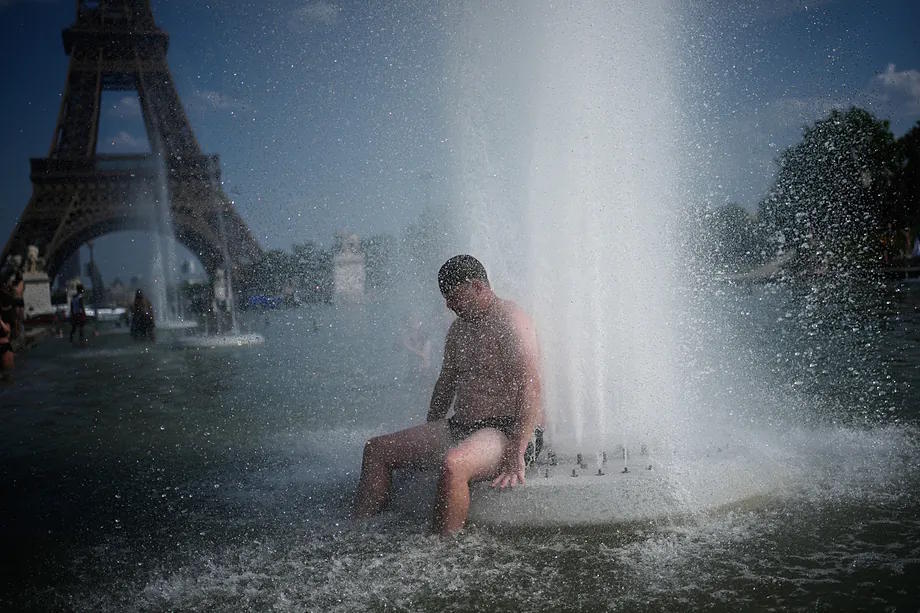
The cultural resistance to la clim (air conditioning) has begun to give way in France after the hottest two days ever recorded, with temperatures reaching 43 degrees and three-quarters of the country on red alert. "As much heat in Paris as in Abu Dhabi," headlines the newspapers, with a complementary fact that says it all: only 25% of the French have air conditioning in their homes, compared to 60% of Spaniards.
The leader of the National Rally, Marine Le Pen, has taken advantage of the heatwave to promise a €20 billion "air conditioning plan" and to adapt hospitals, schools, residences, and public buildings to the heatwaves that are hitting earlier and with greater intensity each year.
"The government is here to set the course, and the time has come to say 'yes' to air conditioning and promote that decision," declared the far-right leader in a populist stance, pointing out how the French elites enjoy that privilege in their homes while the majority of the French struggle to combat high temperatures. Throughout the week, more than 3,000 schools have closed, hundreds of trains have been canceled, and even two nuclear power plants have been shut down due to the high water temperature in the rivers used to cool the reactors (the Nogent-sur-Seine plant stopped on Thursday, following the closure of Golfech on Monday).
The heat in France has been so unbearable these days that even the leader of The Ecologists, Marine Tondelier, has finally broken the taboo: "There are places, like hospitals and schools, that can no longer function without air conditioning." Gone are the ideological reservations, regarding energy consumption and the contribution of la clim to the urban heat island effect.
"But it is absurd to think that this will be solved by simply installing air conditioning in homes," warns the ecologist leader. "If we truly want to protect the French from the impact of climate change, we have to go further and tackle the problem at its root."
The presidential candidate of La France Insoumise, Jean-Luc Mélenchon, has remained almost alone in the anti-air conditioning front: "Air conditioning cannot be the answer to global warming. The solution lies mainly in improving building insulation."
The Mayor of Paris, the socialist Emmanuel Grégoire, who had to distribute more than 1,200 air conditioning units to keep schools open in Paris, has acknowledged his ambivalence despite the extreme situation: "Air conditioning can be useful for cooling public spaces and protecting the most vulnerable populations, but its individual use exacerbates the problem by further heating the city."
"That is why authorities must act quickly in such an unbearable situation as we are experiencing, because otherwise people will buy their own units and install them at home as best they can," warned the mayor. "It is necessary to offer alternative solutions and tools."
Paris, one of the most densely populated cities in Europe, also tops the list of excessive mortality during heatwaves, according to a comparative study of 30 European cities in The Lancet Planetary Health Journal.A large part of the 14,800 victims attributed to the August 2003 heatwave occurred in the French capital, which overwhelmed its hospitals and morgues.
According to Grégoire, the city learned its lesson from what happened more than two decades ago, and "today the most vulnerable population is informed and monitored," and the healthcare system has been tested with extreme temperature drills. "What concerns me the most is people between 50 and 70 years old who consider themselves in good health and continue with their usual activities despite the high temperatures," warns Grégoire. "It is these people who need to protect themselves."
The Paris City Council has decided to keep parks open 24 hours, monuments and museums have moved their closing hours to four in the afternoon, and public beaches along the Seine, the Saint-Martin canal, and La Villette have been crowded with Parisians and tourists eager to cool off.
However, the city faces a fundamental problem, shared by many French cities, which is the lack of adaptation of its buildings to heat, starting with the typical zinc roofs (hot) that turn the top floors into real ovens. "People often look at these attic roofs as charming places," warns Maïder Olivier, head of the Foundation for Housing for Disadvantaged People. "The reality is that these apartments are usually occupied by students who pay very high rents and are exposed to extreme heat at home that is very difficult to ventilate," assures Olivier, highlighting the issue of climate inequality that mainly affects the suburbs.
66% of the French are currently struggling to have "tolerable heat" in their homes, especially in public housing, according to estimates from the foundation. "The State's delay in addressing this problem is putting the lives of millions of people at risk," emphasizes Maïder Olivier. "We are facing a real issue of justice in the face of climate risks."