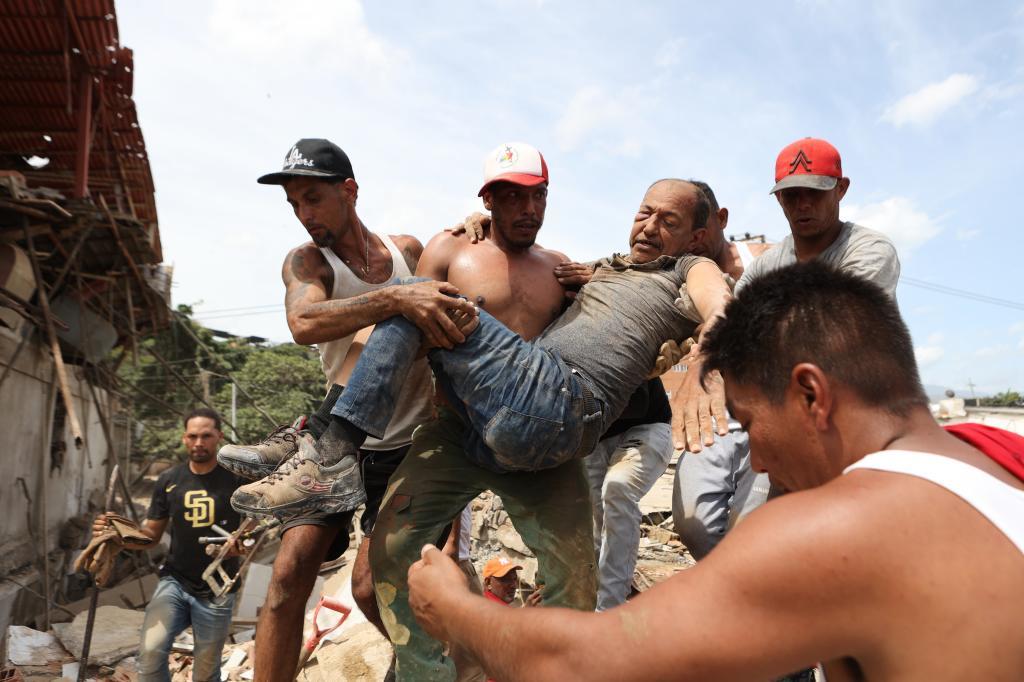
More than half a million Venezuelans live in Spain, including those residing in the country regularly or irregularly. There are around 150,000 Spaniards in Venezuela, considering individuals with dual nationality. The ties on both sides of the Atlantic date back centuries. With these figures, it is understandable that the concern over the earthquakes that have shaken Venezuela has reached all state institutions, and the Government did not hesitate to send aid once the magnitude of the earthquake was known.
Spain woke up to the news of the Venezuelan earthquake, but with a tight schedule for some of the main authorities concerned with these types of tragedies. To start, the King, Felipe VI, was traveling to Mexico with the Minister of Foreign Affairs, José Manuel Albares, to meet with Claudia Sheinbaum. This transfer by Air and Space Force aircraft meant hours of disconnection for the Monarch and the Spanish Foreign Minister.
Before leaving, the Royal Palace tweeted expressing on behalf of the King and Queen "support for the Venezuelan people in the face of the tragedy caused by the two earthquakes that have affected the country" and stated their desire to convey their "solidarity, affection, and strength to all the injured and the communities that have suffered this disaster." Beyond the publication, the exceptional nature of the situation led Queen Letizia to make impromptu statements before attending an event.
In them, the wife of Felipe VI stated that the Monarch "like the rest of the citizens of this country, is very concerned and following the news after those two earthquakes in Venezuela that have so far left a death toll that they suspect will be higher and all that destruction from the tragedy." Doña Letizia emphasized that "Spain has already offered its help and we are waiting for the entire operation to be able to collaborate in the coming weeks, which will be a great challenge in the rescue of possible survivors and then the reconstruction, which will be a great challenge."
The President of the Government, Pedro Sánchez, who attended the Congress session, simply tweeted: "All my support and that of Spain to the Venezuelan people after the devastating earthquakes last night. Our thoughts are with the victims and their families," he wrote.
Meanwhile, the Minister of Foreign Affairs rushed the minutes before boarding a plane to react publicly. He granted an interview to Radio Nacional de España and issued a statement conveying all his "solidarity and support to the Venezuelan brotherly people after the strong earthquakes that devastated the country yesterday." Before taking off, he also spoke on the phone with the Venezuelan Foreign Minister, Yván Gil.
According to Foreign Ministry sources, the Spanish Foreign Minister wanted to "convey all the solidarity and offer all the help of Spain, through AECID as well as the Emergency Military Unit (UME); proposed by the Ministry of Defense." As reported, during the King and Albares' layover in the Dominican Republic for refueling, the diplomat spoke again with Gil to finalize that aid.
In line with those words, the Ministry of Defense mobilized 54 members of the second battalion of the Emergency Military Unit to support in the rescue of victims after the earthquake. The second battalion, based at the Morón de la Frontera Air Base in Seville, consists of command and staff, two intervention companies, and the Engineering company. Its command also oversees the Natural Disaster Emergency Intervention Unit in the Canary Islands. This specialized rescue unit was deployed during the earthquakes in Turkey and Morocco.
The USAR team's capabilities include the use of specially trained search dogs and specific devices such as rescue cameras or geophones. They are looking for the fastest route to reach the country, on an Air and Space Force aircraft, but considering where to land, as Caracas' main airport is closed due to the earthquake.
On the other hand, the Spanish Agency for International Development Cooperation (AECID) was ready to deliver humanitarian aid, although the quantity and arrival of these immediate aid batches, consisting of first aid materials and food, were not specified.
This coordinated effort has been complemented on the ground by the work of the embassy and consulate, which remained open to coordinate assistance and consular support for Spaniards in the area. Currently, there is a Spanish woman of Basque origin who remains missing.
Similar is the work of the Venezuelan Embassy in Madrid. Timoteo Zambrano, the new ambassador, arrived in Spain just a month ago and has not yet presented his credentials to Felipe VI, a necessary step to operate normally in the country. He is the one who must deal with the crisis caused by the earthquake from Spain. The diplomatic mission asked its compatriots to "remain calm" and stay informed through "official channels."
On Friday, with Albares already landed and operational from Mexico City, more information on Spain's aid is expected.