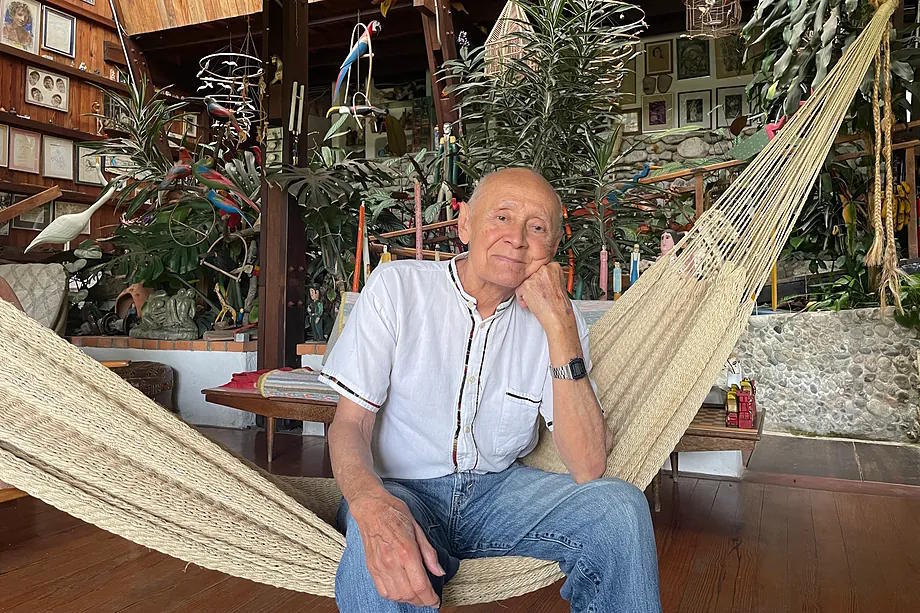
Venezuela has just been shaken by a double earthquake that experts had already anticipated, but the country had to face it blindly. In this interview with EL MUNDO, Raúl Estévez, geophysicist and professor at the University of Los Andes in Mérida, reveals an alarming reality: out of the 300 seismic monitoring stations that existed in the country, only four are currently operational and why western Venezuela was a "time bomb".
QUESTION. It is known in Venezuelan popular culture that every so often there is a major earthquake. Was this seismic event expected in Venezuela?
ANSWER. What happened is not strange for us specialists. This movement occurs by sectors. The central sector, on the San Sebastián fault, produced the Caracas earthquake in 1967. Then, in 1997, it was the Cariaco earthquake, which released the efforts in the east. It was necessary for the west of Venezuela to release the energy to balance all movements. Since the end of the last century, we had been warning that probably the next major earthquake would be in western Venezuela. Along these faults, there are segments that go a long time without earthquakes, called seismic gaps or seismic silence zones, and it is most likely that the next earthquakes will occur in these zones. Where these earthquakes occurred, there was a seismic silence zone. The fact that two earthquakes occurred is strange, but it has happened on other occasions. Also, it is curious that they were so close, with only a few kilometers of difference between the two epicenters.
Q: Do we have exact data on the epicenters?
A. We do not have exact details because there are very few seismic stations left in Venezuela. There were about 300 stations, of which only three or four are still operational. They have been neglected due to governance issues. The data we have comes from international stations of the geological service of the United States and Europe. It is known that the epicenters were about 20 to 30 kilometers southwest of the city of Morón, where the Boconó and San Sebastián faults intersect, one near the town of Yumare and the other near Montalbán.
Q. How should the country prepare to face these types of situations?
A. In Venezuela, there are few well-prepared seismologists left, and the next generations have left the country due to low salaries. We are very underserved. We need to train new resources and restore the national network of seismological stations. At the University of Los Andes, in the seismology laboratory, we had 14 professors and maintained 25 stations, but it disappeared completely. The country was left without the necessary professionals to address regional seismicity.
Q. What measures are advisable for the Venezuelan population?
A. Before returning to seemingly less damaged homes, it is recommended to check for structural damage, such as in beams and columns. Do not re-enter until a professional engineer or trained firefighters evaluate the building. Additionally, it is advised to shut off the gas for one or two days to prevent fires from leaks or sparks, and to be cautious with water, which is often contaminated by pipe breaks. It is essential to be prepared to leave again with protective clothing, appropriate shoes, drinking water, and non-perishable food. Aftershocks can be significant and occur, even weeks after the main event, with magnitudes of 5 or 6.
Q. Is it advisable to stay in open spaces?
A. Of course, it is advisable to go to open spaces, but making sure not to be near poles with transformers, as they act as inverted pendulums that can collapse. In mountainous areas, special care must be taken with landslides and mudflows induced by the shaking. These collapses can block water currents and form partial dams that, when they break, produce torrential floods and downstream flooding.
Q. We see that in the state of Vargas there are more affected areas and also some areas in Caracas. What is the reason for this?
A. We have very little information on damage statistics because the country is not prepared, and authorities have become accustomed to not providing official information. It is known that there are around 123 collapsed buildings, but little is known about the damage in towns near the epicentral area such as Puerto Cabello or Valencia. In La Guaira, the impact is more associated with the high population density and its proximity to the sea. In that locality, there are many ravines, and many mass movements and landslides occur. In Caracas, it has to do with the interaction between buildings and the ground. Since the 1967 earthquake, it was understood that it is not only the quality of the building but also the terrain on which it is built. There is a depth of sediments of about 50 meters or more, with very fragile terrain. These loosely compacted sediments filter seismic waves, allowing only low frequencies to pass through, which resonate and affect taller buildings. The most affected areas in Caracas are usually Altamira, Los Palos Grandes, Chacao, and San Bernardino.
Q. Is there a real possibility of a tsunami?
A. Only in the event that the earthquake occurs on a submarine fault, such as the San Sebastián fault, and is of a magnitude greater than seven. However, for this specific event in Venezuela, it is unlikely because the movements are mainly horizontal (transverse or transform) between the land blocks, and not vertical. Significant tsunamis are generated when the seabed rises abruptly. Although in the island arc, east of Venezuela, there are submarine earthquakes that could generate them, in this case, the earthquakes occurred on land, so they will not produce a tsunami.