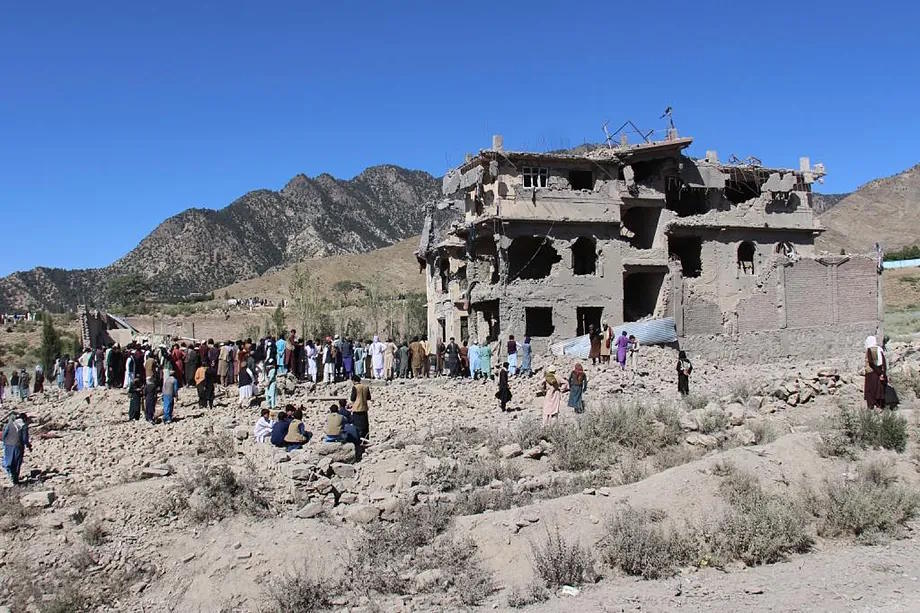
The never-ending war on the border between Pakistan and Afghanistan has intensified once again. On Sunday, Pakistani fighter jets bombed several areas in the Afghan provinces of Paktia, Paktika, and Kunar while ground troops crossed different points of the border. Kabul has denounced a "cowardly act" and a "crime" against the civilian population. Islamabad responded that the operation was aimed exclusively at hiding places of terrorist groups responsible for recent attacks on Pakistani soil. Once again, both neighbors offered irreconcilable versions of the same conflict.
According to the Taliban authorities, dozens of people may have died in the bombings, including numerous civilians. The damage was concentrated especially in the village of Mandikhel, in the province of Paktika, where several houses were reduced to rubble. The Ministry of Information of Pakistan maintained, on the contrary, that the offensive ended the lives of 29 militants and that it was in response to a series of terrorist attacks against security forces and the Pakistani civilian population.
The attacks occurred just a day after a suicide bombing at the Sindh Rangers headquarters in Karachi, where three members of this Pakistani paramilitary force were killed. The action was claimed by Jamaat-ul-Ahrar, a faction of the Tehrik-i-Taliban Pakistan (TTP), the insurgent organization that has been waging a bloody campaign against the Pakistani state for over a decade.
This group is now the main point of friction between Islamabad and the Taliban regime in Kabul. Pakistan maintains that thousands of TTP fighters operate from hideouts in Afghan territory and regularly cross the border to carry out attacks before returning to the other side. The Afghan Taliban systematically deny these accusations and claim that they do not allow Afghanistan to be used as a platform to attack any neighboring country. However, the increase in attacks in Pakistan since the Taliban regained power in Kabul in August 2021 has reinforced the Pakistani authorities' conviction that the problem lies on the other side of the border.
Pakistan is experiencing one of its worst waves of violence in years, especially in the provinces of Khyber Pakhtunkhwa and Baluchistan. Each new attack usually leads to bombings on Afghan territory, while Kabul responds by denouncing indiscriminate attacks on civilians.
Tensions escalated again in October 2025 after several armed clashes that left dozens dead and led to the closure of most border crossings. After weeks of regional mediation, both parties reached a ceasefire that barely survived a few months. The truce collapsed on February 26, when Afghan forces responded to new Pakistani airstrikes against alleged TTP positions. At that time, Islamabad military officials even warned that both countries were on the brink of "open war".
Since then, bombings, artillery exchanges, and skirmishes have been repeated along the over 2,600 kilometers of shared border: the Durand Line. Drawn by the British Empire in 1893 to separate Afghanistan from British India, this border divides the historical territory of the Pashtun ethnicity, the largest community in both Afghanistan and northwest Pakistan.
Islamabad considers the Durand Line a fully recognized international border. Kabul has never officially accepted it. No Afghan government, neither the former republics nor the current Islamic Emirate, has formally recognized that demarcation.
Pakistan's construction of a fence spanning hundreds of kilometers to control the border crossing has further fueled tensions. The Taliban have destroyed sections of the fence several times, claiming it is built on Afghan territory, while Pakistan insists it is an essential infrastructure to curb the infiltration of armed groups.