The armored vehicle was part of the legion of barbecues that are common on the front line. Here they are nicknamed those that have been reinforced with a cage-like wrapping for added protection against drones.
The coating served little purpose. Just like the nets that cover the entire journey. Flames consumed the front part of the armored vehicle. "This is fresh (recent)," says one of the uniformed men.
No one stops to check what happened. The less than 20 kilometers that connect Kramatorsk with Druzhkivka are covered at a frantic speed. The only vehicles that do not do so are those that have not managed to overcome the action of the drones. The journalist counts up to 16 SUVs reduced to charred shells on the sides of the road.
"If you see us stop, it's because we've seen a drone. You have to jump out of the vehicle and run," warned Taras, who leads the unit guiding the visitors.
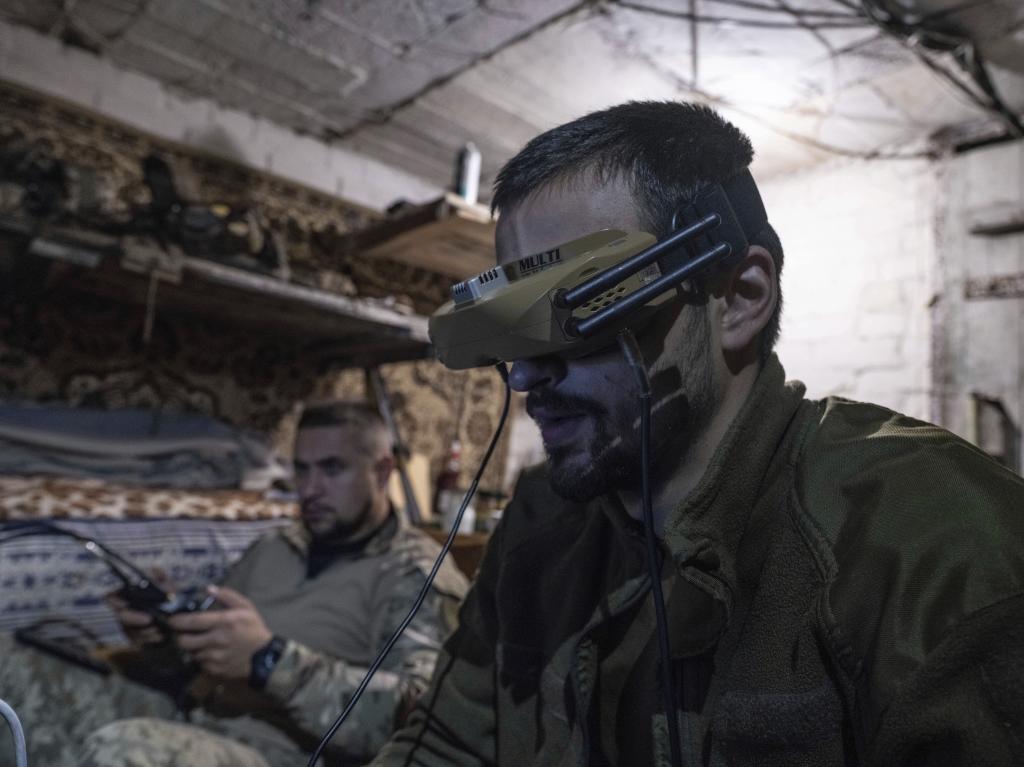
The road reflects the insane spirit that this war has plunged into. It is traversed by all kinds of barbecues - covered with bars, mesh, and spikes - at breakneck speeds. Pairs of soldiers on three-wheeled motorcycles, usually used by special forces. One also comes across four-wheeled robots - the so-called UGVs - transporting supplies, remotely controlled. Or on foot patrols of "drone hunters," watching the sky with their machine guns, ready to shoot down the unmanned aerial vehicles (UAVs) that attack this area daily.
"These units were established in 2025 and are now everywhere because this is a drone war," explains Serhiy Hulevatenko, a lieutenant colonel of the 156 Mechanized Brigade, in the bunker he uses as the headquarters of his group.
The basement is filled with computer screens, rooms, and even a static running machine. "People who spend weeks here use them to exercise. Nobody goes out for a run on the street," says Andrew, who like almost all military personnel does not disclose his last name.
The 31-year-old psychologist also serves as one of the specialized shotgunners in shooting down UAVs, patrolling the streets of Druzhkivka. He is equipped with a rifle of Turkish origin that fires pellet cartridges. "Like the ones used for bird hunting, but here we use them for drones. It has a range of 50 meters," he explains before starting the tour of the village.
"How many drones have I shot down? I stopped counting when I had shot down more than 10," he adds.
The 'Donetsk Fortress'
Druzhkivka, along with Kramatorsk, Sloviansk, and Konstantinivka, make up the four main towns in the Donetsk province that are still under Ukraine's control, the so-called Donbass Fortress of Donbass. A string of towns that line up along almost 50 kilometers following the road that connects them.
Before the conflict, these urban centers were home to over 380,000 inhabitants. In 2014, separatist militias and the military took control of the four towns. Kiev regained them months later and began fortifying them, turning them into its main line of defense in the country's east and a bulwark to halt any Russian advance towards key cities like Dnipro.
Last May, Russian President Vladimir Putin claimed that his forces are on the verge of achieving "the final defeat of the enemy," while Kremlin officials cited by the Financial Times said that their army's military leaders have promised them they will take that "fortress" in the fall.
Russian media like Donbas Today cling to the triumphalist spirit of the Kremlin. The newspaper published an article on the 22nd of last month in which it took for granted what it called the "liberation of Konstantinivka." And added: "The enemy resists, but cannot stop the gradual advance of Russian troops. Now, the main task will be to capture Sloviansk and Kramatorsk, and thus put an end to the liberation of Donbass."
The chief of the Russian General Staff, General Valery Gerasimov, proclaimed in March that his forces control 60% of Konstantinivka, something that has not been confirmed by any independent observer.
Donbas Today tacitly pointed to a reason for Putin's determination to culminate the offensive in this region in the coming months: the anniversary of the defeat of the German army in Slaviansk and Kramatorsk, which was finalized on September 6, 1943.
"The enemy says they control Konstantinivka, but it's not true. They have managed to infiltrate very small groups of soldiers, but we are eliminating them. I think this attempt will end like in Kupiansk (a northern town, which was also about to be captured by the Russians with the same tactic but from which they were evicted). The Donetsk Fortress remains strong," clarifies Serhiy Hulevatenko.
The think tank Institute for the Study of War has reiterated in recent days that Moscow is resorting to "images likely altered by artificial intelligence to exaggerate Russian successes and claim that the front (in Donbass) is on the verge of collapse, contrary to the evidence."
However, Ukrainian experts admit that the situation in Konstantinivka is more than complex. "We all assume that we will lose Konstantinivka perhaps before the end of summer and maybe Druzhkivka will suffer the same fate by the end of the year. But how many more months can the Russian economy resist?" comments a senior Ukrainian army official who prefers to remain anonymous.
The fate of Konstantinivka is linked to that of Druzhkivka, from where the entire supply line of the front line originates. That is why the Russians have intensified the assault on the latter, with the feared Cabs (bombs of 250 kilos or more) and a constant swarm of flying devices.
Shocking destruction
The destructive capacity of these devices is staggering. They are capable of crushing multi-story buildings. It is a sight that is repeated throughout the metropolis, where apartment blocks reduced to piles of rubble are a constant. As well as the devastation seen in what used to be machinery or porcelain factories, especially valued in the Soviet era.
Walking through the city's nerve center means stepping on broken glass or pieces of walls torn from old restaurants. Explosions are a recurring sound. "Watch where you step. Drones often drop anti-personnel mines," Taras points out.
The clique led by the officer walks through the main square. The statue of the lovers—which replaced the ubiquitous figure of Lenin that adorned this spot until 2015—is one of the few things that remain almost untouched. The sculpture, depicting a couple kissing, used to be the preferred spot for newlyweds' photos and became a viral image when Ukrainian President Volodymyr Zelensky—once again defying the risk—filmed a video in this very place last March.
"Donbas is Ukraine," reads a sign on a nearby wall. The main avenues are lined with barbed wire and dotted with burned-out military vehicles. At first glance, the town appears to be a ghost town.
But as the walk continues, civilians emerge, still hidden among the remnants of the enclave. They appear on foot or by bicycle. They hurry to the last businesses that continue to defy logic.
Ludmila and her sister Natalia remain determined to keep their small grocery store open in the heart of the town. When asked how she dares to continue running the shop, literally surrounded by rubble, Natalia smiles and shrugs. "We've been like this for a year. We're at the mercy of fate. Those with children have left. I didn't leave when the Russians occupied the town (in 2014), and I won't now," says Ludmila, 62.
The sisters are among the civilians who have become accustomed to the proximity of death. They almost look with surprise at the group of visitors running along the asphalt and taking cover every few meters. They wander about leisurely.
Serhiy, Taras, and Andrew are always looking at the sky. They are also on the lookout for signals picked up by the drone detector. Every few meters, they check if the doors of nearby houses are open. A necessary precaution to take cover if a drone appears. The poles and branches are riddled with the fiber optic cables used by Russian UAVs.
Turning a corner, near one of the few places where residents can collect water—that liquid, like electricity and gas, is a luxury that vanished from the city months ago—the group comes across a group of neighbors trying to extinguish a fire.
A bomb recently exploded in their apartment building. The flames continue to engulf the upper floors. Taras climbs to the third floor and tries to stop the fire with a jug of water. "Is anyone there?" she shouts, trying to find out if any residents have been hurt. Her efforts to fight the fire are unsuccessful. The blaze is widespread. Several plumes of smoke rise from windows.
"We've called the police and the fire department, but they're not coming," complains one of the dozen Ukrainians gathered near the building.
Taras tries to convince them to evacuate Druzhkivka, following the instructions issued by the authorities. "Where are we going to go?" replies 66-year-old Anna Ivanova.
Suddenly, the terrifying drone sounds and chaos ensues. "Drone, drone!" Everyone runs in a different direction. Some hide under the trees. Others manage to get inside the building. Two locals remain impassive, sitting on a bench under the trees, seemingly comforted by the false sense of tranquility brought on by copious amounts of alcohol.
The alarm continues until a nearby explosion is heard. The AUV appears to have exploded not far away.
The walk through Druzhkivka is dominated by stress. Sometimes, the drone detector picks up the signal emitted by one of the devices. This time it's far away—the device can detect them up to four kilometers away—but its camera offers a clear view of the village. It must be searching for something.
"Civilians are mistaken. They think the Russians won't attack them, but when the pilots are running out of drone battery power, they launch it at anything. A few days ago, an elderly man was blown to pieces. They also attacked a priest," Taras says.
Every so often, Taras or Serhiy raises a finger, and the group stops. It's the alarm signal. Another dash for the nearest open door. The buzzing is sometimes accompanied by bursts of gunfire from the "hunters" deployed among the houses. If a loud bang is heard, it means they've eliminated the threat, and they can continue their walk.
Upon reaching another intersection, the patrol encounters another pair of snipers from their same unit, the 156th. One of them is Andriy, 38 years old. He's been part of the platoons of soldiers dedicated to intercepting UAVs since April. "We work four- or five-hour shifts. We shoot down about three drones a day," he explains.
The young man speaks inside a funeral home, eliciting nervous smiles from those present. Directly opposite, the charred chassis of another van is visible.
As he speaks, a robot moves briskly behind him toward another location.
Druzhkivka seems destined to share the fate of many other settlements in the two Donbas provinces (Donetsk and Luhansk): to disappear, ravaged by Moscow's wartime fury. It once had almost 70,000 residents. "Now there are about 6,000 left," estimates Lieutenant Colonel Hulevatenko.
Many are hiding underground. Yuri and his wife Ksenia have had to convert two simple basement hallways into a shelter. Their house was gutted on the 23rd when yet another Cab-class tank crashed nearby. This time, they have hung five crucifixes at the entrance to the staircase leading to their new refuge, hoping they might offer them protection.
The space is minimal. They've placed five cots and several chairs pressed against the brick walls. You practically have to walk sideways to get from one to another. "Five of us live here," says Yuri, 54.
"We've already left twice and come back. We're tired of moving from place to place," he adds, justifying his determination to remain buried alive.
Today is Ksenia's birthday. Yuri has decided to brave the drones flying overhead and go to a nearby vacant lot to pick flowers. The bouquet rests on the small table they've also managed to bring into the underground space. To celebrate, they only have that, a packet of cookies, and some tea. "And I'll give her a hug," the Ukrainian proclaims, trying to downplay the situation.
Yuri admits, however, that his present has very little to do with the past. A year ago, they both worked in separate restaurants. Ksenia was the cook at one of them. "In 2025, we were able to celebrate the birthday with a big cake and lemonade," he recalls. "The drones changed everything. Businesses started closing, and people left.
Coroner determines that Daveigh Chase, the actress from The Ring, died of AIDS
The coroner determines that Daveigh Chase, the actress from The Ring, died of AIDS
The Ukrainian, who seems unable to let himself be defeated by the painful reality he faces, decides to cling to optimism.
"The city is wounded, but it is not dead," he declares.