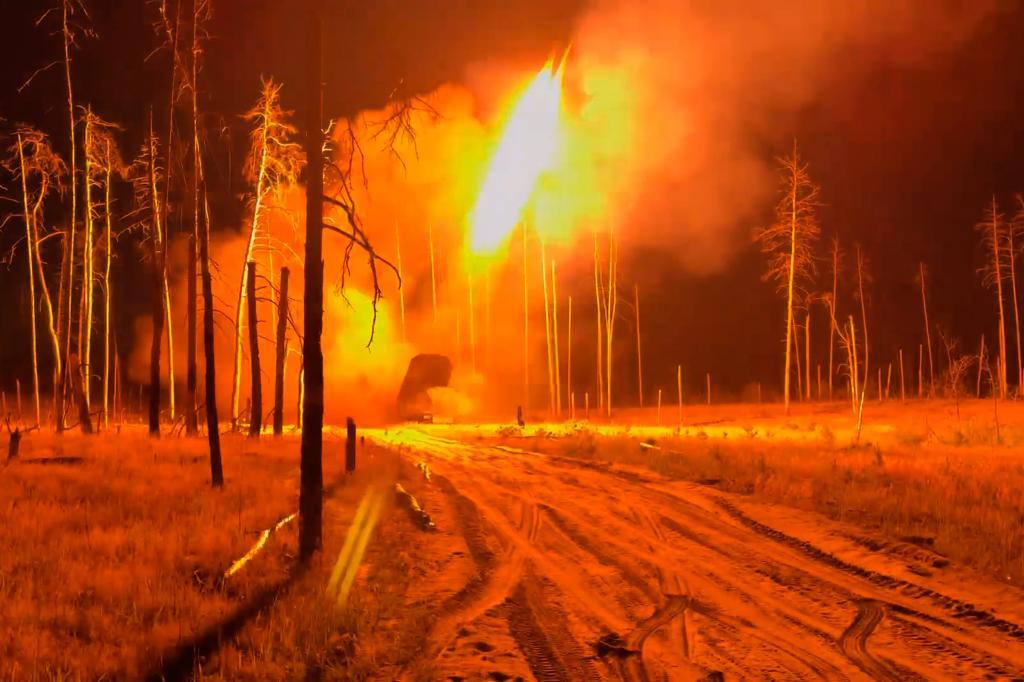
This Monday, horror returned to the city center when a "Shahid" drone intruded during the busy morning rush hour, flying from the Dnieper River towards the bustling Sobornyi Avenue. Despite the intervention of air defenses, the device was hit in one wing and fell engulfed in flames onto pedestrians, creating a "huge fireball" at a busy traffic intersection. Among the affected citizens was Katerina Portna, who miraculously managed to escape the shrapnel while her car was trapped by the blast wave.
"I was afraid I wouldn't be able to get out. I was also wearing my seatbelt," explained Katerina as she recovered from the impact. The scene in the center of this city of 700,000 inhabitants was one of pure chaos, with civilians fleeing and desperate neighbours facing the advancing flames; a woman was screaming hysterically as she watched her home burn: "It's my house, it's my house!". Although there were no fatalities in this incident, the previous day was much more tragic. Russian forces, located just 20 kilometres away, have started to massively use FPV drones (first-person view devices), which are smaller but much more precise than the Shahid drones.
Last Monday, one of these drones crashed into a public transport bus, leaving a trail of blood and three dead passengers on the asphalt. Ukrainian President Volodymyr Zelensky has denounced this alarming increase in bombings on urban areas. According to the president, in just seven days, Russian armed forces have launched 1,400 drones and 1,500 bombs weighing over 250 kilograms on 15 regions of the country. "Almost daily, there are bombings on Kherson, Zaporozhye, Kharkiv, or Sumy. The Russians are attacking the population, targeting residential buildings and our civil infrastructure. Unfortunately, there are victims of this terror almost daily," Zelensky stated on his social media.
On the other hand, Oleh Buryak, head of the military administration of Zaporozhye, argues that the use of drones against government buildings aims more to send a message than to cause actual structural damage. "If they had wanted to cause damage, they would have used a missile or a Shahid. It was part of their show. They targeted a high floor where no one was. They just archive things," commented Buryak, emphasizing that Putin resorts to destroying the territory when he cannot occupy it.
The Ukrainian strategy is not lagging behind in this dynamic of long-range attacks. Kyiv has targeted strategic objectives in Russian territory, such as the Dubna Space Communications Center, over 500 kilometers from the border. However, Ukrainian soldiers draw ethical boundaries in the execution of their missions; Serhiy, a 40-year-old soldier, believed that "the difference between Russia and Ukraine is that we target military objectives or strategic infrastructure. They want to terrorize civilians."
The situation is critical: according to United Nations observers, civilian casualties have recently reached their peak, with 274 deaths in just one month. Meanwhile, on the streets of Zaporozhye, the pain of the civilian population is summed up in the broken cry of Tatiana Analolivna after seeing a bomb flatten the adjacent house to hers: "May they be cursed ten times!". Analysts suggest that the story seems to echo the grief of the war between Iran and Iraq in the last century, now focusing on the systematic punishment of the rear and the enemy's economic potential.