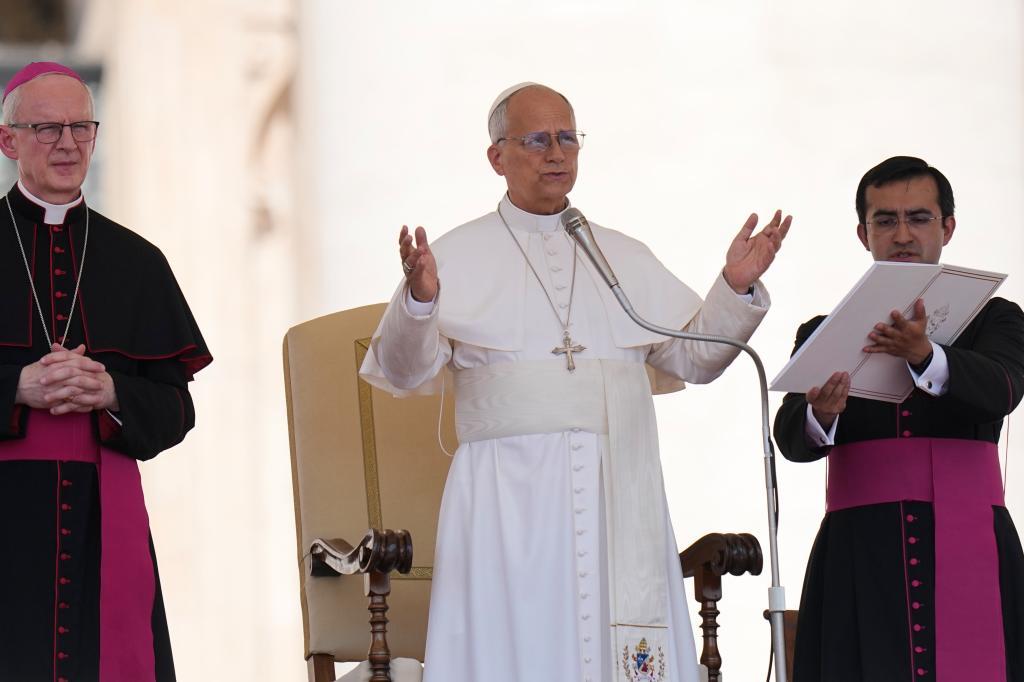
Despite the efforts of Pope Leo XIV, who on Monday made a final appeal to the Priestly Fraternity of St. Pius X through a letter urging its current leaders not to "tear the tunic of Christ," the threats of automatic excommunication in recent weeks and efforts to build bridges from the Vatican have not prevented the ultra-integralist priestly society founded in 1970 by Archbishop Marcel Lefebvre from fulfilling its announcement to consecrate four new bishops without pontifical mandate this Wednesday - the French Marc Hanappier and Michel Poinsinet de Sivry, the Swiss Pascal Schreiber, and the American Michael Goldade - in a lengthy four-hour outdoor ceremony in Écône, Switzerland, officiated in Latin and with ancient rites.
The Lefebvrists have thus fulfilled their challenge, the first major problem within the Catholic Church that Leo XIV has faced since being appointed Pontiff, following the death of Francis last spring. Lefebvre's followers - who died in 1991 - have not only opted for a rupture but also sought to lead the first schism in the Church in this century, with the added notoriety that social media provides today.
The Fraternity argued that they could not wait any longer to take this step, as of the four bishops consecrated by Lefebvre in 1988 without Rome's approval, only two remain, the Spanish Alfonso de Galarreta and the French Bernard Tissier de Mallerais. Hence, the current leaders of the schismatic movement believed it was urgent to ensure the episcopal succession. And that is what they have done in Switzerland.
"I beg you and ask you from the bottom of my heart: Step back! I urge you to carefully consider the spiritual well-being of the faithful, as the schismatic act you would commit would deprive them of the lawful and, in some cases, even valid reception of the sacraments they love and seek for their own sanctification," read the letter that Leo XIV addressed on Monday to the Superior General of the Fraternity, Davide Pagliarani. The Pope committed to embark on "a path of dialogue and understanding that the Holy Spirit can make possible and fruitful." The Lefebvrists have turned a deaf ear.
The Society of St. Pius X has positioned itself as a kind of guardian of what they consider the "true Catholic faith". It is a branch of the traditionalist Church, closely linked to far-right ideological groups. It was in the early 1970s, during the pontificate of Pope Paul VI, that the then Archbishop of Tulle, Monsignor Marcel Lefebvre, opposed the Second Vatican Council (1962-1965), in which he had participated, and created the controversial Society. For years, successive Popes, Pope John Paul II, Pope Benedict XVI - who lifted the excommunication of the four bishops who had been ordained, as a gesture of goodwill and rapprochement - and Pope Francis, tried unsuccessfully to dialogue with this problematic fraternity. The Argentine Pontiff personally endeavored to "create a conducive climate for dialogue." All in vain.
The congregation opposes the religious freedom advocated by the Second Vatican Council, ecumenism (the visible unity of Christians), and collegiality. Experts estimate that today it has around 600,000 followers worldwide, with 100,000 in France - the country with the largest community by far. It is not a significant number in a Catholic Church with around 1.4 billion followers worldwide. However, the Holy See is well aware of the growing discontent in certain ultra-conservative circles today, which view these types of movements favorably. In addition to the six schismatic bishops, it is estimated that there are 735 priests and 264 Lefebvrist seminarians, with numerous institutions, including 94 independent schools. The congregation prides itself on being self-sufficient, as it receives substantial donations from its convinced followers.
The announcement of the ordinations this Wednesday was made on February 2. Since then, the Vatican and Écône have been embroiled in a bitter dispute, exchanging open letters. The Holy See, through Cardinal Víctor Manuel Fernández, proposed postponing the ordinations to allow for "specifically theological dialogue." However, this proposal was rejected.